


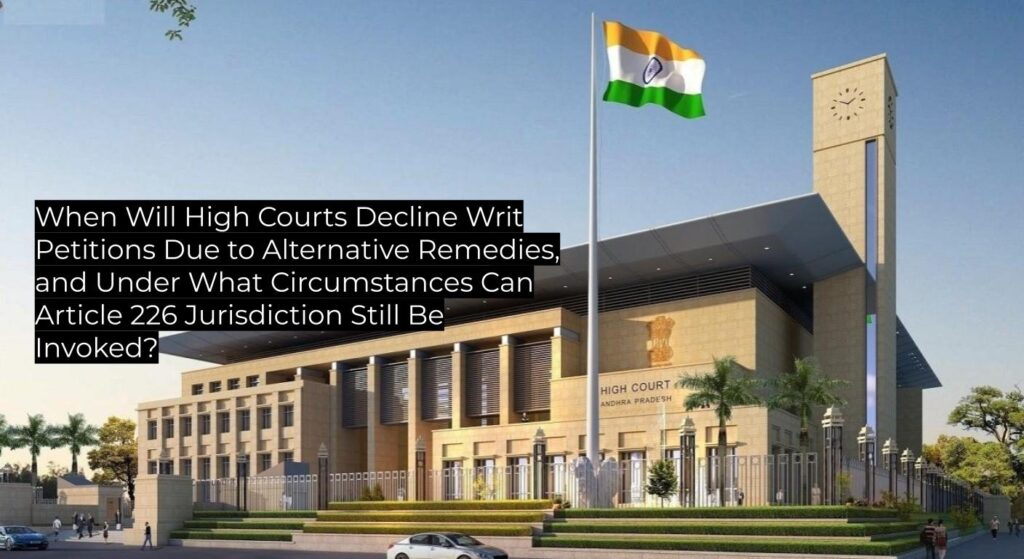
The Andhra Pradesh High Court reaffirmed that when an equally efficacious statutory remedy (such as the Debts Recovery Tribunal) exists, High Courts will ordinarily decline to exercise their writ jurisdiction under Article 226. The ruling, relying on Supreme Court precedents, upholds existing law and provides binding authority within the state for similar cases in the banking and financial sector.
Summary
| Category | Data |
|---|---|
| Case Name | WP/23263/2025 of AKULA VENKATESWARA RAO Vs CENTRAL BANK OF INDIA |
| CNR | APHC010458782025 |
| Date of Registration | 01-09-2025 |
| Decision Date | 02-09-2025 |
| Disposal Nature | DISMISSED NO COSTS |
| Judgment Author | DHIRAJ SINGH THAKUR, CHALLA GUNARANJAN |
| Court | High Court of Andhra Pradesh |
| Bench | THE CHIEF JUSTICE DHIRAJ SINGH THAKUR, SRI JUSTICE CHALLA GUNARANJAN |
| Precedent Value | Binding within Andhra Pradesh; persuasive for other High Courts |
| Overrules / Affirms | Affirms Supreme Court precedents (Radha Krishan Industries, Satyawati Tondon) |
| Type of Law | Procedural / Constitutional (Article 226) |
| Questions of Law |
|
| Ratio Decidendi |
The High Court will ordinarily not exercise extraordinary writ jurisdiction under Article 226 if an equally efficacious alternative remedy is available. Exceptions are not applied in this judgment, as the petitioners have adequate remedy before the Debts Recovery Tribunal per Supreme Court authority. This principle draws on Apex Court holdings in Radha Krishan Industries and Satyawati Tondon. Petitioners are given liberty to approach the alternative forum. |
| Judgments Relied Upon |
|
| Logic / Jurisprudence / Authorities Relied Upon by the Court | The rationale is rooted in judicial discipline and efficiency—Article 226 powers are discretionary and generally not to be used where statutory remedies are adequate and efficacious, except in exceptional situations recognized by the Supreme Court. |
| Facts as Summarised by the Court | The petitioners approached the writ court regarding matters that could be addressed before the Debts Recovery Tribunal, without exhausting that alternative remedy. |
Practical Impact
| Category | Impact |
|---|---|
| Binding On | All subordinate courts and tribunals within Andhra Pradesh |
| Persuasive For | Other High Courts, and can be cited before Supreme Court as affirmation of settled law |
| Follows |
|
What’s New / What Lawyers Should Note
- Reaffirms that High Courts will not entertain writ petitions under Article 226 when an adequate alternative statutory remedy exists, unless exceptional circumstances are shown.
- The existence of a remedy before Debts Recovery Tribunal (DRT) is considered both adequate and efficacious for banking/loan recovery disputes.
- Lawyers should be prepared to demonstrate why the alternative remedy is not “efficacious” if seeking to invoke Article 226 jurisdiction in similar contexts.
- Cites and applies the principles from Supreme Court decisions (Radha Krishan Industries; Satyawati Tondon) without distinguishing or creating new exceptions.
Summary of Legal Reasoning
- The court refers directly to the Supreme Court’s judgments in Radha Krishan Industries and United Bank of India v. Satyawati Tondon, reaffirming their precedential authority on the alternative remedy rule.
- The bench notes that the presence of an “equally efficacious alternative remedy” deprives the writ court of the need to exercise its extraordinary jurisdiction under Article 226, barring exceptional circumstances (not present here).
- The petitioners’ issues pertain to matters cognizable by the Debts Recovery Tribunal, which is identified as the proper statutory forum.
- No exception to the alternative remedy rule (such as violation of natural justice, lack of jurisdiction, or ultra vires action) was found in this case.
- The writ petitions are dismissed accordingly, leaving the door open for petitioners to approach the DRT.
Arguments by the Parties
Petitioner:
- Sought exercise of High Court’s writ jurisdiction under Article 226 in respect of disputes with a bank.
Factual Background
The petitioners filed writ petitions before the High Court challenging actions by the Central Bank of India. The core grievance related to matters for which a statutory remedy was available before the Debts Recovery Tribunal. There is no mention in the order of any exceptional facts or circumstances justifying bypass of the statutory remedy.
Statutory Analysis
- Article 226 of the Constitution of India: The High Court clarified the discretionary nature of writ jurisdiction under Article 226, particularly in the presence of alternative remedies.
- Rulings in Radha Krishan Industries and Satyawati Tondon interpreted to restrict exercise of writ jurisdiction where effective statutory remedy exists.
Dissenting / Concurring Opinion Summary
No dissenting or concurring opinions are recorded; order is unanimous.
Alert Indicators
- ✔ Precedent Followed – Supreme Court precedent applied and reaffirmed.
Citations
- Radha Krishan Industries v. State of Himachal Pradesh, (2021) 6 SCC 771
- United Bank of India v. Satyawati Tondon, (2010) 8 SCC 110