


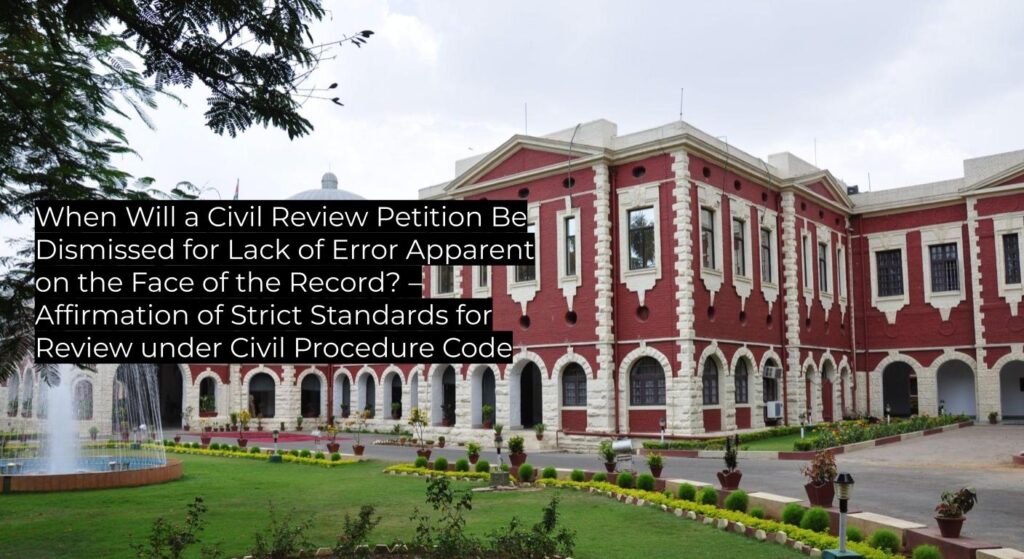
The Jharkhand High Court reaffirms that civil review petitions must demonstrate an “error apparent on the face of the record” for interference; mere disagreement with the earlier judgment is insufficient. The court upholds the stringent threshold required under Order XLVII Rule 1 CPC, maintaining alignment with existing precedent. This remains binding authority for all subordinate courts in the State of Jharkhand and holds persuasive value elsewhere.
Summary
| Category | Data |
|---|---|
| Case Name | C.Rev./139/2019 of NITYA NAND SINHA Vs NATIONAL INSTITUTE OF FOUNDRY AND FORGE TECHNOLOGY THROUGH ITS DIRECTOR NIRANJAN KUMAR SINGH CNR JHHC010423632019 |
| Date of Registration | 23-12-2019 |
| Decision Date | 10-09-2025 |
| Disposal Nature | Dismissed |
| Judgment Author | HON’BLE THE CHIEF JUSTICE, HON’BLE MR. JUSTICE RAJESH SHANKAR |
| Court | High Court of Jharkhand |
| Bench | Division Bench: The Chief Justice, Justice Rajesh Shankar |
| Precedent Value | Binding on Jharkhand subordinate courts; persuasive for other High Courts |
| Type of Law | Civil Procedure |
| Ratio Decidendi | The court held that in a civil review petition, unless there is an “error apparent on the face of the records,” the review cannot be entertained. After perusing the submissions and the record, the court found no such error. Accordingly, the petition was dismissed, reaffirming the established, narrow scope for review jurisdiction. |
| Facts as Summarised by the Court | The petitioner applied for review by civil review petition, which was filed with a delay of 352 days. An interlocutory application was filed seeking condonation of this delay. The delay was condoned; however, the substantive review petition was dismissed as no error apparent on the record was found. |
Practical Impact
| Category | Impact |
|---|---|
| Binding On | All subordinate courts in the State of Jharkhand |
| Persuasive For | Other High Courts, Supreme Court |
What’s New / What Lawyers Should Note
- The court reaffirmed the strict standard required to admit a review petition—an “error apparent on the face of the record” must exist.
- Delay in filing a review petition can be condoned if sufficient cause is shown.
- Mere disagreement with the prior decision, or further argument on already considered points, is no ground for review.
- Lawyers must focus on clear, self-evident errors in the original judgment when drafting or contesting review petitions.
Summary of Legal Reasoning
- The court first addressed and allowed the application for condonation of 352 days’ delay, based on reasons stated and supported by affidavit.
- On merits of the review, the court examined the record and submissions to consider if an “error apparent on the face of the records” existed, as mandated under the Civil Procedure Code.
- The bench found that no such error was made out by the petitioner.
- The review petition was accordingly dismissed, following the settled principle that mere re-argument or dissatisfaction does not warrant review.
Arguments by the Parties
Petitioner
- Filed for review on the asserted basis of error in the previous order.
- Sought condonation of delay, citing sufficient cause in the interlocutory application supported by affidavit.
Respondent
- Opposed the review, contending that no error apparent on the record was demonstrated warranting review.
Factual Background
The petitioner filed a civil review petition challenging an earlier order. There was a delay of 352 days in filing, for which an interlocutory application for condonation, supported by affidavit, was presented. The court condoned the delay. Upon considering the merits of the review, it found no error apparent on the face of the record and dismissed the petition.
Statutory Analysis
The court applied the principles under Order XLVII Rule 1 of the Civil Procedure Code, which restrict review jurisdiction to errors “apparent on the face of the record.” The court emphasized the need for a patent, self-evident error rather than mere possibility of a different view.
Dissenting / Concurring Opinion Summary
No dissenting or concurring opinions are recorded in the judgment.
Procedural Innovations
- The court condoned 352 days’ delay in filing the review, upon the petitioner’s sufficient cause shown in an interlocutory application supported by affidavit.
Alert Indicators
- ✔ Precedent Followed – The judgment applies and affirms settled legal principles regarding the scope and threshold for review under the Code of Civil Procedure.