


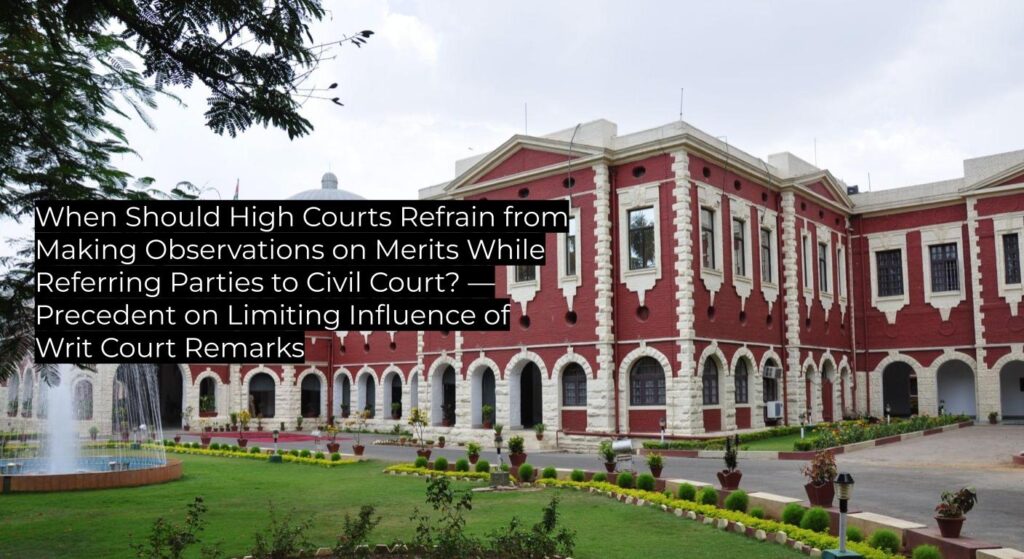
The Jharkhand High Court affirms that when parties are left to pursue remedies before a civil court, the writ court must avoid any observations that may prejudice the merits of the case; all prior remarks are rendered non-binding and inoperative. This judgment upholds the established principle to ensure a fair civil trial, setting a binding precedent for subsequent matters across Jharkhand.
Summary
| Category | Data |
|---|---|
| Case Name | LPA/43/2025 of TAHERA KHATOON Vs THE STATE OF JHARKHAND |
| CNR | JHHC010354452024 |
| Date of Registration | 27-01-2025 |
| Decision Date | 15-10-2025 |
| Disposal Nature | Disposed Off |
| Judgment Author | Hon’ble The Chief Justice; Hon’ble Mr. Justice Rajesh Shankar |
| Court | High Court of Jharkhand |
| Bench | Division Bench: Hon’ble The Chief Justice, Hon’ble Mr. Justice Rajesh Shankar |
| Precedent Value |
|
| Overrules / Affirms | Affirms the principle that writ courts should not make prejudicial observations on merits if parties can seek statutory reliefs |
| Type of Law | Procedural (Civil, Writ Jurisdiction) |
| Questions of Law | Whether writ court observations on merits should bind parties when substantive disputes are remitted to competent civil courts. |
| Ratio Decidendi |
The court held that when parties are relegated to a civil court to pursue their remedy, any observations or findings on the merits by the writ court must not influence the decision of the civil court. The writ court should abstain from making observations that could prejudice either party’s case. Any such observations made in prior writ orders are declared irrelevant and non-binding for the subsequent civil proceedings. The civil court must decide the matter solely on the record and evidence before it, uninfluenced by earlier writ court remarks. This ensures fairness and upholds the autonomy of the civil court in adjudicating disputes remitted to its jurisdiction. |
| Facts as Summarised by the Court |
The appellants challenged an order from a writ petition (W.P.(C) No. 7049 of 2017) which contained certain observations on merits. The High Court, upon hearing the matter, decided that the parties should be left to seek remedies before the civil court and clarified that no observation from the previous writ order should affect the civil court’s decision. A 26-day delay in filing the appeal was condoned. |
Practical Impact
| Category | Impact |
|---|---|
| Binding On | All subordinate courts in Jharkhand, specifically civil courts adjudicating matters remitted from the writ jurisdiction |
| Persuasive For | Other High Courts while considering writ-to-civil court remand situations |
| Follows | Established procedural principles regarding writ courts avoiding prejudicial observations when relegating parties to civil court |
What’s New / What Lawyers Should Note
- Reiterates and clarifies that all observations on merits in a writ order become non-binding when parties are directed to approach civil courts.
- Explicit direction: civil courts must decide afresh, uninfluenced by any writ court remarks, ensuring a fair and impartial hearing.
- Lawyers can rely on this precedent to shield their clients from adverse writ court observations in subsequent civil litigation.
- Useful citation for opposing attempts to introduce writ court findings as binding or persuasive on factual or legal issues in civil courts.
Summary of Legal Reasoning
- The court first addressed the preliminary issue of delay in filing the LPA, found sufficient cause, and condoned the 26-day delay.
- On hearing the matter, the bench observed that since the parties were permitted to pursue remedies before the civil court, the writ court should not have made any observations that could prejudice either party.
- The court explicitly directed that all observations made in the writ court’s previous order (dated 8 August 2024 in W.P.(C) No. 7049 of 2017) shall not influence or bind the civil court’s determination.
- The division bench thereby upheld the principle that subordinate courts must act independently of any prior writ observations when the matter is remanded or referred for their adjudication.
- No additional legal authorities or prior judgments are discussed; the rationale is rooted in maintaining fairness and the procedural autonomy of the civil courts.
Arguments by the Parties
Petitioner
- Sought removal of observations on merits made by the writ court, citing potential prejudice if left unaddressed.
Respondent (State)
- Waived notice; no specific opposing argument recorded in text.
Factual Background
The case concerns an appeal against observations made in a writ petition (W.P.(C) No. 7049 of 2017) involving parties from Ranchi and Lohardaga. The original writ court order contained remarks potentially prejudicial to either party in their future civil court proceeding. On appeal, the High Court condoned a 26-day delay in filing and clarified that all such observations would not bind or influence the civil court, relegating the parties to seek remedies there.
Statutory Analysis
- The judgment addresses procedural aspects of writ jurisdiction versus civil remedies.
- The High Court discusses its power to relegate parties to civil courts and underscores the necessity of avoiding any remarks that could prejudice subsequent proceedings.
- No specific statute interpreted in detail; principle draws on established boundaries between writ and ordinary civil jurisdiction.
Dissenting / Concurring Opinion Summary
No dissenting or concurring opinions are recorded in the judgment. Both judges concurred in the operative reasoning and outcome.
Procedural Innovations
- The judgment demonstrates proactive condonation of delay (26 days) in filing the appeal, based on reasons in the supporting affidavit.
Alert Indicators
- ✔ Precedent Followed – Existing law affirmed regarding writ courts avoiding prejudicial remarks when remanding disputes to civil courts.