


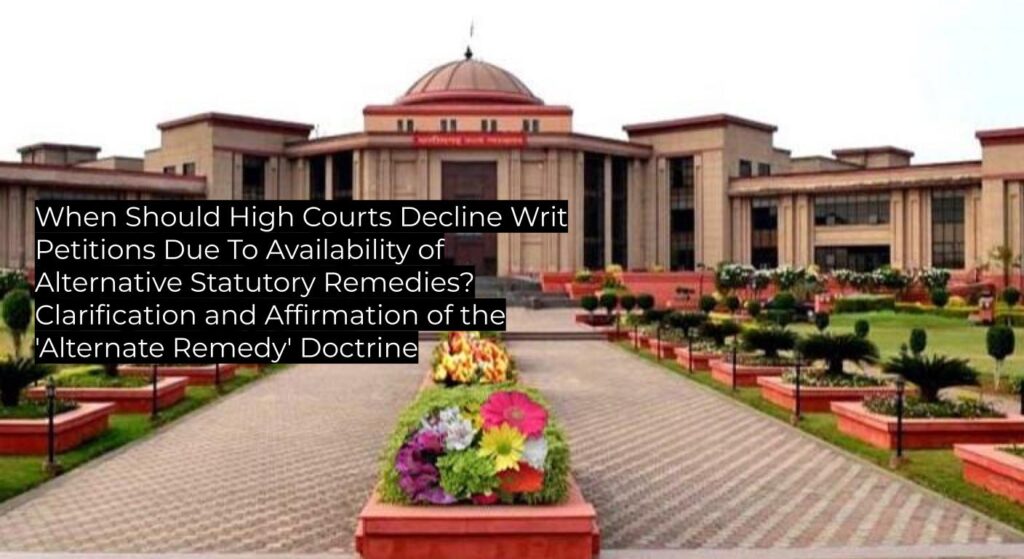
The court reaffirmed that writ jurisdiction under Article 226 should not ordinarily be exercised when an adequate and efficacious alternative statutory remedy exists, in line with binding Supreme Court precedents. This judgment upholds existing law and serves as binding authority for similar writ petitions, particularly regarding service and employment issues in cooperative societies under statutory governance.
Summary
| Category | Data |
|---|---|
| Case Name | WPC/5692/2025 of MANOJ PATEL Vs STATE OF CHHATTISGARH |
| CNR | CGHC010461912025 |
| Date of Registration | 29-10-2025 |
| Decision Date | 30-10-2025 |
| Disposal Nature | DISMISSED |
| Judgment Author | Hon’ble The Chief Justice, Hon’ble Shri Justice Bibhu Datta Guru |
| Court | High Court of Chhattisgarh |
| Bench | Hon’ble Shri Ramesh Sinha, Chief Justice; Hon’ble Shri Bibhu Datta Guru, Judge |
| Precedent Value | Binding |
| Overrules / Affirms | Affirms |
| Type of Law | Service Law / Administrative Law / Writ jurisdiction |
| Questions of Law | Whether the High Court should entertain a writ petition under Article 226 when an alternative remedy under Section 55(2) of the Chhattisgarh Cooperative Societies Act, 1960 is available. |
| Ratio Decidendi |
The court reaffirmed the well-settled position that writ jurisdiction under Article 226 of the Constitution of India should not ordinarily be exercised when an adequate and efficacious alternative statutory remedy exists. Relying on binding Supreme Court precedents, the court held that the existence of a remedy before the Registrar under Section 55(2) of the Chhattisgarh Cooperative Societies Act constitutes such an alternative remedy. Therefore, the writ petition was dismissed on this ground with liberty to the petitioner to avail of the statutory forum. |
| Judgments Relied Upon |
|
| Logic / Jurisprudence / Authorities Relied Upon by the Court |
|
| Facts as Summarised by the Court |
The petitioner, a daily wage Data Entry Operator since 2008 at a cooperative society, challenged recruitment notices for outsourcing similar posts, seeking regularization. The respondents contended that as an employee of the cooperative society, the petitioner should avail the remedy before the Registrar under Section 55(2) of the Chhattisgarh Cooperative Societies Act, 1960. The court found that this alternative remedy was available and dismissed the writ petition. |
Practical Impact
| Category | Impact |
|---|---|
| Binding On | All subordinate courts in Chhattisgarh |
| Persuasive For | Other High Courts; may be cited before the Supreme Court on similar questions of alternate remedy and writ jurisdiction |
| Follows |
|
What’s New / What Lawyers Should Note
- Reaffirms that High Courts will not entertain writ petitions under Article 226 if an effective alternative statutory remedy exists, unless exceptional circumstances are shown.
- Section 55(2) of the Chhattisgarh Cooperative Societies Act, 1960 is a recognized statutory forum for cooperative society service disputes.
- Lawyers should approach statutory forums first in similar disputes and avoid direct invocation of writ jurisdiction unless grounds for bypassing the alternate remedy are specifically pleaded and established.
- Writ petitions seeking regularization or challenging employment actions in cooperative societies will be dismissed at the threshold if alternate remedies have not been exhausted.
Summary of Legal Reasoning
- The court noted the long-settled principle that when a statutory remedy exists, High Courts should ordinarily not exercise writ jurisdiction under Article 226.
- Reference was made to the Supreme Court judgments in State of H.P. and Others v. Gujarat Ambuja Cement Limited (2005) 6 SCC 499 and Assistant Commissioner (CT) LTU, Kakinada v. Glaxo Smith Kline Consumer Health Care Ltd., (2020) 19 SCC 172, re-affirming the alternate remedy doctrine.
- The court applied this principle to the case, holding that the petitioner, as an employee of a cooperative society, has a statutory remedy before the Registrar under Section 55(2) of the Chhattisgarh Cooperative Societies Act, 1960.
- Concluding that no exceptional circumstances were shown to justify bypassing the statutory remedy, the writ petition was dismissed with liberty to approach the appropriate forum.
Arguments by the Parties
Petitioner:
- The petitioner has been working since 2008 as a Data Entry Operator on daily wages.
- Requested direction for regularization, arguing that repeated representations have gone unanswered.
- Challenged the move to fill the posts through outsourcing as arbitrary and unjustified.
Respondent (MARKFED / State):
- Contended that the petitioner is an employee of the cooperative society.
- Stated that any dispute must be raised before the Registrar under Section 55(2) of the Chhattisgarh Cooperative Societies Act, 1960, which provides an alternative remedy.
Factual Background
The petitioner is a daily wage Data Entry Operator who has served the Prathamik Krishi Saakh Sahakari Samiti Maryadit since 2008. The society issued tenders/notices to outsource the post of Data Entry Operator, which the petitioner challenged, also seeking regularization of his service. Despite making several representations for regularization, no action was taken by respondents. The respondents argued that the petitioner should use the statutory remedy available under Section 55(2) of the Chhattisgarh Cooperative Societies Act, 1960. The court refused to entertain the writ petition, citing availability of alternate remedy.
Statutory Analysis
- Section 55(2) of the Chhattisgarh Cooperative Societies Act, 1960: Recognized by the court as providing an effective statutory alternative remedy for cooperative society employees to raise service-related disputes before the Registrar.
- Article 226 of the Constitution of India: The court emphasized the self-imposed restrictions on the exercise of writ jurisdiction when alternative remedies are available unless exceptional circumstances are demonstrated.
Alert Indicators
- ✔ Precedent Followed – When existing law is affirmed.