


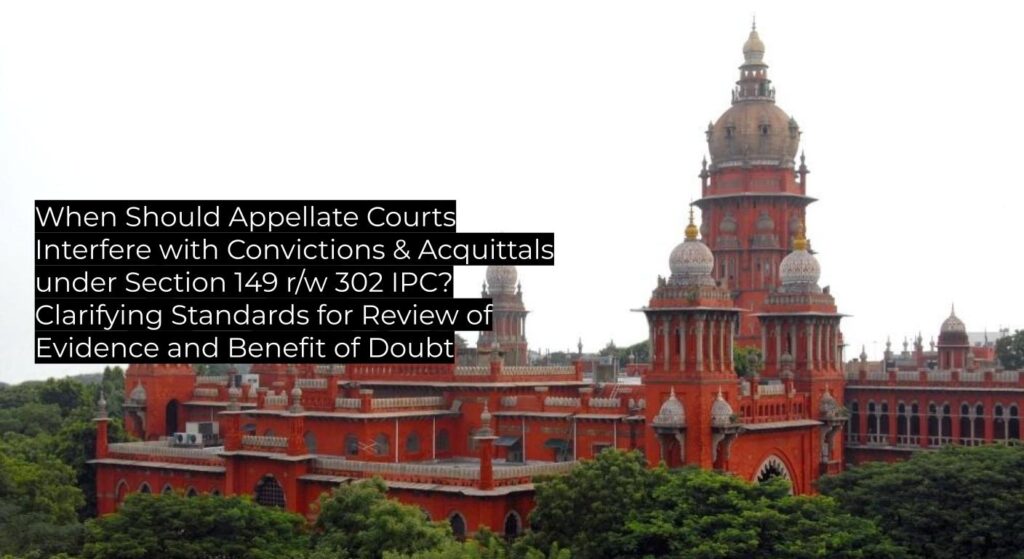
The Madras High Court comprehensively reaffirms established Supreme Court precedent: appellate interference in criminal convictions and acquittals, especially for large-scale mob violence, requires careful weighing—not mere counting—of evidence, close attention to contradictions and omissions, and reinforces the primacy of the benefit of doubt. This judgment is binding within Tamil Nadu and serves as persuasive authority elsewhere, reiterating the double presumption of innocence on appeal.
Summary
| Category | Data |
|---|---|
| Case Name | CRL A/298/2018 of DHARMALINGAM, M/A 32 YEARS, Vs THE STATE REP BY ITS, CNR HCMA010269762018 |
| Date of Registration | 07-05-2018 |
| Decision Date | 02-09-2025 |
| Disposal Nature | ALLOWED |
| Judgment Author | HONOURABLE MR JUSTICE M.S. RAMESH, HONOURABLE MR. JUSTICE V. LAKSHMINARAYANAN |
| Court | Madras High Court |
| Bench | Division Bench: HONOURABLE MR JUSTICE M.S. RAMESH and HONOURABLE MR. JUSTICE V. LAKSHMINARAYANAN |
| Precedent Value | Binding within jurisdiction; persuasive elsewhere |
| Overrules / Affirms | Reaffirms Supreme Court standards for appellate review; sets aside trial court convictions under Section 149 r/w 302 IPC |
| Type of Law | Criminal Law—Appeals—Section 149, 302 IPC, Standards for Appellate Interference |
| Questions of Law |
|
| Ratio Decidendi |
The appellate court must weigh—not merely count—the evidence against the accused in cases of large-scale violence, paying close attention to contradictions, lack of independent witnesses, and failure to properly investigate or consider defense evidence. The presence of close relatives as key witnesses, significant contradictions among them, failure to recover weapons, delay in statement recordings, and disregard of defense documents cast substantive doubt, entitling the accused to acquittal. For appeals against acquittal, the double presumption of innocence applies; only where the trial court’s acquittal is perverse, based on misreading evidence, or where no reasonable alternate view is possible, can the appellate court interfere. This standard, established by the Supreme Court, is reaffirmed. |
| Judgments Relied Upon |
|
| Logic / Jurisprudence / Authorities Relied Upon by the Court |
|
| Facts as Summarised by the Court | Two persons (Sundarajan and Kuppusamy) were killed in mob assaults stemming from local enmities and political rivalries. After investigations involving multiple accused, charges under Section 149/302 IPC were framed; the trial court convicted several accused, while acquitting others. Defense highlighted contradictions among family-witness testimony, lack of independent eye witnesses, absence of weapon recovery, investigatory lapses, failure to consider defense documents, and delayed statements reaching court. |
| Citations | Neutral Citation: Not specified; See references to cited Supreme Court decisions in the judgment text. |
Practical Impact
| Category | Impact |
|---|---|
| Binding On | All subordinate courts within Madras High Court’s jurisdiction (Tamil Nadu) |
| Persuasive For | Other High Courts, Supreme Court—especially for appeals involving Section 149 IPC, mob violence, or standard of review in criminal appeals |
| Overrules | Sets aside convictions under Section 149 r/w 302 IPC by the trial court |
| Follows |
|
What’s New / What Lawyers Should Note
- The judgment meticulously reiterates that appellate courts must weigh evidence, not count it, particularly in cases alleging large-scale unlawful assembly under Section 149 IPC.
- Contradictions and inconsistencies among prosecution witnesses, especially close relatives, seriously undermine the prosecution’s case—benefit of doubt must go to the accused.
- Trial judges must address and reason on defense documents and witnesses; failure to do so affects the legality of the conviction.
- Absence of prompt, independent witness testimony, failure to seize or match real evidence, and delays in bringing statements to court all cumulatively entitle the accused to acquittal.
- In State appeals against acquittal, the double presumption of innocence is reaffirmed: interference is justified only for patent perversity or fundamental misreading of evidence—mere possibility of another view is insufficient.
- Sets clear standards for appellate review, ensuring that trial errors or investigatory lapses cannot be glossed over in serious criminal appeals.
Summary of Legal Reasoning
- The court first analyzes the standard for considering defense documents (such as Section 174 CrPC reports and other defense exhibits), holding that trial courts are bound to address all evidence and may not ignore defense materials.
- Citing Petha Narayana, Sambhu Das, Masalti, and Binay Kumar Singh, the court affirms that in mob violence cases, the quality rather than the quantity of witnesses is critical; consistency and credibility among at least two independent witnesses is essential to sustain conviction under Section 149.
- The division bench scrutinizes the considerable contradictions in prosecution witness testimony (both as to presence, sequence, specific acts, and related recoveries), noting that witnesses were close relatives and their statements were inconsistent across crucial aspects.
- The lack of independent corroboration, unexplained investigatory lapses, failure to recover weapons, discrepancies regarding real evidence, and delayed statement delivery all together cast insurmountable doubt on the prosecution’s case.
- The benefit of doubt is extended to the accused, citing Supreme Court jurisprudence mandating acquittal where multiple reasonable inferences exist.
- On State appeals challenging acquittals, the bench quotes at length from recent Supreme Court precedent (Babu Sahebagouda Rudragoudar) to restate that double presumption of innocence restricts appellate interference—acquittals may only be reversed for patent perversity, misreading, or where no reasonable view supports the acquittal.
- The court concludes trial errors, contradictions, and lack of credible evidence are so fundamental as to reverse the convictions and uphold acquittals.
Arguments by the Parties
Petitioners (Accused):
- Criticised the trial judge’s failure to consider defense witnesses and documents (including the RDO report and Ex.D2).
- Highlighted contradictions and inconsistencies among prosecution witnesses, most of whom were relatives.
- Pointed to the absence of independent eye witnesses and lack of recovery of alleged weapons.
- Noted delays in statement submissions and lack of proper investigation into a prior complaint filed by one accused.
- Argued that the conviction was unsustainable due to these flaws and benefit of doubt should favour the accused.
Respondent (State):
- Emphasised that there were multiple motives for the crime and the accused’s presence was admitted even by their own prior complaints.
- Asserted that key eye witnesses’ testimony (albeit relatives) and corroboration across witnesses adequately established the case.
- Explained that absence of independent witnesses was due to a village resolution deterring testimony against the accused.
- Downplayed contradictions in witness testimony, characterising them as minor and not fatal.
Factual Background
The case arises from the fatal attacks on two individuals, Sundarajan and Kuppusamy, in July 2003 in a Salem district village, following political and personal enmity. The prosecution alleged multiple accused formed an unlawful assembly, armed with stones and sticks, and assaulted the deceased at multiple locations. FIRs were lodged (Crime No.538/2003), and subsequently a large number of accused were prosecuted under Section 149/302 IPC. The trial court convicted several accused, but acquitted others. The defense highlighted numerous contradictions in the state’s case, lack of independent evidence, and procedural lapses, challenging both conviction and acquittal in appeals.
Statutory Analysis
- Section 174 CrPC: The court clarifies the limited scope of Section 174 proceedings (inquest)—their purpose is to ascertain the cause of death, not to assign blame or identify accused. Inquest reports cannot by themselves defeat the prosecution’s case but must be considered where material.
- Section 149 IPC: Recognising the challenge in mass violence cases, the court relies upon Supreme Court guidance in requiring consistent identification and trustworthy evidence from at least two witnesses per accused; mere presence in a crowd does not suffice.
- CrPC Section 374 (Appeals): Confirms appellate courts’ powers to fully reappreciate evidence.
- Section 378 CrPC (State Appeal against Acquittal): Cites Supreme Court standards—double presumption of innocence; interference permitted only for perverse, unreasonable, or evidence-ignoring acquittals.
Procedural Innovations
- Explicitly affirms the trial judge’s obligation to consider all defense exhibits, witness testimony, and relevant documents; total omission to do so affects conviction validity.
- Detailed appraisal of the impact of delayed statement submissions and the prejudice to fair trial rights.
Alert Indicators
- ✔ Precedent Followed – Reinforces and clarifies existing standards on appellate review (conviction and acquittal), evidentiary contradictions, and benefit of doubt in criminal trials, as laid down by the Supreme Court.
Citations
- Petha Narayana and Others v. State of Andhra Pradesh, (1975) 4 SCC 153
- Sambhu Das and Others v. State of Assam, (2010) 10 SCC 374
- Masalti v. State of Uttar Pradesh, AIR 1965 SC 202
- Binay Kumar Singh v. State of Bihar, (1997) 1 SCC 283
- Chandra Shekhar Bind v. State of Bihar, (2001) 8 SCC 690
- Sanjana v. State, Madras High Court, Crl.A.No.1128 of 2022 dated 28.04.2025
- Amar Singh v. Balwinder Singh, (2003) 2 SCC 518
- Babu Sahebagouda Rudragoudar v. State of Karnataka, (2024) 8 SCC 149
- H.D. Sundara v. State of Karnataka, (2023) 9 SCC 581
- Constable 907 Surendra Singh v. State of Uttarakhand, 2025 INSC 114
- Muthu Naicker v. State of Tamil Nadu, (1978) 4 SCC 385
- Vinubhai Ranchhodbhai Patel v. Rajivbhai Dudabhai Patel, (2018) 7 SCC 743