


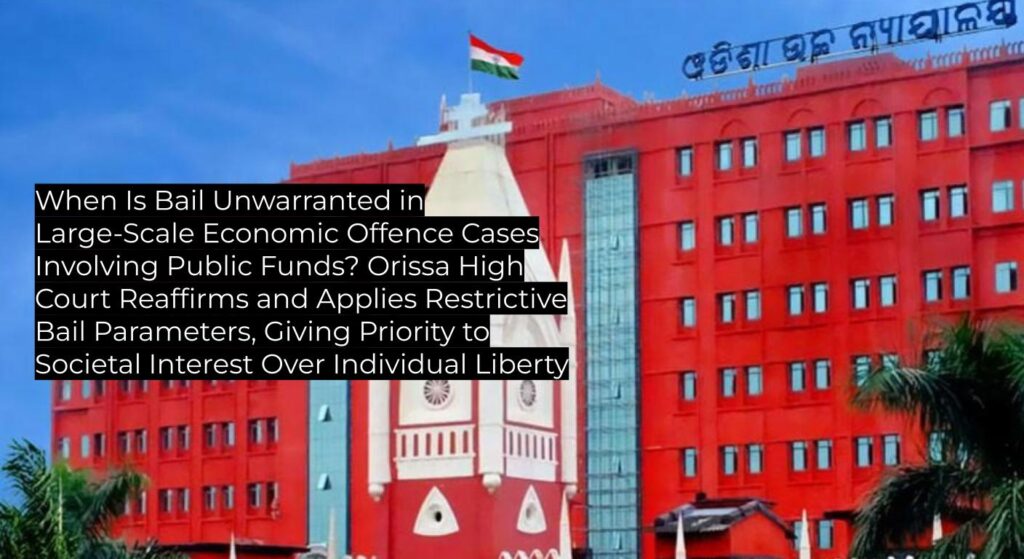
The court held that in cases of extensive financial fraud affecting public interest and involving misappropriation of funds intended for public benefit, bail should be refused where prima facie material establishes the accused’s involvement, especially when there is risk of witness influence and criminal antecedents. This decision follows and applies Supreme Court precedents, significantly reinforcing the restrictive approach to bail in economic offences under Section 483 of BNSS, 2023. It is binding on all subordinate courts in Odisha and serves as persuasive authority elsewhere.
Summary
| Category | Data |
|---|---|
| Case Name |
|
| Date of Registration | 21-07-2025 |
| Decision Date | 31-10-2025 |
| Disposal Nature | Disposed Off |
| Judgment Author | MR. JUSTICE GOURISHANKAR SATAPATHY |
| Court | Orissa High Court |
| Bench | Single Bench — Justice Gourishankar Satapathy |
| Precedent Value | Binding in Odisha, Persuasive elsewhere |
| Overrules / Affirms | Affirms and applies established Supreme Court precedent |
| Type of Law | Criminal Law — Bail in economic offences under Section 483 of BNSS, 2023 |
| Questions of Law |
|
| Ratio Decidendi |
|
| Judgments Relied Upon |
|
| Logic / Jurisprudence / Authorities Relied Upon by the Court | The court applied the Supreme Court’s parameters for bail, requiring courts to consider prima facie case, gravity, antecedents, risk of absconding/reoffending, and public interest; relied on specific passages guiding courts to prioritize societal concerns in serious financial fraud cases over individual liberty where risks are manifest. |
| Facts as Summarised by the Court |
|
Practical Impact
| Category | Impact |
|---|---|
| Binding On | All subordinate courts in Odisha |
| Persuasive For | Other High Courts, Supreme Court |
| Follows |
|
What’s New / What Lawyers Should Note
- The judgment rigorously applies and reinforces the strict approach to bail in economic offences involving large-scale public or quasi-public funds, especially where the accused have criminal antecedents and potential to influence witnesses.
- Courts are reminded to prioritize societal interest over individual liberty where evidence suggests serious misappropriation affecting the public at large and the trial is yet to commence.
- Explicit reliance on both documentary and oral (witness) evidence in bail considerations — a case being “mainly documentary” does not make bail more likely if oral evidence and influence risks exist.
- Lawyers should prepare to address issues of criminal antecedents and risk of tampering or witness influence in economic offence bail matters.
- Even where the cooperative society is “private” and self-financed, if funds are intended for public benefit, restrictive bail principles will apply.
- The precedent is binding in Odisha and provides strong persuasive authority elsewhere, especially in economic offence bail matters invoking Section 483 of BNSS, 2023.
Summary of Legal Reasoning
- The Court began by setting out the statutory discretion for bail under Section 483 of BNSS, referencing the guiding principles from Supreme Court precedent (Prasanta Kumar Sarkar v. Ashis Chatterjee).
- It reviewed the petitioners’ contentions regarding the private nature of the cooperative, absence of public funds, and asserted that the dispute was commercial and documentation had been seized.
- The Prosecution argued, and the Court found merit, that the society was created to benefit the population of mining-affected villages, and the records prima facie showed systematic manipulation, forgery, and misappropriation of funds.
- The Court emphasized the presence of criminal antecedents of the petitioners (one with one antecedent, the other with fourteen), holding this strongly against them as per Supreme Court dicta in Ash Mohammad v. Shiv Raj Singh and Azwar v. Waseen.
- Citing CBI v. Ramendu Chattopadhyay and Y.S. Jagan Mohan Reddy v. CBI, the Court stated that economic offences involving public funds demand special circumspection.
- On the fact that both documentary and oral evidence are involved and that the accused are influential, the risk of witness influence was found significant.
- Balancing individual liberty against societal interest, the Court concluded that public interest and seriousness of the fraud outweighed the bail plea, the trial was yet to commence, and key witnesses were yet to be examined.
- The applications for bail were thus rejected.
Arguments by the Parties
Petitioner
- The FIR informant was not a society member or resident; thus, locus was lacking.
- The cooperative was private, self-financed, with no government aid — no loss of public money.
- All transactions were genuine commercial transactions, with proper bills and TDS deducted.
- No criminal liability as there was no inducement, entrustment, or substantiated evidence.
- The petitioners did not have office-bearing positions (in the case of one), and no documents of forgery were found against them.
- The case was primarily based on documentary evidence already seized; thus, no risk of tampering.
- The prolonged trial and satisfaction of the triple test for bail justified their release.
Respondent (State)
- The president and secretary, with co-accused, misappropriated over ₹175 crores.
- Funds were siphoned off through fraudulent bills, forged cheques, and without supporting vouchers via a conspiracy.
- Specific money trails traced to the petitioners and their associates.
- Statements from relevant officials (BDOs, Regional Manager OMC) confirmed no actual periphery development.
- The petitioners had significant criminal antecedents — one with fourteen, another with one case.
- There was strong risk of repetition and possible influence over witnesses if released on bail.
Factual Background
The case arises from allegations of large-scale financial misappropriation by the president, secretary, and associates of Gandhamardan Loading Agency and Transporting Cooperative Society Ltd., which was formed for the development of mining-affected villages in Odisha. The alleged fraud, spanning from 2017-18 to 2023-24, involves siphoning public-benefit funds through forged documents, fictitious expenses, and unauthorized withdrawals totaling crores of rupees. The case was registered as EOW PS Case No.03 of 2025 based on an FIR, with offences charged under Sections 406, 409, 420, 467, 468, 471, and 120-B IPC. The petitioners were denied bail at the designated court, prompting applications to the High Court.
Statutory Analysis
- The court analyzed Section 483 of BNSS, 2023, governing the grant of bail.
- It discussed the parameters for exercise of bail discretion as laid down by the Supreme Court, focusing on matters such as prima facie case, gravity, antecedents, likelihood of influencing witnesses, and societal interest.
- Relevant IPC sections considered include 406/409/420/467/468/471/120-B, pertaining to criminal breach of trust, cheating, forgery, and conspiracy.
Alert Indicators
- ✔ Precedent Followed – The decision closely follows and reinforces existing Supreme Court precedent on restrictive bail in large-scale economic offences, particularly where public interest is involved and influential accused present a risk of witness influence or further offence.