


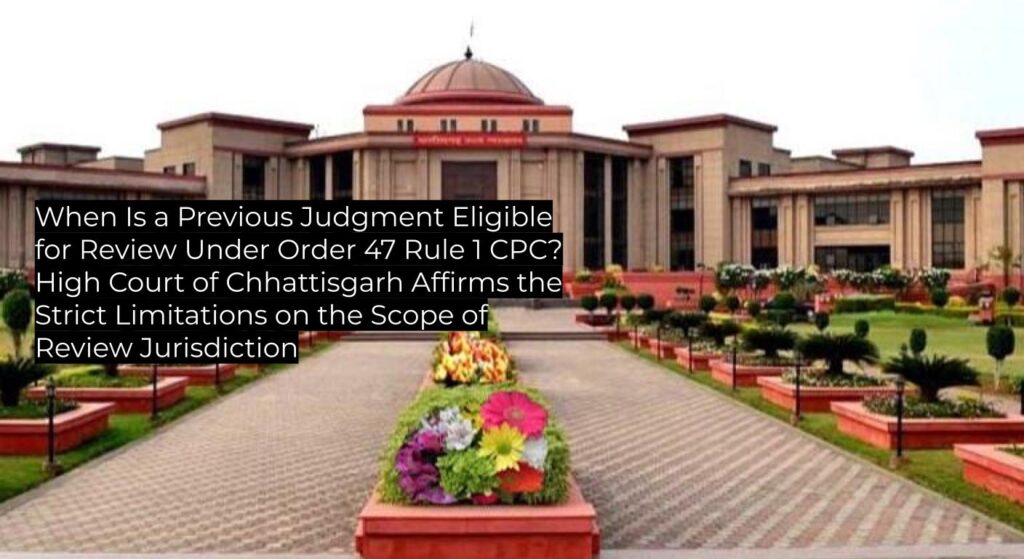
The court reaffirmed that review powers cannot be exercised as an appeal in disguise and are limited strictly to error apparent on the face of the record or other statutorily prescribed grounds. Change in law or subsequent favorable judgments do not justify review. This judgment upholds existing Supreme Court precedent and serves as binding authority on the limited scope of review jurisdiction under CPC for subordinate courts and persuasive guidance elsewhere.
Summary
| Category | Data |
|---|---|
| Case Name | REVP/340/2025 of PRAMOD KUMAR KANWAR (PAIKARA) Vs SOUTH EASTERN COALFIELDS LIMITED |
| CNR | CGHC010412462025 |
| Date of Registration | 13-10-2025 |
| Decision Date | 16-10-2025 |
| Disposal Nature | DISMISSED |
| Judgment Author | HON’BLE SHRI JUSTICE RAKESH MOHAN PANDEY |
| Court | High Court Of Chhattisgarh |
| Precedent Value | Binding on subordinate courts; persuasive for other High Courts |
| Overrules / Affirms | Affirms Supreme Court precedents on scope of review under CPC |
| Type of Law | Civil Procedure Code, Order 47 Rule 1; Review Jurisdiction |
| Questions of Law |
|
| Ratio Decidendi |
The power of review under Order 47 Rule 1 CPC must be confined strictly to the grounds set out therein: error apparent on the face of the record, discovery of new evidence not previously accessible despite due diligence, or other sufficient reasons strictly within the statutory framework. Mere erroneous decisions, changes in law, or subsequent favorable judgments do not justify exercise of review powers. The review jurisdiction is a narrow exception and cannot be employed as an appeal in disguise or to rehear and re-argue matters already determined. |
| Judgments Relied Upon |
|
| Logic / Jurisprudence / Authorities Relied Upon by the Court |
The Court reiterates that review jurisdiction is not an appeal in disguise; an error must be self-evident, not requiring complex reasoning. Review is for correction of mistakes apparent on record, not for re-hearing or substituting views. Change in law or subsequent judgments are not grounds for review. |
| Facts as Summarised by the Court |
The petitioner sought review of a prior order dismissing his writ petition on the ground of delay, citing inability to present his case earlier and relying on a subsequent division bench decision (Coal India v. Rahul Jaiswal) where delay was condoned. The Court found no error apparent on the record of the original order. |
Practical Impact
| Category | Impact |
|---|---|
| Binding On | All subordinate courts within Chhattisgarh. |
| Persuasive For | Other High Courts, and the Supreme Court. |
| Follows |
|
What’s New / What Lawyers Should Note
- Reaffirms that review proceedings under Order 47 Rule 1 CPC cannot serve as an appeal or rehearing of the case.
- Clarifies that errors must be apparent on the face of the record for review; reappraising evidence or reasoning does not suffice.
- Points out that change of law or favorable subsequent decisions are expressly excluded as grounds for review, as per the Explanation to Order 47 Rule 1 CPC.
- Lawyers should advise clients that missing earlier opportunities to present arguments is not, by itself, sufficient ground for review.
Summary of Legal Reasoning
- The Court began by setting out the statutory framework under Order 47 Rule 1 CPC, including its Explanation, which bars the use of subsequent judgments as a ground for review.
- The precedent from Parsi on Devi was cited to explain that error must be apparent on the record, not requiring complex reasoning or debate.
- The Court referred to Perry Kansagra, emphasizing that review is not an appeal in disguise, and its scope is exceptional and limited.
- Previous Supreme Court judgments were quoted to reiterate that review cannot be used to reargue or revisit the merits of a case; it is only for correction of manifest errors or where new evidence, despite due diligence, was unavailable.
- The Court found that the petitioner’s only new ground was the subsequent division bench judgment favoring condonation of delay, which cannot justify review of the original order. No error apparent on the face of the record was found in the prior decision.
- Accordingly, the review petition was held misconceived and dismissed.
Arguments by the Parties
Petitioner
- Claimed inability to appear at the hearing of the original writ petition and thus failure to present the correct facts and law.
- Contended that delay was condoned in a subsequent Division Bench judgment (Coal India v. Rahul Jaiswal), and the benefit of that precedent should apply.
- Asserted entitlement to employment under the relevant rehabilitation policy due to acquired land.
- Asked for review/recall of the original order that dismissed the writ petition on the ground of delay.
Respondents
- Opposed all submissions made by the petitioner.
Factual Background
The petitioner’s writ petition (WPS No. 8296 of 2018) seeking employment under a rehabilitation policy for acquisition of land was dismissed by the High Court on the ground of delay. In the present review petition, the petitioner argued that he failed to present his case at the time of the original hearing and relied on a later Division Bench judgment in a similar case where delay was overlooked. The Court examined whether this justified a review or recall of its earlier decision.
Statutory Analysis
- The Court reproduced and applied Order 47 Rule 1 CPC, including its Explanation, emphasizing that a subsequent change in law or another court’s decision is not ground for review of a final judgment.
- It reiterated the limited statutory grounds for review: error apparent on the face of record, discovery of previously unavailable material evidence, or any other sufficient reason fitting within the narrow statutory intent.
Dissenting / Concurring Opinion Summary
No dissenting or concurring opinions are recorded in the judgment.
Procedural Innovations
No new procedural innovations or guidelines were established in this judgment.
Alert Indicators
- ✔ Precedent Followed – The judgment follows and applies existing Supreme Court precedent on the scope and limits of review jurisdiction.