


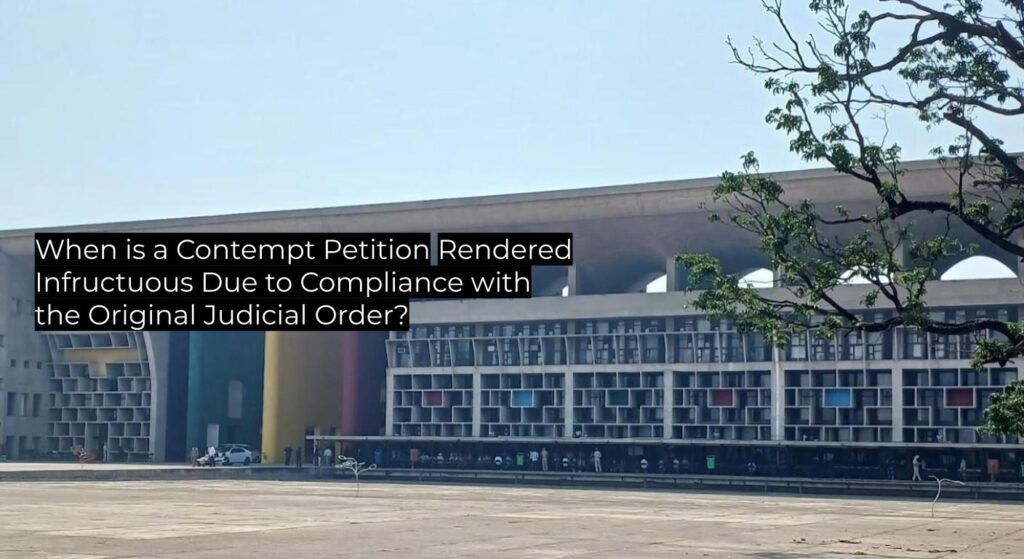
A single-judge decision of the Punjab & Haryana High Court reaffirms that contempt petitions become infructuous when the respondent authority demonstrates complete compliance with the earlier court order and passes a well-reasoned speaking order as directed. The judgment affirms existing precedent, offering binding authority within the jurisdiction for contempt proceedings in administrative/retiral benefit disputes.
Summary
| Category | Data |
|---|---|
| Case Name | COCP/1717/2023 of PRITAM KAUR Vs AVNISH KUMAR, DIRECTOR, DEPT OF RESEARCH AND MEDICAL EDUCATION, PUNJAB, CNR PHHC010736692023 |
| Date of Registration | 30-05-2023 |
| Decision Date | 10-09-2025 |
| Disposal Nature | DISPOSED OF |
| Judgment Author | Ms. Justice Nidhi Gupta |
| Court | High Court of Punjab and Haryana |
| Bench | Single bench (Ms. Justice Nidhi Gupta) |
| Precedent Value | Binding within the High Court of Punjab and Haryana; persuasive for other fora |
| Overrules / Affirms | Affirms existing approach to contempt proceedings post-compliance |
| Type of Law | Procedural/Administrative (Contempt of Courts Act; Administrative/Retiral Matters) |
| Questions of Law |
|
| Ratio Decidendi |
The High Court held that when the respondent authority has complied with the direction of the court—including passing a well-reasoned, speaking order within the prescribed time—the contempt petition is rendered infructuous. The petitioner, if dissatisfied with the substance of the speaking order, is at liberty to challenge it through appropriate legal proceedings. No further orders in contempt are required once full compliance is demonstrated. The proceedings are thus disposed of, reaffirming existing legal protocol in such cases. |
| Facts as Summarised by the Court |
The petitioner alleged non-compliance with a court order directing the respondent to consider and decide her legal notice for retiral benefits within a stipulated time and to issue a reasoned order. The respondent filed a reply with a copy of the speaking order passed as directed. Both counsels acknowledged compliance, and the petition was disposed of with liberty to challenge the speaking order as per law. |
Practical Impact
| Category | Impact |
|---|---|
| Binding On | All subordinate courts and authorities within the jurisdiction of Punjab & Haryana High Court |
| Persuasive For | Other High Courts, and relevant administrative authorities managing compliance/ad hoc contempt |
| Follows | The general principle that contempt proceedings are not maintainable once compliance is achieved |
What’s New / What Lawyers Should Note
- The Court confirms that once compliance with its earlier order is established—particularly via a reasoned and speaking order—no further contempt action is necessary.
- Petitioners retain the right to challenge the merits of any resultant order through appropriate legal channels, even after contempt proceedings are disposed of.
- Lawyers can rely on this authority when respondents produce proof of compliance during contempt hearings.
Summary of Legal Reasoning
- The Court observed that the respondent authority had complied fully with the previous order by passing the required speaking order within the timeline fixed by the Court, and had provided proof thereof on record.
- Both parties acknowledged said compliance in court, with the petitioner’s counsel seeking liberty to challenge the content of the administrative order if aggrieved.
- Based on these facts, the Court concluded that no further orders were necessary in the contempt petition.
- The petition was accordingly disposed of, explicitly preserving the petitioner’s right to pursue separate legal remedies against the speaking order if desired.
Arguments by the Parties
Petitioner
- Sought initiation of contempt proceedings for alleged non-compliance with court order dated 23.01.2023, which required consideration of legal notice and passing of a reasoned order.
- Upon submission of the compliance documents, requested liberty to challenge the resultant speaking order as per law.
Respondent (State/Authority)
- Informed the Court that necessary compliance had been made, with a speaking order passed on 15.06.2023 (Annexure R-1).
- Submitted proof of compliance on record and provided copies to the petitioner.
Factual Background
The petitioner initiated contempt proceedings alleging non-compliance with a High Court order dated 23.01.2023, which required the respondent to dispose of her legal notice for retiral benefits by passing a reasoned speaking order within four weeks. The order took note of the petitioner’s age (90 years) and parity with similarly situated retirees. Subsequently, the respondent passed the required speaking order and presented evidence of compliance in court. Both sides acknowledged this compliance, leading to disposal of the contempt petition, with liberty reserved for the petitioner to challenge the administrative order as per law.
Statutory Analysis
- The Court’s analysis focused on the procedural requirements under the Contempt of Courts Act and its power to ensure compliance with its directions.
- Emphasized that once an authority has demonstrably complied with the court’s direction (by passing a speaking and reasoned order), no further contempt jurisdiction remains to be exercised.
- The right of the petitioner to challenge the substance of the resultant administrative order remains unimpaired.
Dissenting / Concurring Opinion Summary
No dissenting or concurring opinions were recorded in this single-judge decision.
Procedural Innovations
No new procedural innovations or directions were issued in this judgment.
Alert Indicators
- ✔ Precedent Followed – The judgment affirms the established legal position that contempt proceedings abate on demonstrable compliance, with no further contempt orders required.