


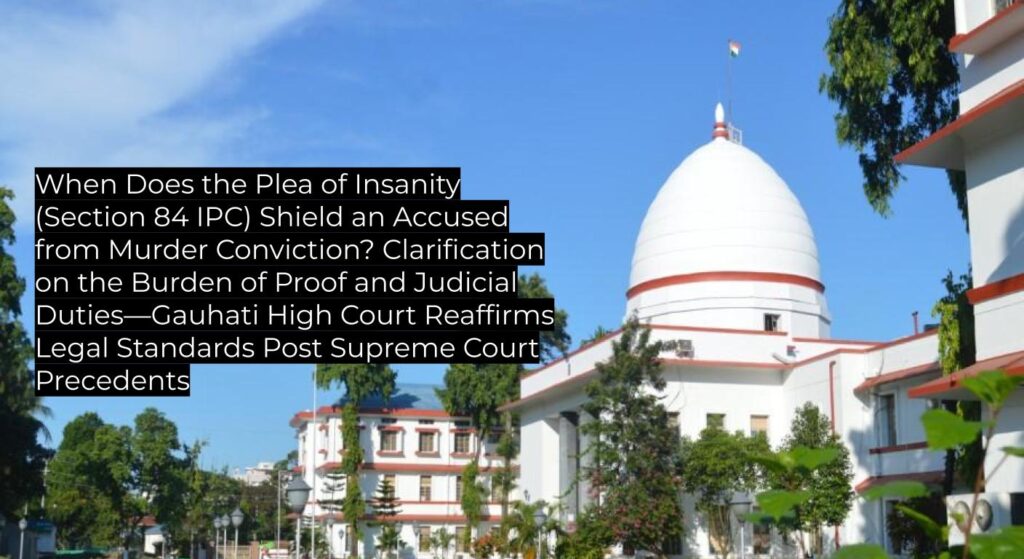
The Gauhati High Court clarifies that the burden to prove unsoundness of mind at the time of the offence (for protection under Section 84 IPC) firmly rests on the accused and must be established by preponderance of probability. The Court affirms previous Supreme Court and High Court rulings, explaining when judicial intervention by way of medical examination is warranted, and reasserts that absence of motive alone or abnormal conduct is not sufficient to prove legal insanity. This decision stands as binding authority for courts in Assam, Nagaland, Mizoram, and Arunachal Pradesh.
Summary
| Category | Data |
|---|---|
| Case Name | CRL.A(J)/23/2020 of Pabitra Kalita Vs The State of Assam |
| CNR | GAHC010077642020 |
| Date of Registration | 30-05-2020 |
| Decision Date | 30-10-2025 |
| Disposal Nature | Dismissed |
| Judgment Author | Hon’ble Mr. Justice Michael Zothankhuma |
| Concurring or Dissenting Judges | Hon’ble Mrs. Justice Mitali Thakuria (concurring) |
| Court | Gauhati High Court |
| Bench | Division Bench (Michael Zothankhuma, J. & Mitali Thakuria, J.) |
| Precedent Value | Binding within Gauhati High Court jurisdiction |
| Overrules / Affirms | Affirms established Supreme Court and High Court precedent |
| Type of Law | Criminal law — IPC Sections 302, 84; Indian Evidence Act Sections 3, 4, 105 |
| Questions of Law |
|
| Ratio Decidendi |
The Court held that the presumption of sanity stands unless rebutted by the accused; this rebuttal must meet the standard of preponderance of probabilities. Legal insanity (not medical insanity) at the time of commission of the offence must be specifically established by the accused, through relevant evidence (oral, documentary, or circumstantial). Unless there are clear reasons—such as past history of insanity, abnormal behaviour observed and documented by authorities, or substantive application made by or on behalf of the accused—the judiciary is not mandated to subject the accused to medical examination under Sections 328 and 329 CrPC. Absence of motive or mere abnormality of act (such as killing a parent) is not sufficient for Section 84 IPC defence. |
| Judgments Relied Upon |
|
| Logic / Jurisprudence / Authorities Relied Upon by the Court |
|
| Facts as Summarised by the Court |
Appellant killed his mother with a ‘dao’ and attempted suicide. No prior history of insanity. No motive established by prosecution. During trial, an unsigned application for psychiatric evaluation was filed and rejected after the judge conversed with and found appellant lucid. No evidence/observation from family, prosecution witnesses, prison staff, or medical records indicating insanity. Court and authorities interacted with appellant on several occasions and saw no abnormality demanding Section 328/329 CrPC procedure. |
Practical Impact
| Category | Impact |
|---|---|
| Binding On | All subordinate courts in Assam, Nagaland, Mizoram, and Arunachal Pradesh |
| Persuasive For | Other High Courts and potentially the Supreme Court, especially regarding procedural handling of insanity pleas |
| Follows |
|
What’s New / What Lawyers Should Note
- The judgment reiterates that a plea of insanity (Section 84 IPC) must pertain to legal insanity at the time of the offence; medical insanity or subsequent behaviour is insufficient.
- The accused bears the burden of proving insanity on the preponderance of probabilities; the doctrine is clearly set out and explained with reference to leading Supreme Court decisions.
- Mere absence of motive or the heinous nature of the act does not automatically raise a presumption of insanity for the purpose of Section 84 IPC.
- Judicial and prosecutorial duty to initiate medical examination arises only where there is credible material or history indicating insanity—not solely on the basis of an abnormal or extreme crime.
- Failure to prove insanity during the crucial time of the offence—by relevant evidence (witnesses, history, documented behaviour or examination)—will defeat the defence.
- Reasserts that evidence from 313 CrPC statements, or a bare, unsigned application for medical referral, will not be sufficient without corroborative evidence of prior or contemporaneous abnormal behaviour.
- Section 84 IPC defences, to succeed, must be supported by timely, credible, and preferably medical evidence or unambiguous observations by authorities.
Summary of Legal Reasoning
- Presumption & Burden: The law presumes all accused sane at the time of offence. This presumption can be rebutted only by the accused, and must reach the standard of preponderance of probabilities (cf. Dahyabhai Chhaganbhai Thakkar, Devidas Loka Rathod, Prakash Nayi alias Sen).
- Legal vs. Medical Insanity: Explained difference between legal insanity (which alone is relevant to Section 84 IPC) and medical insanity (clinical diagnosis).
- Evidence Required: The defence must present evidence—direct (medical or expert), circumstantial, or witness-based (including observations by officers, family, or jail authorities)—suggesting the accused was incapable of knowing the nature of the act or knowing it was wrong/contrary to law at the material time.
- Procedural Duties: Only if there is material raising credible doubt about the accused’s sanity (past history, observed abnormal behaviour, documented evidence) does the court need to trigger medical examination under Section 328/329 CrPC (cf. Bapu v. State of Rajasthan, State of Gujarat v. Manjuben).
- Application to Facts: In the present case, there was no such material: neither past history of mental illness, nor testimonies, nor conduct before, during, or after the incident reflected unsoundness of mind in the legal sense. The application for psychiatric referral was unsigned and found baseless after direct interaction by the trial judge.
- No Motive Irrelevant: The absence of motive is no basis to presume insanity; proof of legal insanity is a factual, evidence-based matter (cf. Ratan Lal; Surendra Mishra).
- Dismissal of Appeal: With no evidence suggestive of insanity at the time of the act, conviction under Section 302 IPC stands affirmed.
Arguments by the Parties
Petitioner (Appellant):
- Admitted killing but asserted act done due to unsoundness of mind; claimed to fall within Section 84 IPC.
- Cited attempted suicide as indicative of mental disturbance.
- Argued the appellant should have been medically examined to establish unsoundness; no such examination was conducted.
- Claimed lack of motive supports the insanity plea.
- Alleged violation of procedural rights under Article 21 due to prosecution’s failure to ensure medical examination.
- Relied upon Supreme Court and Gujarat High Court cases, emphasizing presumption rebuttal standards and procedural duties.
Respondent (State):
- No conduct during inquiry or trial suggested insanity; the appellant responded rationally to judges’ questions.
- The unsigned application seeking medical referral was unsupported by any documentary evidence of insanity.
- Multiple authorities and relatives never observed abnormality; appellant able to communicate rationally.
- Cited Supreme Court authority that burden lies on accused to establish insanity at the time of the offence.
- Stressed that belated or unsubstantiated claims cannot compel court to trigger Section 328/329 CrPC procedures.
Factual Background
The case stemmed from the killing of the mother of the appellant by the appellant with a dao, an incident reported by the father/informant two days later. Following the killing, the appellant attempted to slit his own throat. He was treated in hospital for over a month but never medically examined for mental health issues related to the offence. During trial, defence raised insanity but no supporting medical or historical evidence was adduced; the trial court, after considering an unsigned referral application and direct judicial interaction, found the appellant to be of sound mind and convicted him under Section 302 IPC.
Statutory Analysis
- Section 84 IPC: Lays down the exception for acts committed by a person incapable, due to unsoundness of mind, of knowing the nature or wrongfulness of the act. The standard is legal, not medical, insanity.
- Sections 3, 4, 105 Evidence Act: Section 105 places burden for such exceptions on the accused, and demands standard of preponderance of probabilities. Definitions of ‘proved’, ‘disproved’, and presumptions discussed.
- Sections 328, 329 CrPC: Provide for judicial procedure for inquiry and trial of persons with unsoundness of mind, set in motion only upon sufficient material to create doubt.
- No “reading down” or expansion of the statutory terms was carried out; interpretation strictly based on precedent.
Dissenting / Concurring Opinion Summary
No dissenting or separate concurring opinion was detailed; both judges delivered the order concurring in the same ratio and reasoning.
Procedural Innovations
- No new procedural rules were framed. The judgment affirms the protocol that unsigned or inadequately supported applications for medical referral during trial will not trigger mandatory court action; all such decisions must be grounded in direct judicial observation and credible evidence.
Alert Indicators
- ✔ Precedent Followed – The judgment strictly follows binding Supreme Court and High Court precedent on the law regarding insanity and burden of proof.