


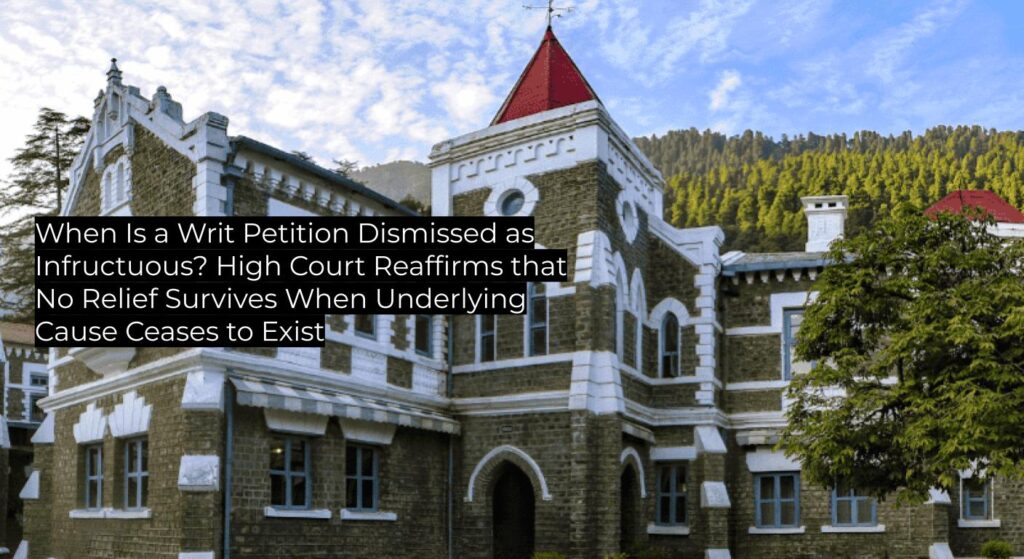
The High Court reiterates that writ petitions seeking relief in admission-related matters become infructuous if the legal basis for the claim ceases to exist (such as failure to qualify in entrance examinations); follows established precedent and offers binding clarity for subordinate courts and persuasive value elsewhere in education-sector litigation.
Summary
| Category | Data |
|---|---|
| Case Name | WPMS/2666/2024 of NIKITA NEGI Vs STATE OF UTTARAKHAND |
| CNR | UKHC010155432024 |
| Date of Registration | 27-09-2024 |
| Decision Date | 15-10-2025 |
| Disposal Nature | DISMISSED AS INFRUCTUOUS |
| Judgment Author | Hon’ble Mr. Justice Manoj Kumar Tiwari |
| Court | High Court of Uttarakhand |
| Bench | Single Judge |
| Precedent Value | Binding on subordinate courts; persuasive for other High Courts |
| Type of Law | Education, Administrative Law, Writ Jurisdiction |
| Questions of Law | Whether writ petitions seeking admission-related relief survive when the petitioner’s eligibility lapses (e.g., on not qualifying relevant entrance exams)? |
| Ratio Decidendi |
The court held that writ petitions become infructuous if the essential precondition for the relief claimed—such as qualification in an entrance exam—no longer exists at the time of adjudication. Counsel for petitioners submitted that petitioners’ failure in entrance examinations rendered the writs moot; the State Counsel agreed the relief had ceased to survive. Accordingly, the writ petitions were dismissed as infructuous, and any interim relief was vacated. |
| Facts as Summarised by the Court |
Petitioners had filed writ petitions seeking relief regarding admission to the D.El.Ed. Course. However, counsel for the petitioners stated that since the petitioners failed to qualify in the entrance examination, the petitions had become infructuous. The State also agreed that the reliefs sought did not survive. The court, therefore, dismissed the petitions as infructuous and vacated any interim order. |
Practical Impact
| Category | Impact |
|---|---|
| Binding On | All subordinate courts in Uttarakhand |
| Persuasive For | Other High Courts; education-sector litigation nation-wide |
What’s New / What Lawyers Should Note
- Reaffirms the principle that writ petitions become infructuous when the basis for relief ceases—e.g., petitioner’s non-qualification for entrance exams.
- Clarifies that counsels’ joint statement about changed circumstances is sufficient for dismissal as infructuous, without further inquiry.
- Highlights the importance of continuous eligibility for relief in admission and education-centric writs.
Summary of Legal Reasoning
- The court noted counsel submissions that the petitioners failed the qualifying entrance examinations, thereby nullifying the basis for the relief sought in the writs.
- The State Counsel concurred that no effective relief could be granted in light of these developments.
- As relief sought was no longer possible, the petitions were dismissed as infructuous, with interim orders vacated.
- The court followed established judicial practice that writ petitions become infructuous when supervening facts negate the substratum of the claim.
Arguments by the Parties
Petitioner
Counsel submitted that the petitioners could not qualify in the entrance examination for admission to the D.El.Ed. Course, rendering the writ petitions infructuous.
State/Respondent
State Counsel submitted that, in view of the circumstances, the relief claimed in the writ petitions did not survive.
Factual Background
The petitioners filed writ petitions seeking relief concerning admission to the D.El.Ed. Course for the relevant academic session. During the pendency of the proceedings, petitioners failed to qualify in the required entrance examinations. Petitioners’ counsel placed this on record, and the State agreed that the petitions could no longer be sustained.
Alert Indicators
- Precedent Followed – Existing practice and settled law on infructuous petitions affirmed.