


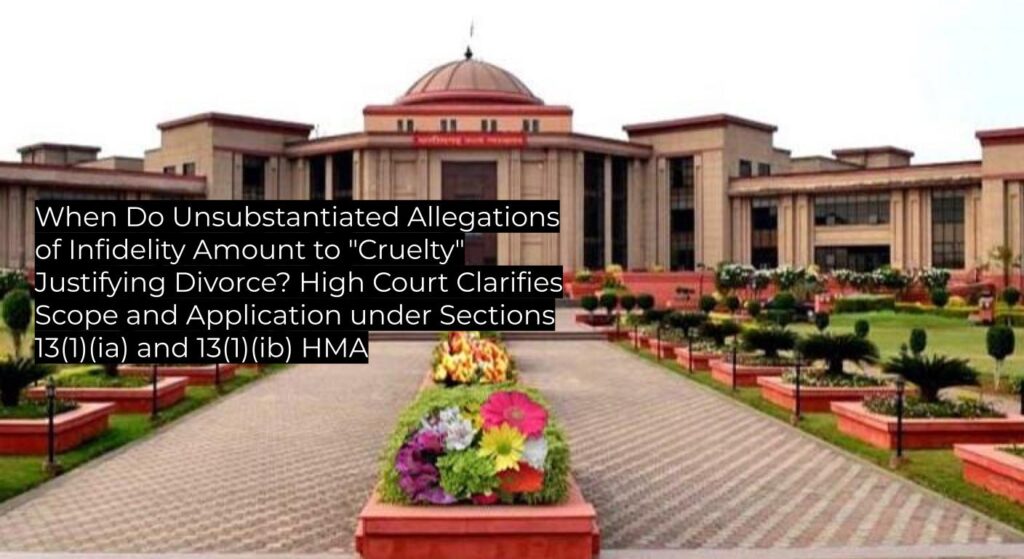
Chhattisgarh High Court applies Supreme Court precedent to hold that unproven and scandalous allegations of adultery levelled by one spouse against the other constitute mental cruelty warranting divorce, while also reaffirming the elements required for establishing desertion under matrimonial law; the judgment sets binding precedent for subordinate courts within the state.
Summary
| Category | Data |
|---|---|
| Case Name | FAM/223/2016 of Ghanshyam Singh Dewangan Vs Smt. Damyanti Dewangan |
| CNR | CGHC010126712016 |
| Date of Registration | 26-10-2016 |
| Decision Date | 03-09-2025 |
| Disposal Nature | ALLOWED |
| Judgment Author | HON’BLE SHRI JUSTICE AMITENDRA KISHORE PRASAD |
| Concurring or Dissenting Judges | HON’BLE SMT. JUSTICE RAJANI DUBEY |
| Court | High Court of Chhattisgarh |
| Bench | Division Bench: HON’BLE SMT. JUSTICE RAJANI DUBEY, HON’BLE SHRI JUSTICE AMITENDRA KISHORE PRASAD |
| Precedent Value | Binding on subordinate courts within Chhattisgarh |
| Overrules / Affirms | Overrules trial court judgment dated 19.09.2016 |
| Type of Law | Matrimonial Law (Hindu Marriage Act, 1955) |
| Questions of Law |
|
| Ratio Decidendi |
The court held that making baseless allegations of infidelity amounts to mental cruelty sufficient to grant divorce under Section 13(1)(ia) of the HMA. The respondent made unverified, scandalous allegations of an illicit relationship, impacting the appellant’s reputation and peace of mind, which constitutes grave mental cruelty as per Supreme Court precedent. On desertion, the court found that continuous, unsubstantiated absence of one spouse without reasonable cause fulfills factum of separation and animus deserendi under Section 13(1)(ib) HMA. The trial court’s failure to properly apply these principles warranted reversal. |
| Judgments Relied Upon | Vijaykumar Ramchandra Bhate v. Neela Vijaykumar Bhate, (2023) 6 SCC 334 |
| Logic / Jurisprudence / Authorities Relied Upon by the Court | Supreme Court’s interpretation that baseless accusations of infidelity constitute grave insult and cruelty warranting divorce; factum of separation and animus deserendi necessary for desertion. |
| Facts as Summarised by the Court | Parties married in 2009; after two children, separation occurred in 2013. Husband alleged desertion and mental cruelty; wife alleged dowry harassment and appellant’s infidelity; trial court denied divorce. |
| Citations | (2023) 6 SCC 334 (Vijaykumar Ramchandra Bhate v. Neela Vijaykumar Bhate) |
Practical Impact
| Category | Impact |
|---|---|
| Binding On | All subordinate courts in Chhattisgarh |
| Persuasive For | Other High Courts and forums dealing with similar questions under Sections 13(1)(ia) and 13(1)(ib) HMA |
| Overrules | Trial court judgment dated 19.09.2016 in Civil Suit No. 30-A/2015 |
| Follows | Vijaykumar Ramchandra Bhate v. Neela Vijaykumar Bhate, (2023) 6 SCC 334 |
What’s New / What Lawyers Should Note
- Reaffirms that uncorroborated and scandalous allegations of extramarital affairs in court pleadings or complaints constitute “mental cruelty” under Section 13(1)(ia) of the Hindu Marriage Act.
- Sets out that allegations of cruelty or desertion must be supported by substantive evidence; mere assertions or counter-allegations do not suffice.
- Desertion is established if the factum of separation and animus deserendi are proved, and the non-returning spouse fails to justify prolonged absence.
- Clarifies judicial approach where both parties trade allegations: non-proving of grave allegations (such as infidelity or dowry harassment) can decisively affect the outcome.
- Appellate courts must intervene where trial courts misapply settled principles regarding cruelty and desertion.
- Divorce can be granted even where children are involved if legal thresholds are met and no efforts at reconciliation are proved.
Summary of Legal Reasoning
- The High Court undertook a careful review of both parties’ pleadings and evidence, noting mutual allegations of cruelty and desertion.
- Relied heavily on the Supreme Court decision in Vijaykumar Ramchandra Bhate v. Neela Vijaykumar Bhate (2023), reiterating that baseless accusations of infidelity in pleadings, complaints, or examinations amount to “mental cruelty”.
- Found that the respondent not only alleged infidelity but also formally complained to the appellant’s employer, damaging his reputation; these remained unsubstantiated upon inquiry.
- Held that such conduct independently satisfies the threshold for cruelty under Section 13(1)(ia) HMA, even absent additional abusive conduct.
- Examined whether desertion was proved: found that the respondent admitted to leaving the matrimonial home in 2013 and living separately since, and her explanations (dowry harassment) were unsubstantiated.
- Court clarified that mere allegations of dowry harassment or unsafe matrimonial environment, if not proved, cannot justify continued desertion.
- Accordingly, set aside the trial court’s contrary view and allowed the appeal, granting a decree of divorce.
Arguments by the Parties
Petitioner (Appellant/Husband):
- Trial Court misappreciated evidence; erred by not granting divorce.
- Provided evidence that respondent lived separately for more than two years without reasonable cause.
- Rebutted by respondent’s admission of leaving in July 2013.
- Asserted the respondent threatened to implicate him in false criminal cases and made unfounded allegations of infidelity, amounting to mental cruelty.
- Claimed the marriage had irretrievably broken down.
Respondent (Wife):
- Appellant failed to approach court with clean hands; allegations were false and unsubstantiated.
- Claimed she faced mental and physical harassment for dowry; forced to leave due to intolerable conditions.
- Alleged appellant was in an illicit relationship and failed to maintain her and their children.
- Argued mere separation without wilful abandonment does not constitute desertion.
- Stated appellant created the situation leading to separation, thus cannot take advantage of his own wrong.
- Contended that the interests of two minor children necessitated retaining the marriage.
Factual Background
The parties were married on 06.05.2009 as per Hindu customs and had two daughters. The respondent-wife left the matrimonial home in 2013, allegedly due to dowry harassment and the appellant’s alleged infidelity. The appellant-husband claimed that the wife deserted him without just cause and threatened false criminal prosecution, amounting to cruelty. The trial court dismissed the husband’s petition for divorce. On appeal, the High Court re-examined the evidence, including admissions by the respondent regarding her departure, and the consequences of unsubstantiated allegations.
Statutory Analysis
- Section 13(1)(ia) Hindu Marriage Act, 1955: Interpreted to mean that baseless and scandalous allegations of infidelity and formal complaints of extramarital affairs constitute mental cruelty sufficient for divorce.
- Section 13(1)(ib) HMA: Both “factum of separation” and “animus deserendi” must be shown for desertion. Prolonged separation without reasonable, substantiated cause, with no efforts to return, meets this test.
- Section 23(1)(a) HMA: Considered regarding bar on relief if the petitioner is taking advantage of his/her own wrong; court found this was not applicable as husband’s conduct was not established as wrongful by evidence.
Dissenting / Concurring Opinion Summary
No separate dissenting or concurring opinion; both judges issued a joint order.
Procedural Innovations
- Permanent alimony of Rs. 15,000/- per month ordered based on affidavit filed by respondent, in compliance with Supreme Court’s guidelines in Rajnesh v. Neha, AIR 2021 SC 569.
- Liberty granted to respondent and daughters to approach appropriate forum for upward revision if required.
Alert Indicators
- ✔ Precedent Followed: Overrules trial court judgment and applies Supreme Court authority in (2023) 6 SCC 334.
Citations
- Vijaykumar Ramchandra Bhate v. Neela Vijaykumar Bhate, (2023) 6 SCC 334
- Rajnesh v. Neha, AIR 2021 SC 569