


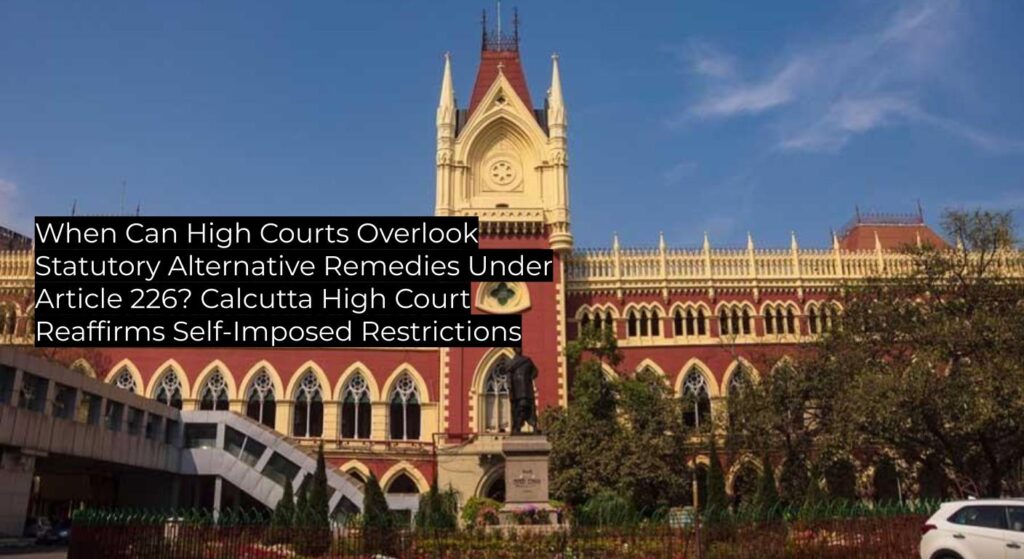
The Calcutta High Court clarifies that, absent exceptional circumstances like violation of natural justice or lack of jurisdiction, the existence of a statutory appellate remedy mandates a self-imposed restriction on writ jurisdiction; this upholds settled Supreme Court precedent and serves as binding authority for future cases in the realm of land reform disputes and similar statutory contexts.
Summary
| Category | Data |
|---|---|
| Case Name | WPLRT/174/2025 of EMAN MISTRY AND ORS. Vs STATE OF WEST BENGAL AND ORS. |
| CNR | WBCHCA0473252025 |
| Date of Registration | 08-10-2025 |
| Decision Date | 29-10-2025 |
| Disposal Nature | DISMISSED |
| Judgment Author | HON’BLE JUSTICE SABYASACHI BHATTACHARYYA |
| Concurring or Dissenting Judges | HON’BLE JUSTICE UDAY KUMAR |
| Court | Calcutta High Court |
| Bench | Division Bench: HON’BLE JUSTICE SABYASACHI BHATTACHARYYA, HON’BLE JUSTICE UDAY KUMAR |
| Precedent Value | Binding on subordinate courts within the jurisdiction; persuasive in other courts |
| Overrules / Affirms | Affirms established Supreme Court precedent, particularly Harbanslal Sahnia v. Indian Oil Corporation Ltd. |
| Type of Law | Constitutional Law — Writ Jurisdiction, Statutory Appeals under Land Reform Laws |
| Questions of Law | Whether writ courts should entertain petitions under Article 226 when a statutory alternative remedy exists |
| Ratio Decidendi |
The High Court reiterated that the rule requiring exhaustion of alternative statutory remedies before invoking writ jurisdiction is a discretionary, self-imposed limitation—not an absolute bar. However, unless exceptions such as enforcement of fundamental rights, breach of natural justice, jurisdictional errors, or vires of the statute are involved, writ petitions should not bypass available statutory appellate remedies. The Court found no such exceptions present in this case and upheld the Tribunal’s refusal to interfere, emphasizing adherence to the statutory appellate hierarchy. |
| Judgments Relied Upon | Harbanslal Sahnia and another vs. Indian Oil Corporation Limited (2003) 2 SCC 107 |
| Logic / Jurisprudence / Authorities Relied Upon by the Court |
Supreme Court’s principle stating the exclusion of writ jurisdiction due to alternative remedy is a rule of discretion and not compulsion; exceptions identified include violation of fundamental rights, breach of natural justice, orders lacking jurisdiction, or challenges to the vires of an Act. |
| Facts as Summarised by the Court |
Petitioners challenged an order of the BL&LRO before the West Bengal Land Reforms Tribunal, which declined interference on the ground of availability of an appellate remedy. Petitioners invoked writ jurisdiction claiming hardship, but no circumstances justifying exception to the alternative remedy rule were found. |
Practical Impact
| Category | Impact |
|---|---|
| Binding On | All subordinate courts/authorities within the jurisdiction of the Calcutta High Court |
| Persuasive For | Other High Courts, as a reaffirmation of Supreme Court principle; may be cited in similar statutory contexts |
| Follows | Harbanslal Sahnia & Anr. v. Indian Oil Corporation Limited & Ors. (2003) 2 SCC 107 |
What’s New / What Lawyers Should Note
- Reaffirms that the discretionary exclusion of writ jurisdiction for alternative remedy is not absolute, but exceptions are strictly limited.
- Clarifies that mere hardship or inconvenience will not suffice; writ will lie only in cases of violation of fundamental rights, breach of natural justice, lack of jurisdiction, or challenges to statutory vires.
- Reinforces adherence to the statutory appellate hierarchy, especially in land reform disputes.
- Lawyers should advise clients to exhaust statutory remedies unless a clear exception applies or risk dismissal of writ petitions.
Summary of Legal Reasoning
- The Court acknowledged the principle from the Supreme Court’s Harbanslal Sahnia decision that the bar on writ petitions due to an alternative remedy is discretionary, not mandatory.
- It was recognized that the Supreme Court set out specific exceptions: writ jurisdiction can be exercised for enforcement of fundamental rights, where there’s a breach of natural justice, lack of jurisdiction, or challenge to the vires of an Act.
- The Court found that none of these exceptions were present—there was no jurisdictional error, no violation of natural justice, and no challenge to statutory vires in the present case.
- Therefore, the High Court deferred to the statutory appellate remedy under the West Bengal Land and Land Reforms Act and upheld the Tribunal’s refusal to entertain the petitioner’s challenge.
- The Court clarified that adherence to the statutory appellate structure is necessary under normal circumstances to prevent bypassing of the legislative intent expressed in the statute.
- Dismissal of the writ petition thereby reinforced this settled jurisprudence.
Arguments by the Parties
Petitioner
- Sought relief under Article 226 against the Tribunal’s order, arguing hardship.
- Relied on Harbanslal Sahnia (2003) 2 SCC 107 to argue that alternative remedy should not bar writ jurisdiction absolutely.
Respondent (State)
- Maintained that the existence of a statutory appellate remedy precluded writ jurisdiction in the absence of special circumstances.
- Supported the Tribunal’s view and opposed interference by the High Court.
Factual Background
The petitioners challenged an order passed by the Block Land & Land Reforms Officer (BL&LRO) before the West Bengal Land Reforms and Tenancy Tribunal. The Tribunal, First Bench, refused to interfere on the ground that the petitioners had an alternative statutory appeal available under the West Bengal Land and Land Reforms Act against the BL&LRO’s order. The petitioners approached the High Court under Article 226, pleading hardship, but the High Court found no exceptional circumstance warranting bypass of the statutory remedy.
Statutory Analysis
The judgment focused on provisions of the West Bengal Land and Land Reforms Act that provide a statutory remedy of appeal from orders of the BL&LRO. The High Court discussed Article 226 of the Constitution, interpreting the writ jurisdiction as subject to self-imposed restraints when statutory remedies exist. The Court reiterated exceptions recognized by the Supreme Court: violation of fundamental rights, breach of natural justice, want of jurisdiction, or challenge to the vires of a statute. No “reading down” or constitutional invalidation was undertaken in this decision.
Dissenting / Concurring Opinion Summary
There was no dissent. Justice Uday Kumar expressly concurred with Justice Sabyasachi Bhattacharyya’s reasoning and conclusion.
Procedural Innovations
No procedural innovations or new directions were issued in this judgment.
Alert Indicators
- ✔ Precedent Followed – The decision applies settled law as affirmed by the Supreme Court in Harbanslal Sahnia.