


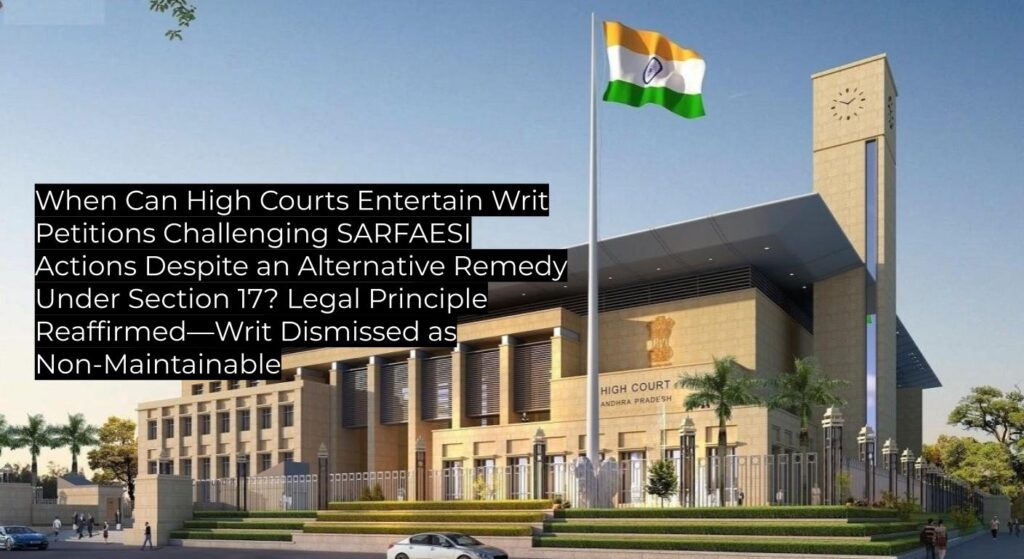
The Andhra Pradesh High Court upheld the requirement to exhaust the statutory remedy under Section 17 of the SARFAESI Act before invoking writ jurisdiction under Article 226, reaffirming existing precedent and clarifying that writ petitions are not maintainable when an efficacious alternative remedy exists. This principle remains binding on all subordinate courts and reinforces procedural discipline in bank recovery disputes.
Summary
| Category | Data |
|---|---|
| Case Name |
WP/10839/2025 of S V V RAMACHANDRA RAO Vs M/S STATE BANK OF INDIA CNR APHC010217442025 |
| Date of Registration | 24-04-2025 |
| Decision Date | 10-09-2025 |
| Disposal Nature | DISMISSED |
| Judgment Author | RAVI NATH TILHARI, J & MAHESWARA RAO KUNCHEAM, J |
| Court | High Court of Andhra Pradesh |
| Bench | RAVI NATH TILHARI, J & MAHESWARA RAO KUNCHEAM, J |
| Precedent Value |
|
| Type of Law |
|
| Questions of Law | Whether a writ petition under Article 226 can be entertained when an alternative efficacious remedy under Section 17 of the SARFAESI Act is available. |
| Ratio Decidendi | The High Court reaffirmed that when an alternative statutory remedy is available under Section 17 of the SARFAESI Act, recourse should be first taken to that forum. Writ jurisdiction under Article 226 is not normally invoked except in exceptional cases. The petitioner acknowledged the availability of the alternative remedy and sought interim protection to enable him to avail it. The writ was accordingly dismissed on this procedural ground, with interim relief continued for two weeks to allow approaching the statutory forum. |
| Logic / Jurisprudence / Authorities Relied Upon by the Court | Emphasised procedural discipline by enforcing the availability of alternative remedy as a bar to maintainability of writ petitions challenging SARFAESI actions, unless exceptional circumstances are shown. |
| Facts as Summarised by the Court | The petitioner challenged the bank’s SARFAESI action, arguing the bank’s equitable mortgage was not registered with the Central Registry and that the petitioner held a registered simple mortgage. The bank objected on grounds of alternative remedy. The petitioner accepted the existence of Section 17 remedy, seeking interim protection. The court dismissed the writ, granting two weeks’ interim relief to approach the alternate forum. |
Practical Impact
| Category | Impact |
|---|---|
| Binding On | All subordinate courts in Andhra Pradesh |
| Persuasive For | Other High Courts, Supreme Court of India |
| Follows | Procedural precedent regarding maintainability of writ petitions where alternative remedies exist |
What’s New / What Lawyers Should Note
- Reinforces that writ petitions under Article 226 are not maintainable against SARFAESI proceedings when a statutory alternative remedy under Section 17 is available.
- Petitioners must avail and exhaust the remedy under Section 17 of the SARFAESI Act before approaching the High Court.
- Interim protection may be granted temporarily to enable recourse to the statutory remedy if an alternative remedy is conceded to by the petitioner.
- Banks can cite this judgment to oppose direct writ petitions challenging SARFAESI actions unless exceptional circumstances are present.
Summary of Legal Reasoning
- The principal issue was whether the High Court can entertain a writ petition under Article 226 where an efficacious statutory remedy exists under Section 17 of the SARFAESI Act.
- The court recorded that the petitioner’s counsel conceded the availability of the alternative statutory remedy.
- By accepting the preliminary objection raised by respondents, the court dismissed the writ petition as non-maintainable on this procedural ground.
- The court, considering pragmatic fairness, continued the interim order for two weeks to allow the petitioner to approach the Debts Recovery Tribunal.
- The court adhered to established jurisprudence—writ jurisdiction is exceptional when statutory alternatives exist.
- No discussion of other precedents or statutory interpretation; focus was on maintainability.
Arguments by the Parties
Petitioner
- The bank’s equitable mortgage was not registered with the Central Registry; hence, SARFAESI action was contested.
- The petitioner claimed a registered simple mortgage/lien over the property.
- Upon objection, counsel agreed that a statutory remedy was available and sought extension of interim relief.
Respondent (Bank)
- Raised preliminary objection: Petitioner has an efficacious statutory alternative remedy under Section 17 of the SARFAESI Act.
- No objection to continuing interim protection for two weeks to enable petitioner to approach the statutory forum.
Factual Background
The dispute arose when the State Bank of India initiated proceedings under the SARFAESI Act against a residential property. The petitioner challenged the bank’s action on the ground that the bank’s equitable mortgage was not registered with the Central Registry and claimed priority due to his own registered simple mortgage over the property in question. The respondent bank initiated action to recover outstanding dues against the property, which the petitioner tried to prevent through the writ petition. During the writ proceedings, the petitioner admitted an alternative remedy exists and sought time to pursue it.
Statutory Analysis
- The key statutory provision discussed was Section 17 of the SARFAESI Act, which provides an aggrieved person the right to approach the Debts Recovery Tribunal against SARFAESI measures taken by secured creditors.
- The court noted that the existence of this alternative remedy precludes the maintainability of writ petitions under Article 226 in the absence of exceptional circumstances.
- The writ was dismissed on this procedural basis, with interim relief extended for a limited time.
Dissenting / Concurring Opinion Summary
No dissenting or concurring opinions were recorded. The judgment was unanimous.
Procedural Innovations
The court allowed interim relief to continue for two weeks post dismissal of the writ petition, providing the petitioner a reasonable window to avail the statutory remedy.
Alert Indicators
- ✔ Precedent Followed – When existing law is affirmed.