


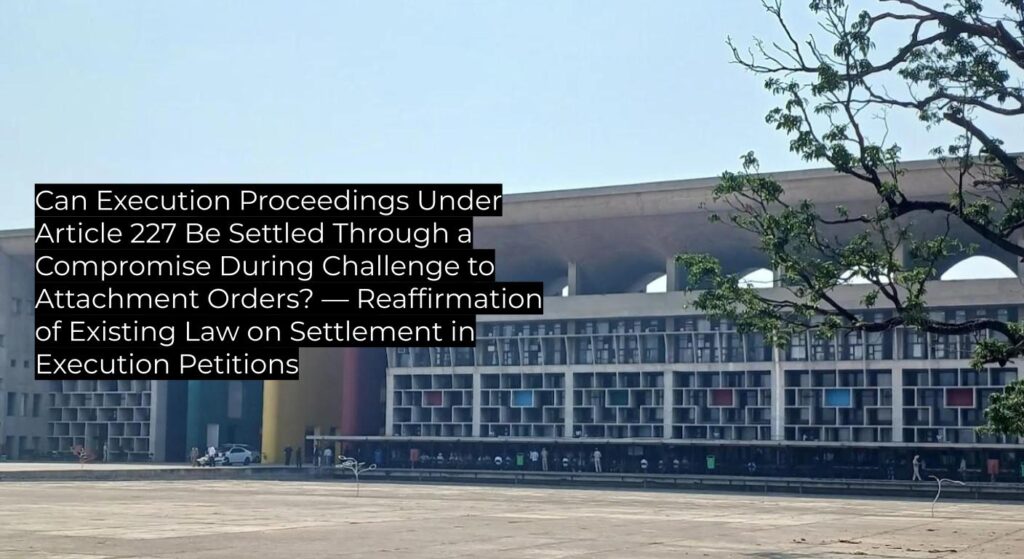
The Punjab and Haryana High Court held that execution proceedings—including auction of an attached property—may be stayed and then fully disposed of based upon a consensus between the judgment debtor and decree holder, with detailed payment terms recorded as part of the order. This judgment clarifies the court’s approach to consent orders in execution matters under Article 227, reaffirming established principles and providing binding precedent for subordinate courts in similar scenarios.
Summary
| Category | Data |
|---|---|
| Case Name | CR/785/2023 of RAJINDER SINGH DECEASED TH LR SUKPREET SINGH Vs DALBIR KUMAR |
| CNR | PHHC010097242023 |
| Date of Registration | 02-02-2023 |
| Decision Date | 30-10-2025 |
| Disposal Nature | DISPOSED OF |
| Judgment Author | MR. JUSTICE VIKAS BAHL |
| Court | High Court of Punjab and Haryana |
| Precedent Value | Binding on subordinate courts; persuasive for future execution proceedings involving consent terms |
| Overrules / Affirms | Affirms existing practice of settlement-based disposal in execution matters |
| Type of Law | Civil Procedure; Execution of Decrees |
| Questions of Law | Whether execution proceedings and auction of attached property can be stayed/disposed based on consensus settlement terms recorded in an order under Article 227. |
| Ratio Decidendi |
The Court held that when parties reach a consensus in execution proceedings—including agreement on amount, schedule of payment, and security—such consensus can be recorded, and execution proceedings stayed, subject to compliance. Non-compliance may render the attached property liable to auction and open the defaulting party to contempt proceedings. The approach ensures expeditious and consensual resolution of execution disputes, provided the court supervises compliance through affidavits and timelines. The arrangement becomes binding and enforceable upon both parties and forms the basis for lifting encumbrances once compliance occurs. |
| Facts as Summarised by the Court |
The petitioner (through LR), facing execution and imminent auction of attached property, proposed to pay Rs.5,00,000 immediately and the balance in two installments. Both sides agreed to a payment plan and the timeline for compliance that would satisfy the decree, lift the attachment, and conclude the execution. |
Practical Impact
| Category | Impact |
|---|---|
| Binding On | All subordinate courts within the jurisdiction of the Punjab and Haryana High Court |
| Persuasive For | Other High Courts and in similar execution proceedings elsewhere |
| Follows | Affirms the established practice of permitting consensual settlement in executing court processes |
What’s New / What Lawyers Should Note
- The order sets out a clear template for consensual resolution of execution disputes, defining payment schedules and consequences of default.
- Consent orders in execution can include a direct bar on auction subject to compliance, with express provision for contempt in case of default.
- Lawyers can cite this precedent for negotiated stays of execution/attachment, provided terms are unambiguous and recorded on court file.
- Requirement that affidavit be filed before the Executing Court ensures enforceability and court supervision.
- Default under consent terms reopens liability to both auction of property and contempt, emphasizing consequences of non-compliance.
Summary of Legal Reasoning
- On application under Section 151 CPC, the court restored the case for final consideration.
- Recording the consensus between parties, the court used its powers under Article 227 and procedural provisions to dispose of pending execution, stay the auction, and provide for compliance via informed schedule.
- The reasoning relied upon the capacity of the High Court to intervene in execution proceedings where parties mutually agree to settle, and to make such settlement binding by way of specific directions.
- The court explicitly delineated steps for enforcement and consequences for non-compliance, thereby ensuring the order is both a shield and a sword, balancing interests of both sides.
- No new statutory interpretation was undertaken; the reasoning affirmed past practice of settlement-driven disposal in civil execution matters, with explicit judicial endorsement.
Arguments by the Parties
Petitioner
- Offered immediate payment of Rs. 5,00,000 to show bona fide intent.
- Proposed structured payment of remaining amount to satisfy the decree and prevent auction of attached property.
Respondent
- Agreed to accept the proposed payment schedule.
- Accepted delivery of the initial payment as per court’s direction, confirming settlement.
Factual Background
The dispute arose from the execution of a civil decree dated 18.04.2018 in which the property of the petitioner was attached for realization of dues. When auction of the attached property became imminent, the petitioner’s legal representative came forward with a proposal to pay part of the decree debt immediately and the rest in two installments, seeking stay of auction. Both parties agreed to the settlement recorded by the court, with structured payments leading to full satisfaction of decree and lifting of encumbrances.
Statutory Analysis
- Section 151 CPC (inherent powers) was invoked for restoration of the case.
- Article 227 of the Constitution of India was the procedural basis for the High Court’s supervisory jurisdiction.
- No new interpretation or expansion of these provisions occurred; rather, the court applied them to give effect to a consensual arrangement in execution.
Procedural Innovations
- Requirement that the petitioner’s legal representative file an affidavit before the Executing Court confirming compliance with the payment schedule.
- The execution proceeding was stayed and scheduled to be disposed of upon compliance without need for further hearing, offering procedural efficiency.
Alert Indicators
- ✔ Precedent Followed – This judgment affirms and clarifies established practice regarding disposal of execution proceedings based on consensus and maintains conformity with settled law.