


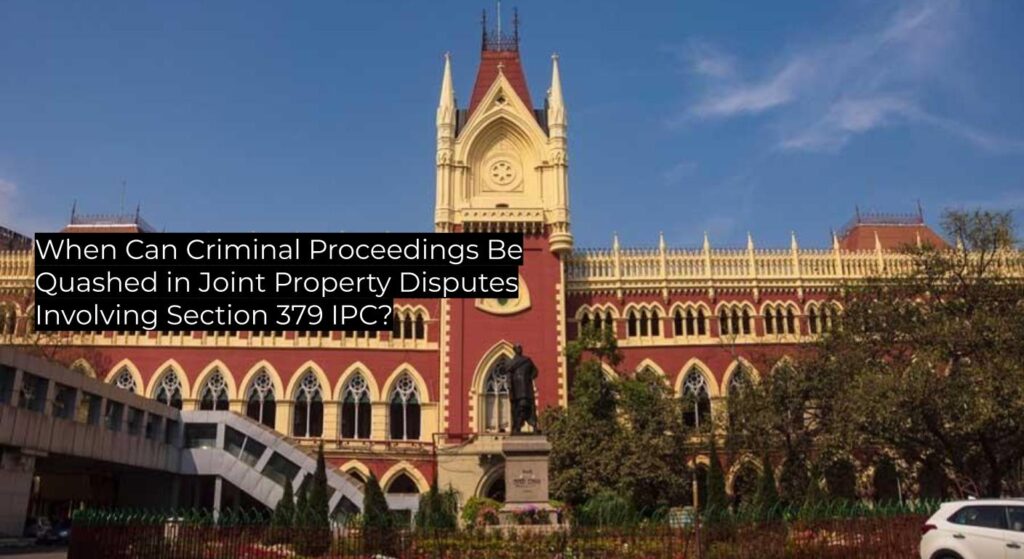
The Calcutta High Court, reaffirming existing Supreme Court and High Court precedent, clarified that criminal proceedings under Section 379 IPC (theft) are not maintainable where joint property or civil co-ownership is admitted, and the complainant lacks exclusive title; such disputes are quintessentially civil. This judgment, relying on binding Supreme Court authority, strengthens lawyers’ ability to seek quashment under Section 482 CrPC in similar fact situations and operates as binding precedent within West Bengal and persuasive authority elsewhere.
Summary
| Category | Data |
|---|---|
| Case Name | CRR/1557/2007 of ABDUS SAFI @ BABAN Vs STATE |
| CNR | WBCHCA0200732007 |
| Date of Registration | 24-04-2007 |
| Decision Date | 01-09-2025 |
| Disposal Nature | DISPOSED |
| Judgment Author | HON’BLE JUSTICE CHAITALI CHATTERJEE (DAS) |
| Court | Calcutta High Court |
| Bench | Single Judge (HON’BLE JUSTICE CHAITALI CHATTERJEE DAS) |
| Precedent Value | Binding within Calcutta High Court’s jurisdiction; persuasive for other courts |
| Overrules / Affirms | Affirms previous Supreme Court authorities; clarifies application in property disputes |
| Type of Law | Criminal Procedure / Criminal Law – Quashing/Section 482 CrPC; Section 379 IPC |
| Questions of Law | Whether a dispute concerning use/enjoyment of jointly held property by admitted co-sharers can attract Section 379 IPC (theft) and warrant criminal prosecution, or is purely civil and amenable for quashment under Section 482 CrPC. |
| Ratio Decidendi | Criminal proceedings under Section 379 IPC are not sustainable where the dispute is over joint property with multiple co-sharers, and the complainant’s exclusive ownership is unproved. Such matters are essentially civil disputes; criminal process cannot be allowed as a tool for resolving civil co-ownership conflicts. The High Court’s power under Section 482 CrPC should be exercised in such cases to prevent abuse of process and secure the ends of justice. The factum of joint ownership and previous acquittals in parallel (related) proceedings further supports quashment. The test is whether civil remedies were available and if allegations are cloaked in criminality. Acceptance of defence at charge stage is impermissible, but blatant civil disputes should not result in criminal prosecution. |
| Judgments Relied Upon | State of Orissa v. Debendranath Padhi; Naresh Kumar v. State of Karnataka; Paramjeet Batra v. State of Uttarakhand; Usha Chakraborty v. State of West Bengal |
| Logic / Jurisprudence / Authorities Relied Upon by the Court | Supreme Court authority that civil disputes should not be allowed to be dressed up as criminal charges (especially when civil remedy is available and pursued), and accused’s defence cannot be adjudicated at charge stage. Existence of multiple co-sharers, and prior acquittal in related complaint, negates criminal intent/application of Section 379 IPC. |
| Facts as Summarised by the Court | Dispute arose between co-sharers of a pond, with both sides claiming right to share of fish. FIR and complaints under Sections 504/506/379/34 IPC were registered, followed by a civil co-sharer dispute. Parallel criminal and complaint proceedings were pending; one resulted in acquittal, with Magistrate’s comment on civil nature of dispute. No civil suit was pending, but documents showed joint property status and multiplicity of co-sharers; the complainant’s exclusive title was unproven. |
| Citations | (2005) 1 C.Cr.L.R (SC) 487 (State of Orissa v. Debendranath Padhi); 2024 INSC 196 (Naresh Kumar v. State of Karnataka); 2013 11 SCC 673 (Paramjeet Batra v. State of Uttarakhand); 2023 SCC OnLine SC 90 (Usha Chakraborty v. State of West Bengal) |
Practical Impact
| Category | Impact |
|---|---|
| Binding On | All subordinate courts under Calcutta High Court; revisional and quashment petitions involving Section 379/IPC in property disputes. |
| Persuasive For | Other High Courts and Supreme Court (as factual application of established Supreme Court precedent in property/Section 379 IPC disputes). |
| Follows | State of Orissa v. Debendranath Padhi (2005) 1 C.Cr.L.R (SC) 487; Paramjeet Batra v. State of Uttarakhand (2013 11 SCC 673); Usha Chakraborty v. State of West Bengal (2023 SCC OnLine SC 90). |
What’s New / What Lawyers Should Note
- Reiterates that joint ownership/co-sharership bars prosecution under Section 379 IPC; civil disputes should not be criminalised.
- Prior acquittal in a related criminal complaint is a relevant factor for quashment in connected proceedings.
- At the charge stage, courts should avoid “mini-trials”; defence evidence on title cannot be examined, but evident civil nature of dispute warrants exercise of Section 482 CrPC powers.
- Lawyers can rely on joint ownership, absence of exclusive title, and existence of multiple co-sharers as grounds for seeking quashment of criminal complaints where civil elements are predominant.
Summary of Legal Reasoning
- The Court examined FIRs and complaints, highlighting that the dispute arose among multiple admitted co-sharers of a pond (alleged “snatching away of fish”).
- Observed that the Magistrate’s order of acquittal in a parallel criminal complaint (under Section 379 IPC regarding the same property) was premised on absence of exclusive possession and finding the property to be joint and WAQF property with many co-sharers.
- Relied on Supreme Court rulings:
- State of Orissa v. Debendranath Padhi: At the charge stage, courts cannot consider the defence evidence; only prosecution’s case is seen.
- Naresh Kumar v. State of Karnataka, Paramjeet Batra v. State of Uttarakhand, Usha Chakraborty v. State of West Bengal: Where a dispute is civil in nature but cloaked as a criminal case, and civil remedies exist, the High Court should quash proceedings to prevent process abuse.
- The Court found that mere assertion of civil co-sharership negates the core ingredient of criminal intent necessary for Section 379 IPC, and allows quashment under Section 482 CrPC.
- Emphasized that continuation of proceedings would be wasteful and an abuse of process; criminal trial should not be used for inter se civil disputes.
Arguments by the Parties
Petitioner
- Dispute is purely civil; property (pond) is co-owned, with record of rights in their names.
- Allegations in the complaints and FIR do not disclose commission of a cognizable criminal offence.
- Prior acquittal in related proceedings concerning the same property supports their case for quashment.
Respondent/State
- Disputed pond is a WAQF property (with order confirming same).
- Complainant has to prove ownership before theft can be alleged; unless complainant establishes exclusive title, prosecution is unsustainable.
- Supported the Magistrate’s refusal to discharge the petitioners as on evidence, title dispute is not determinable at criminal proceedings.
Factual Background
The dispute arose regarding co-sharers of a pond. The de-facto complainant alleged on multiple occasions (14 August 2005, 16 October 2005) that petitioners, also co-sharers, snatched or took away fish and threatened the complainant and his brother. On this basis, FIRs and a criminal complaint under Sections 504/506/379/34 IPC were registered and related criminal proceedings were initiated. In a parallel complaint, the accused had already been acquitted, with the Magistrate holding the dispute was civil in nature involving multiple co-sharers and WAQF property. No civil proceedings were pending, but rights documents showed multiplicity of co-sharers.
Statutory Analysis
- Section 379 IPC: Theft requires proof of dishonest removal of property from the possession of another; exclusive ownership or possession by complainant must be established. Where property is jointly owned, such removal does not generally constitute “theft”.
- Sections 401 and 482 CrPC: High Court’s revisional and inherent powers to prevent abuse of process and secure ends of justice; power under Section 482 CrPC should be exercised to quash proceedings when allegations are clearly civil. The Court reaffirmed that at the charge framing stage (Section 239 CrPC), courts do not conduct mini-trials or entertain accused’s evidence, but must see if continuation of proceedings would be an abuse of court process especially in evident civil disputes.
Alert Indicators
- ✔ Precedent Followed – The court follows and applies established Supreme Court authority.
Citations
- State of Orissa v. Debendranath Padhi, (2005) 1 C.Cr.L.R (SC) 487
- Naresh Kumar v. State of Karnataka, 2024 INSC 196
- Paramjeet Batra v. State of Uttarakhand, 2013 11 SCC 673
- Usha Chakraborty v. State of West Bengal, 2023 SCC OnLine SC 90