


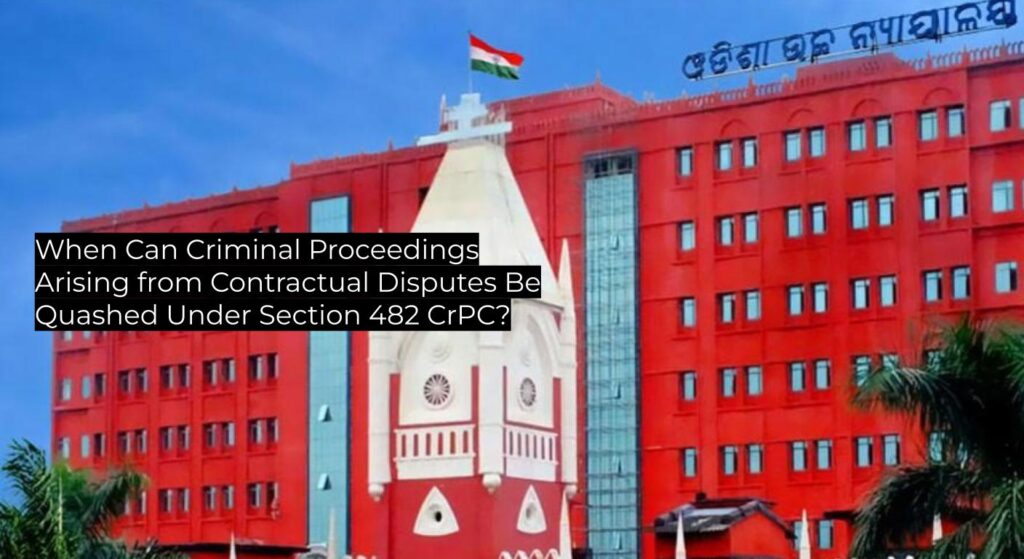
The Orissa High Court reaffirmed that criminal proceedings grounded in civil or contractual disputes lacking basic criminal ingredients are liable to be quashed under Section 482 CrPC. The judgment follows and applies settled Supreme Court precedents, providing binding authority within the State for distinguishing between civil and criminal liability in business transactions.
Summary
| Category | Data |
|---|---|
| Case Name | CRLMC/348/2023 of SATYA PRIYA JAYASINGH Vs STATE OF ODISHA (EOW) |
| CNR | ODHC010047142023 |
| Date of Registration | 19-01-2023 |
| Decision Date | 17-10-2025 |
| Disposal Nature | Disposed Off |
| Judgment Author | MR. JUSTICE CHITTARANJAN DASH |
| Court | Orissa High Court |
| Precedent Value | Binding authority for subordinate courts in Orissa; persuasive for other High Courts |
| Type of Law | Criminal Law (Quashing of FIR/Proceedings under Section 482 CrPC), Intersection with Civil/Contract Law |
| Questions of Law | Whether criminal proceedings based on essentially civil or contractual disputes, lacking ingredients of criminal offence, can be quashed under Section 482 CrPC? |
| Ratio Decidendi |
The High Court held that when allegations in an FIR or complaint pertain primarily to a civil dispute, with no material to substantiate criminal ingredients, continued criminal prosecution constitutes an abuse of process and must be quashed under Section 482 CrPC. The judgment emphasised that the process of law cannot continue where allegations, taken at face value, do not make out any criminal offence. Reliance was placed on Supreme Court precedents which draw a clear distinction between private civil disputes and genuine criminal conduct. If civil remedies are available and the substance of the allegations is contractual in nature, criminal process should not be invoked. |
| Judgments Relied Upon |
|
| Logic / Jurisprudence / Authorities Relied Upon by the Court | Applied principles from Bhajan Lal on quashing jurisdiction and distinguishing civil wrong from criminality; reiterated that the possibility of conviction in such cases is “remote and bleak” and continuing criminal proceedings will amount to oppression and prejudice. |
| Facts as Summarised by the Court |
The petitioner, Managing Partner of a firm engaged in granite quarry operations, was alleged to have received payment for transferring a quarry lease. The FIR claimed the petitioner did not honour the alleged agreement to transfer the lease, though such transfer was impermissible under law at the relevant time. The petitioner had executed an irrevocable power of attorney permitting quarry operation. The monetary dispute pertained to a contractual/business transaction, and there existed civil remedies for recovery. No material supported the criminal charges alleged in the FIR. |
Practical Impact
| Category | Impact |
|---|---|
| Binding On | All subordinate courts in Orissa |
| Persuasive For | Other High Courts, Supreme Court |
| Follows |
|
What’s New / What Lawyers Should Note
- Reaffirms that disputes rooted in commercial, financial, or contractual dealings are not to be criminalised unless basic ingredients of a criminal offence are met.
- Provides a binding template for invoking Section 482 CrPC to quash FIRs or proceedings where allegations amount to a civil wrong rather than a cognizable offence.
- Emphasises that the mere assertion of fraud or criminal breach, without substantiating ingredients distinct from civil liability, will not sustain prosecution.
- Suggests that parties facing criminal litigation arising out of contract disputes may rely on this ruling to seek quashing at the High Court stage.
Summary of Legal Reasoning
- The court reviewed the FIR and supporting materials, noting all allegations concerned a failed transfer of mining lease for which the payment was allegedly made.
- Observed that such transfer was illegal under law at the relevant time, and the only mechanism executed was a power of attorney allowing quarry operation—an act outside the scope of a criminal wrong.
- Explored Supreme Court authorities, including Bhajan Lal and Taarinaa Sen, setting out that criminal process should not be misused for the settlement of civil and contractual disputes where civil remedies are adequate.
- Distinction drawn between a “mere breach of contract” and conduct amounting to a criminal offence; in the absence of criminal intent, prosecution amounts to an abuse of process.
- The possibility of conviction was described as “remote and bleak”, and the court held the criminal proceedings would only cause oppression and prejudice.
- Concluded that the allegations lacked the required prima facie ingredients of offences under IPC Sections 420/406/467/468/471/506/34 and were thus liable to be quashed.
Arguments by the Parties
Petitioner:
- Alleged FIR was based on a purely contractual, business dispute for which civil remedies exist.
- Asserted the power of attorney was executed for quarry operation—the transfer of lease was not legally permissible.
- Contended that the criminal case was a vexatious attempt to coerce transfer of the lease and settle personal vendetta.
- Stated that the complaint lacked material to constitute any offence under the cited IPC sections.
Respondent (Opposite Party / Informant):
- Alleged petitioner failed to honour agreement to transfer lease despite having received a significant sum as consideration.
- Asserted criminal liability on the ground that expectations raised by the petitioner induced the contract and payment.
Factual Background
One Ajay Kumar Agarwal lodged a report alleging that Satya Priya Jayasingh, as Managing Partner of a firm operating granite quarries, agreed to transfer a quarry lease in consideration for a large sum. Despite payment, the lease was not transferred as per the promise, though an irrevocable power of attorney was executed, allowing the informant to run the quarry. The petitioner maintained that such transfer was not permissible in law at the relevant time, and all disputes are contractual in nature, with redress available via civil remedies. The investigation pertained to offences under several IPC sections (420, 406, 467, 468, 471, 506, 34).
Statutory Analysis
- Section 482 CrPC: Thorough discussion and application of inherent jurisdiction to quash proceedings; reiterates breadth of discretion but shortage of material to proceed to trial.
- IPC Sections 420, 406, 467, 468, 471, 506, 34: Court analysed ingredients and found the FIR’s allegations did not meet the threshold for these offences because the crux of the matter was civil/contractual, not criminal.
- Orissa Minor Minerals Rules, 2016 & subsequent 2022 amendments: Court noted the legal bar on transfer of lease at the relevant time, finding no “criminal inducement” when transfer was anyway impermissible.
Alert Indicators
- ✔ Precedent Followed – When existing law is affirmed.