


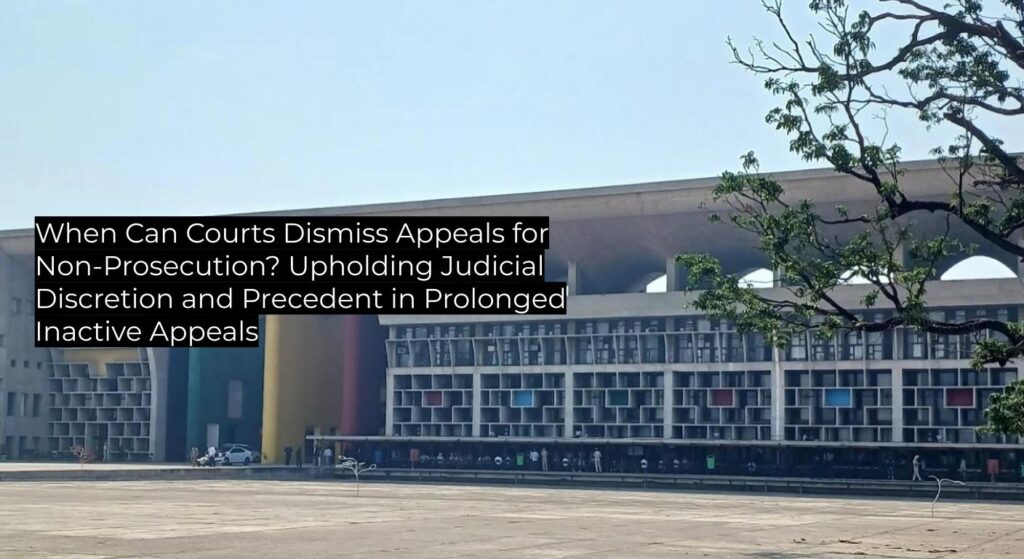
The High Court reaffirmed its authority to dismiss long-pending appeals for want of prosecution when appellants repeatedly fail to appear, while providing limited liberty for revival. This judgment continues established precedent and clarifies practical procedures in cases of prolonged inaction, serving as binding authority within the court’s jurisdiction.
Summary
| Category | Data |
|---|---|
| Case Name | FAO/2122/2003 of SOM NATH Vs MAL SINGH |
| CNR | PHHC010227672003 |
| Date of Registration | 22-05-2003 |
| Decision Date | 29-10-2025 |
| Disposal Nature | DISMISSED |
| Judgment Author | MR. JUSTICE VIRINDER AGGARWAL |
| Court | High Court of Punjab and Haryana |
| Precedent Value | Binding within jurisdiction |
| Type of Law | Procedural (Appellate Procedure: Dismissal for Non-Prosecution) |
| Ratio Decidendi |
The court held that, after repeated non-appearance of appellants in a long-pending appeal, dismissal for want of prosecution is justified. The court emphasized the need to prevent indefinite pendency. Nonetheless, appellants are granted liberty to revive the appeal within a specified time frame (three months), maintaining a balance between judicial efficiency and opportunity for redress. |
| Facts as Summarised by the Court |
The case, registered in 2003, remained pending for over two decades. Noticeably, no one appeared for the appellants on the hearing date despite being called twice, indicating lack of interest in prosecuting the appeal. |
Practical Impact
| Category | Impact |
|---|---|
| Binding On | All subordinate courts within Punjab & Haryana |
| Persuasive For | Other High Courts |
What’s New / What Lawyers Should Note
- Reaffirms the High Court’s practice to dismiss appeals for want of prosecution after repeated non-appearance and long pendency.
- Provides explicit liberty for appellants to seek revival within a three-month period if aggrieved.
- Lawyers should ensure diligent follow-up and representation to prevent dismissal of appeals on procedural grounds.
- Useful precedent on managing backlog and ensuring expeditious disposal of dormant cases.
Summary of Legal Reasoning
- The court observed that the appeal, pending since 2003, had seen no representation despite being called twice on the day of hearing, indicating the appellants’ lack of interest in prosecuting their case.
- It was held that there was no justification to retain inactive cases on the court docket indefinitely.
- The court exercised its inherent powers to dismiss the appeal for want of prosecution.
- In the interest of fairness, liberty was granted to the appellants to seek revival within three months if any substantive grievance remained.
Arguments by the Parties
Petitioner (Appellants)
No arguments presented, as there was no appearance on behalf of the appellants despite repeated calls.
Respondent (Insurance Company)
Represented by counsel on record. (Specific arguments not detailed in the judgment.)
Factual Background
- The matter pertained to an appeal registered in 2003 which had remained pending for more than two decades.
- On the scheduled hearing, no party appeared for the appellants despite multiple calls, which led the court to infer the appellants’ disinterest in pursuing the case.
Statutory Analysis
- The judgment addressed procedural law relating to dismissal of appeals for non-prosecution.
- It reiterated the judiciary’s power to clear dockets by dismissing inactive matters when appellants fail to appear or prosecute their case, with provision for conditional revival within a stated period.
Dissenting / Concurring Opinion Summary
No dissenting or concurring opinions recorded in the judgment.
Procedural Innovations
- The judgment allowed for dismissal of the appeal for non-prosecution but innovatively granted the appellants a fixed period (three months) to seek revival if aggrieved.
Alert Indicators
- ✔ Precedent Followed – The decision is consistent with established judicial procedures regarding dismissal for non-prosecution.