


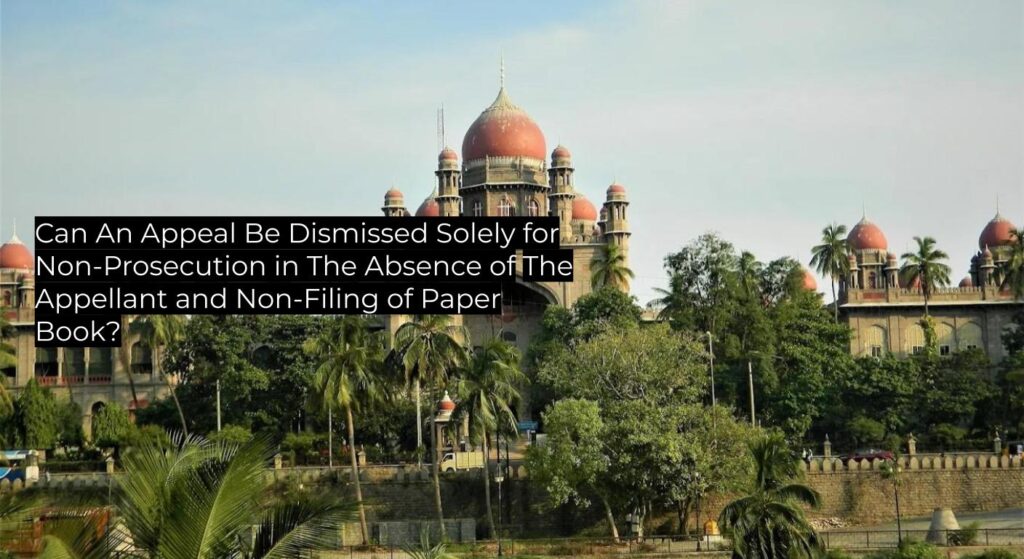
The High Court for the State of Telangana has reaffirmed that an appeal may be dismissed for non-prosecution when the appellant fails to appear and take necessary procedural steps. This judgment upholds existing precedent on procedural discipline in appellate proceedings and serves as binding authority on managing appellate dockets for courts in the State.
Summary
| Category | Data |
|---|---|
| Case Name | M/s. Rama Spinners Pvt.Ltd., Vs The Asst. Accounts Officer APSEB |
| CNR | HBHC010431682008 |
| Decision Date | 15-03-2019 |
| Disposal Nature | Dismissed for non-prosecution |
| Judgment Author | Justice Raghvendra Singh Chauhan (with Justice T.Amarnath Goud concurring) |
| Court | High Court for the State of Telangana |
| Bench | Division Bench: Justice Raghvendra Singh Chauhan, Justice T.Amarnath Goud |
| Precedent Value | Binding on subordinate courts in Telangana; persuasive for other High Courts |
| Type of Law | Civil Procedure/Appellate Practice |
| Questions of Law | Whether the High Court may summarily dismiss a civil appeal for non-prosecution if the appellant fails to appear or take required steps. |
| Ratio Decidendi |
|
| Facts as Summarised by the Court | The appellant sought an adjournment to prepare the paper book but subsequently failed to appear or file the paper book, resulting in dismissal for non-prosecution. |
Practical Impact
| Category | Impact |
|---|---|
| Binding On | All subordinate courts in the State of Telangana |
| Persuasive For | Other High Courts, Supreme Court |
What’s New / What Lawyers Should Note
- Reaffirms the court’s power to dismiss appeals summarily for non-prosecution due to appellant’s inaction.
- Demonstrates that even after an adjournment is granted at the appellant’s request, continued non-compliance will result in dismissal.
- Clarifies that procedural compliance—such as filing the paper book and ensuring appearance—is essential for prosecution of appeals.
- Confirms that any pending ancillary petitions stand disposed of as infructuous upon dismissal for non-prosecution.
Summary of Legal Reasoning
- The appeal was adjourned at the appellant’s (or its counsel’s) request to allow for preparation and filing of the paper book.
- On the next scheduled date, neither party nor their counsel was present, and the requisite paper book was not filed.
- The Court concluded that the failure to prosecute demonstrated a lack of diligence and justified summary dismissal.
- The bench accordingly dismissed the appeal for non-prosecution and declared all pending miscellaneous petitions infructuous.
- The judgment reinforces established principles of procedural discipline and judicial efficiency.
Arguments by the Parties
No arguments by either party are recorded in this judgment, as neither the appellant nor respondents (nor their counsel) appeared on the date of hearing.
Factual Background
The appeal arose from an order and decree dated 19-12-2007 of the III Additional District and Sessions Judge (Fast Track Court) at Medak. The matter was adjourned on 25-02-2019 at the appellant’s request to prepare the paper book. Subsequently, on the next date, neither the appellant nor any counsel appeared or filed the required paper book, resulting in dismissal of the appeal for non-prosecution. Miscellaneous petitions were also declared infructuous.
Statutory Analysis
No specific statutory provisions were discussed or interpreted in the judgment. The legal basis for dismissal for non-prosecution is confirmed by the procedural conduct observed by the bench.
Dissenting / Concurring Opinion Summary
No dissenting or separate concurring opinions were recorded. The dismissal order was made by both judges on the division bench.
Procedural Innovations
No new procedural innovations or guidelines were established in this judgment.
Alert Indicators
- ✔ Precedent Followed – The judgment reaffirms the principle that appellate courts may dismiss appeals for non-prosecution when the appellant fails to appear or comply with procedural requirements.