


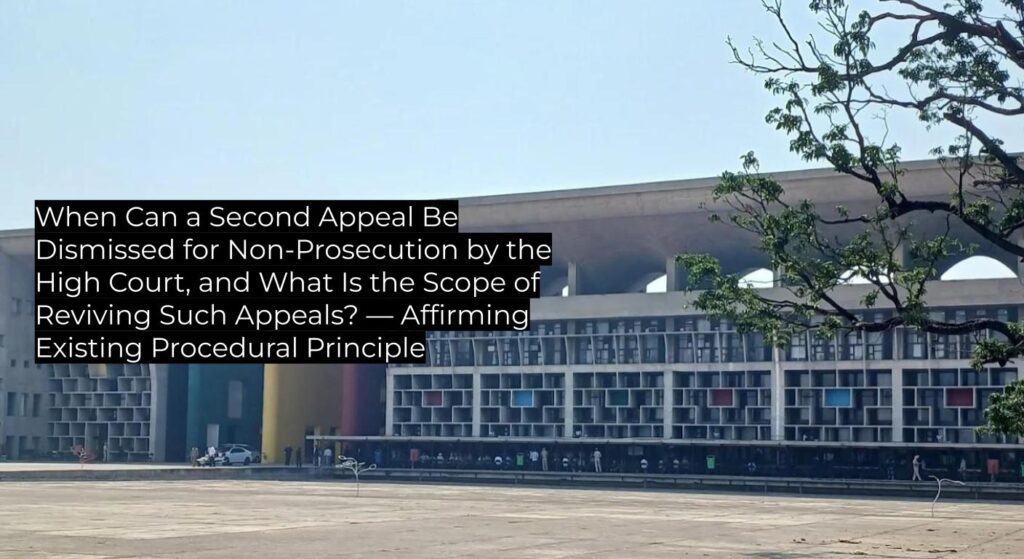
The High Court reaffirmed that where an appellant and their counsel are unavailable despite service of notice, a second appeal may be dismissed for non-prosecution, but the appellant retains the right to seek restoration by demonstrating sufficient cause; this ruling upholds existing procedural norms and serves as binding authority for future cases within the jurisdiction.
Summary
| Category | Data |
|---|---|
| Case Name | RSA/2073/1994 of PURAN SINGH Vs JAGTAR MOHINDER SINGH |
| CNR | PHHC010292701994 |
| Date of Registration | 20-09-2008 |
| Decision Date | 28-10-2025 |
| Disposal Nature | DISMISSED |
| Judgment Author | MR. JUSTICE PARMOD GOYAL |
| Court | High Court of Punjab and Haryana |
| Bench | Single judge (MR. JUSTICE PARMOD GOYAL) |
| Precedent Value | Binding within Punjab and Haryana High Court’s jurisdiction |
| Type of Law | Procedural |
| Ratio Decidendi |
The appeal was dismissed for non-prosecution as the appellant could not be served at the available address and the counsel had expired, with no fresh address available. The court held that, in such circumstances, when the appellant is not traceable and no legal representation is available, the proper course is to dismiss the appeal for non-prosecution. However, liberty is granted to the appellant to seek revival of the appeal by showing sufficient cause for absence or non-appearance. This affirms the procedural mechanism for dismissal and possible restoration of appeals in case of non-prosecution. |
Practical Impact
| Category | Impact |
|---|---|
| Binding On | All subordinate courts and benches within the jurisdiction of the Punjab and Haryana High Court |
| Persuasive For | Other High Courts |
What’s New / What Lawyers Should Note
- Reaffirms that High Courts may dismiss second appeals for non-prosecution when appellant and counsel are untraceable and no fresh address or representation is on record.
- Clarifies that such dismissal is not absolute; the appellant retains the right to seek restoration by showing sufficient cause.
- Lawyers should monitor address/service records and ensure alternate representations when original counsel is no longer available to avoid dismissal.
Summary of Legal Reasoning
- The court verified the office report indicating that notice sent to the appellant was returned unserved, with the appellant not found at the recorded address.
- It was observed that appellant’s counsel had expired and no new address or alternate counsel was provided by the appellant.
- In the absence of appellant or representative, and having satisfied itself of due process, the court dismissed the appeal for non-prosecution.
- The order expressly grants liberty to the appellant to seek revival by showing “sufficient cause,” in line with procedural fairness.
Arguments by the Parties
Petitioner (Appellant):
- No representation; none present for appellant.
Respondent:
- Represented by Mr. Manish Prabhakar, Advocate.
- No substantive arguments recorded beyond presence.
Factual Background
- A second appeal was filed in 1994 and registered on 20-09-2008.
- Office report showed that notice to the appellant was unserved as appellant was not found at the provided address.
- The counsel for the appellant passed away some time ago, and no new address or counsel details were available on record.
- The court, having found non-appearance and lack of representation, proceeded to dismiss the appeal for non-prosecution.
Statutory Analysis
- The judgment applied procedural law governing dismissal for non-prosecution (as per High Court’s inherent procedural powers).
- The decision affirms the power of the court to grant restoration/recall of such an order upon sufficient cause being shown by the party aggrieved.
Dissenting / Concurring Opinion Summary
No concurring or dissenting opinion; single judge bench.
Procedural Innovations
None specified; followed established procedure for dismissal for non-prosecution and provision for restoration upon sufficient cause.
Alert Indicators
- ✔ Precedent Followed – Existing procedural law regarding dismissal and possible restoration was affirmed.