


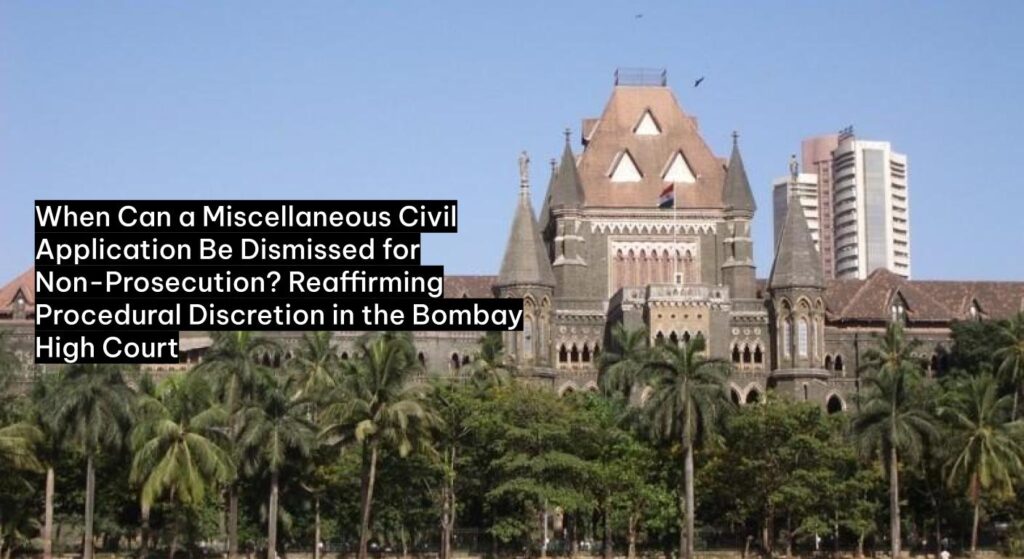
The judgment reiterates the High Court’s authority to dismiss a Miscellaneous Civil Application for want of prosecution when parties remain absent despite repeated opportunities. The ruling upholds established precedent concerning procedural discipline and is binding on subordinate courts within the jurisdiction.
Summary
| Category | Data |
|---|---|
| Case Name | MCA/100/2025 of PRIYA W/O MAYUR BHAGWAT Vs MAYUR S/O PRALHADRAO BHAGWAT |
| CNR | HCBM040045602025 |
| Date of Registration | 10-02-2025 |
| Decision Date | 10-09-2025 |
| Disposal Nature | DISMISSED |
| Judgment Author | HON’BLE SHRI JUSTICE PRAVIN S. PATIL |
| Court | Bombay High Court |
| Precedent Value | Binding on subordinate courts within Bombay High Court’s jurisdiction |
| Type of Law | Procedural law |
| Ratio Decidendi |
When a party fails to appear and show interest in prosecuting their Miscellaneous Civil Application despite repeated listings and opportunities, the court is empowered to dismiss the matter for want of prosecution. The repeated absence of the applicant signifies a lack of interest in prosecuting the case, justifying dismissal. This principle maintains procedural discipline and the effective functioning of the judicial process. |
| Facts as Summarised by the Court | The applicant failed to appear before the court on multiple consecutive dates (18.07.2025, 25.07.2025, 07.08.2025, and 10.09.2025). Given this, the Court concluded lack of interest and dismissed the application for want of prosecution. |
Practical Impact
| Category | Impact |
|---|---|
| Binding On | All subordinate courts within the jurisdiction of the Bombay High Court |
| Persuasive For | May be cited before other High Courts for procedural discipline in similar circumstances |
What’s New / What Lawyers Should Note
- The judgment reaffirms the long-standing principle that persistent non-appearance by an applicant justifies dismissal of a civil application for want of prosecution.
- Lawyers must ensure proactive follow-up and regular representation in listed matters to avoid summary dismissal.
- The court is not obligated to indefinitely adjourn matters in the absence of diligence by the parties.
Summary of Legal Reasoning
- The court noted that the applicant was absent on three previous occasions (18th July, 25th July, and 7th August 2025) and again on the present date (10th September 2025).
- An earlier order specifically warned that the matter would be listed under the caption of ‘dismissal’ if the applicant failed to appear.
- The continued absence of the applicant was treated as manifest disinterest in prosecuting the matter.
- On that basis, the court exercised its discretion to dismiss the Miscellaneous Civil Application for want of prosecution, ensuring procedural efficiency and finality.
Arguments by the Parties
Petitioner
No arguments were advanced or submissions made by the petitioner/applicant due to continued absence.
Respondent
No submissions are recorded in the order.
Factual Background
The applicant instituted a Miscellaneous Civil Application before the Bombay High Court, registered on 10-02-2025. Despite multiple opportunities and adjournments (on 18.07.2025, 25.07.2025, and 07.08.2025), the applicant repeatedly failed to appear. The court placed the matter under the caption ‘dismissal’ and, on finding continued absence on 10.09.2025, dismissed the application for want of prosecution.
Statutory Analysis
- No specific statutory sections are interpreted in the judgment.
- The decision turns on the inherent procedural power of the court to dismiss matters for non-prosecution when parties, despite warnings and repeated opportunities, fail to appear or show interest.
Dissenting / Concurring Opinion Summary
The judgment is authored by a single judge; no dissenting or concurring opinions are recorded.
Procedural Innovations
The judgment does not indicate any new procedural innovations; it applies established procedure for dismissal of cases due to non-appearance and want of prosecution.
Alert Indicators
- ✔ Precedent Followed – The judgment affirms the established procedural law regarding dismissal for non-prosecution.