


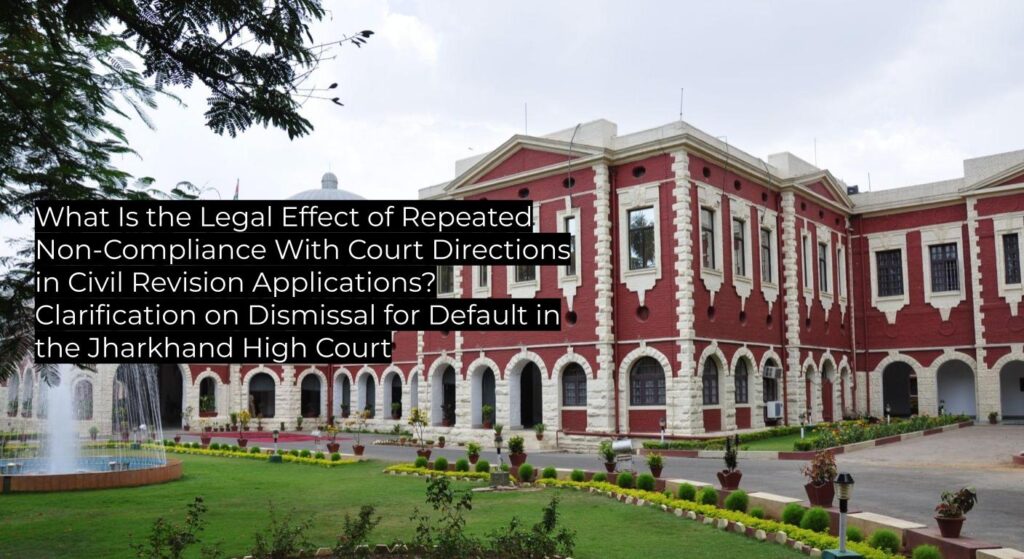
The Jharkhand High Court reaffirms the established principle that persistent failure to comply with court orders or take procedural steps constitutes valid grounds for dismissal of a civil revision for non-prosecution. The judgment upholds existing precedent, confirming binding procedural standards for litigants in similar applications.
Summary
| Category | Data |
|---|---|
| Case Name | C.R./8/2022 of SURJEET GHOSH ALIAS SURJIT GHOSH Vs MS NUND AND SAMONT COMPANY PRIVATE LIMITED THROUGH ITS MANAGING DIRECTOR AND PRINCIPAL OFFICER |
| CNR | JHHC010156342022 |
| Date of Registration | 11-05-2022 |
| Decision Date | 31-10-2025 |
| Disposal Nature | Dismiss For Default/Non-Prosecution |
| Judgment Author | HON’BLE MR. JUSTICE PRADEEP KUMAR SRIVASTAVA |
| Court | High Court of Jharkhand |
| Precedent Value | Binding on subordinate courts within Jharkhand; persuasive elsewhere |
| Type of Law | Civil Procedure |
| Ratio Decidendi |
The court held that failure to comply with repeated opportunities and directions for procedural steps, such as effecting substituted service, coupled with prolonged inaction after restoration, demonstrates lack of interest in prosecuting the case and justifies dismissal for non-prosecution. The court reaffirmed its inherent power to dismiss for default where procedural obligations are not fulfilled, reflecting the necessity for litigants to diligently comply with court orders. |
| Facts as Summarised by the Court |
The petitioner failed to effect substituted service on opposite parties despite repeated extensions over several months. The civil revision was earlier dismissed for default, restored on an application, but again no action was taken for nearly a year. The court inferred a lack of diligence and dismissed the matter for non-prosecution. |
Practical Impact
| Category | Impact |
|---|---|
| Binding On | All subordinate courts within the jurisdiction of the Jharkhand High Court |
| Persuasive For | Other High Courts and tribunals considering similar procedural defaults |
What’s New / What Lawyers Should Note
- Reiterates that unreasonable and repeated failure to comply with court directions, even after restoration of a petition, may result in dismissal for non-prosecution.
- Lawyers must ensure prompt and diligent compliance with procedural orders, particularly regarding service of notice, to avoid dismissal of their clients’ cases.
- Restoration of a matter does not absolve the petitioner from fulfilling procedural requirements within the stipulated periods.
Summary of Legal Reasoning
- The court reviewed the history of non-compliance by the petitioner, including the failure to effect substituted service despite repeated extensions and opportunities.
- Emphasized that after the matter was dismissed for default and subsequently restored, the petitioner again failed to take the required procedural steps for nearly a year.
- Held that the repeated neglect and inaction reflected a lack of interest in pursuing the case.
- Concluded that dismissal for non-prosecution was warranted, reinforcing the principle that courts are justified in striking out cases where litigants do not diligently comply with procedural obligations.
Arguments by the Parties
Petitioner
No appearance; no submissions recorded at the hearing.
Respondent (Opposite Party No.1)
Appeared through counsel. No specific arguments set out in the judgment.
Factual Background
The petitioner filed a civil revision application but failed to serve notice to the opposite parties as directed by the court. Despite repeated grants of time and even after restoration of the case following an earlier dismissal for default, the petitioner did not take steps for substituted service for almost a year. This persistent non-compliance and inaction resulted in dismissal for non-prosecution.
Statutory Analysis
- The judgment reaffirms the court’s power to dismiss civil revisions for default/non-prosecution based on long-standing procedural principles.
- No specific statutory section is interpreted in detail; the court acts upon its inherent procedural authority to enforce compliance with its directions.
Alert Indicators
- ✔ Precedent Followed – Existing law regarding dismissal for default/non-prosecution for failure to comply with court orders is reaffirmed.