


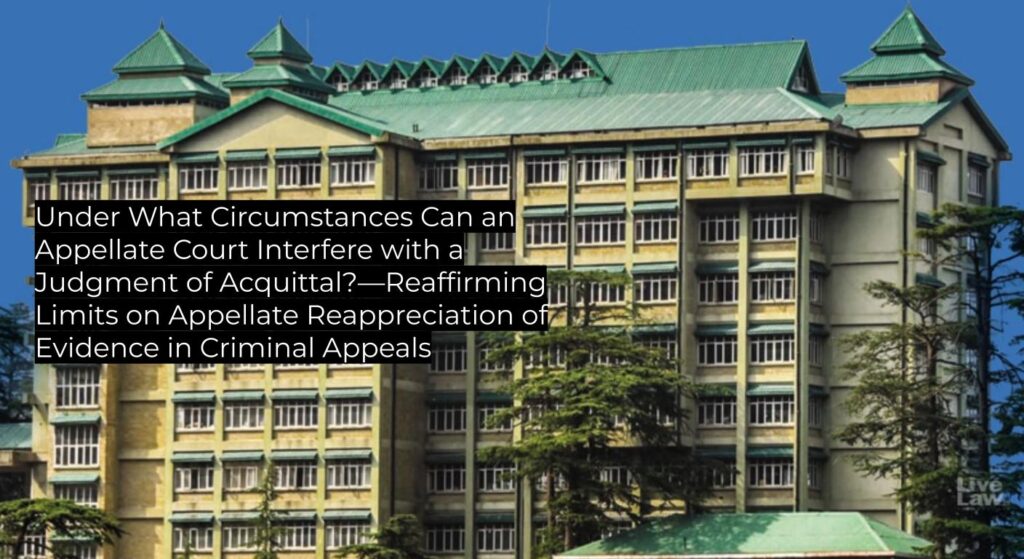
The judgment reiterates that interference with acquittal is permissible only if the trial court’s decision is perverse, based on misreading or omission of material evidence, or if no reasonable view except guilt is possible; merely finding another possible view is insufficient. This ruling upholds existing Supreme Court precedent and serves as binding authority for courts in Himachal Pradesh on the scope of appeals against acquittal in criminal cases.
Summary
| Category | Data |
|---|---|
| Case Name | CR.A/135/2013 of STATE OF HP Vs Sanjay Guleria |
| CNR | HPHC010331992013 |
| Date of Registration | 17-05-2014 |
| Decision Date | 31-10-2025 |
| Disposal Nature | Dismissed |
| Judgment Author | Hon’ble Mr. Justice Rakesh Kainthla |
| Court | High Court of Himachal Pradesh |
| Bench | Single Bench: Hon’ble Mr. Justice Rakesh Kainthla |
| Precedent Value | Binding on subordinate courts in Himachal Pradesh |
| Overrules / Affirms | Affirms existing Supreme Court precedents on scope of appeals against acquittal |
| Type of Law | Criminal Procedure |
| Questions of Law | Under what circumstances can an appellate court interfere with an order of acquittal in a criminal case? |
| Ratio Decidendi |
|
| Judgments Relied Upon |
|
| Logic / Jurisprudence / Authorities Relied Upon by the Court | Supreme Court principles on limits of interference in appeals against acquittal; the “double presumption” of innocence; the imperative for restraint where two reasonable views exist. |
| Facts as Summarised by the Court | The respondent was acquitted by the trial court of offences under Sections 279, 337 IPC and Section 187 of the Motor Vehicles Act, relating to a road accident with injuries. The prosecution alleged negligence on the part of the bus driver. The trial court found contradictions and lack of reliable eyewitnesses, doubting the involvement of the respondent’s bus. The State appealed against acquittal, arguing improper appreciation of evidence. |
Practical Impact
| Category | Impact |
|---|---|
| Binding On | All subordinate courts in Himachal Pradesh |
| Persuasive For | Other High Courts |
| Follows |
|
What’s New / What Lawyers Should Note
- Reaffirms that appellate interference with acquittal is strictly limited to cases of patent perversity, misreading or omission of material evidence, or where no reasonable alternative view exists.
- Cites and summarises current Supreme Court precedents on Section 378 CrPC appeals, reinforcing the double presumption of innocence for acquitted persons.
- Clarifies that minor contradictions and absence of some corroboration do not automatically justify overturning a trial court’s acquittal if the trial court’s view is reasonably possible.
- Lawyers for appellants must specifically demonstrate perversity or legal error, not merely an alternative reading of facts, to succeed on appeal against acquittal.
Summary of Legal Reasoning
- The court emphasised it was bound by the settled law from the Supreme Court regarding appeals against acquittal, specifically citing Surendra Singh v. State of Uttarakhand, Babu Sahebagouda Rudragoudar v. State of Karnataka, and Chandrappa v. State of Karnataka.
- The principles reiterated include: (1) the appellate court can reappreciate evidence but should not interfere unless the acquittal is perverse, ignores material evidence, or is not a plausible view on evidence; (2) double presumption of innocence for acquitted accused; (3) if two views are reasonably possible, the acquittal should not be disturbed.
- In the facts, the prosecution’s case was marred by contradictions, absence of credible eyewitness testimony, and failure to prove exclusive involvement of the respondent’s bus.
- The trial court’s acquittal was based on doubts arising from evidence, and such a view was found to be reasonable, thus not calling for appellate interference.
Arguments by the Parties
Appellant (State):
- Argued that the prosecution’s case was established beyond reasonable doubt and the trial court erred in discarding prosecution evidence.
- Asserted that minor contradictions were unduly magnified and did not fatally weaken the prosecution’s case.
- Submitted that medical evidence corroborated the complainant’s version and the trial court failed to account for injuries to the victim.
- Prayed for reversal of acquittal, arguing for re-appreciation in light of material evidence.
Respondent (Accused):
- Supported the trial court’s judgment.
- Emphasised no grounds for appellate interference as the trial court’s acquittal rested on reasonable doubts and proper appreciation of evidence.
Factual Background
A criminal case was registered alleging that the respondent, driving a bus, caused injury to the informant Raj Kumar in a road accident on 23rd February 2003. The FIR was lodged under Sections 279, 337 IPC and Section 187 of the Motor Vehicles Act. Investigation revealed contradictions: the registration number was missing from the initial report, timeline discrepancies arose, and supporting witnesses did not corroborate key aspects. The trial court, citing these contradictions and gaps, acquitted the accused. The State appealed, claiming improper appreciation of the evidence.
Statutory Analysis
- Section 378, Code of Criminal Procedure, 1973: Sets out the appellate jurisdiction of High Courts over acquittals, interpreted strictly as per Supreme Court precedent.
- Section 313, Code of Criminal Procedure: Statement of the accused used to test prosecution’s case.
- Section 279, 337 IPC and Section 187, Motor Vehicles Act: Offence provisions forming basis of prosecution.
- Section 437-A, CrPC / Section 481, BNSS: Requirement for a bond by the acquitted accused in anticipation of possible further appeals.
- The judgment adopts a restrained approach in line with Supreme Court guidance, limiting the scope of appellate intervention.
Procedural Innovations
- Direction to the acquitted respondent/accused to furnish a personal bond under Section 437-A CrPC (and Section 481 of BNSS, 2023) in anticipation of possible Supreme Court proceedings, specifying amount, surety, and time-frame.
Alert Indicators
- ✔ Precedent Followed – The judgment strictly follows and applies existing Supreme Court precedent regarding appellate powers over acquittal.