


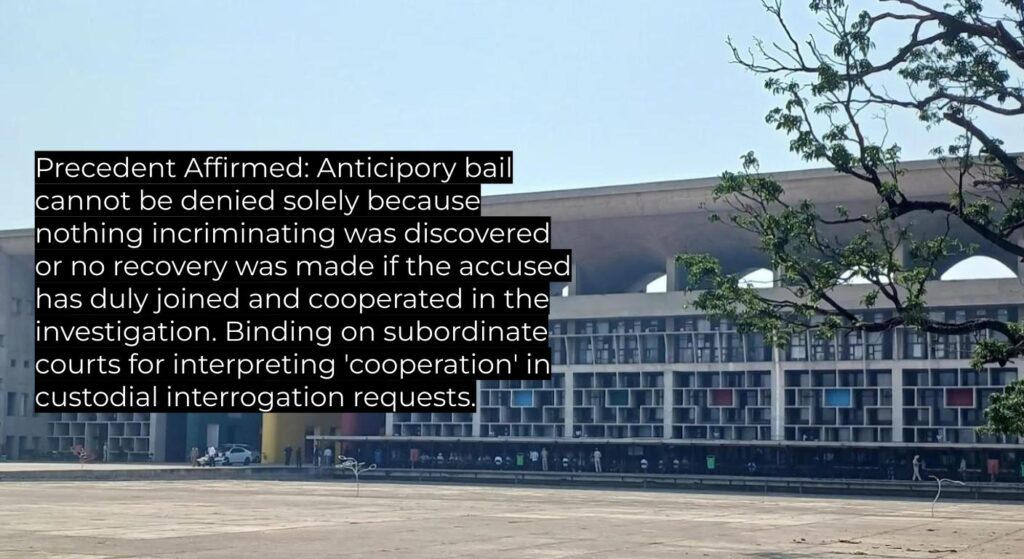
The High Court clarified that “cooperation in investigation” means making oneself available and responding to lawful queries—not necessarily yielding discovery or recovery. Existing Supreme Court and High Court jurisprudence is upheld; custodial interrogation cannot be insisted on absent compelling grounds. This decision carries binding precedent value within Punjab & Haryana, guiding future anticipatory bail matters.
Summary
| Category | Data |
|---|---|
| Case Name | CRM-M/51678/2025 of Gurmeet Sagar vs. State of Punjab |
| CNR | PHHC011485382025 |
| Date of Registration | 11-09-2025 |
| Decision Date | 30-10-2025 |
| Disposal Nature | ALLOWED |
| Judgment Author | Mrs. Justice Manisha Batra |
| Court | High Court of Punjab & Haryana |
| Precedent Value | Binding within territorial jurisdiction; persuasive elsewhere |
| Type of Law | Criminal Procedure (Anticipatory Bail under Bharatiya Nagarik Suraksha Sanhita, 2023) |
| Questions of Law |
|
| Ratio Decidendi |
Once an accused joins investigation, the absence of discovery/recovery does not per se constitute non-cooperation. ‘Cooperation’ implies availability for investigation and responding to lawful queries, not compulsory self-incrimination or forced recovery. Custodial interrogation is justified only if compelling grounds exist beyond mere non-discovery. The accused’s pre-trial liberty should not be curtailed merely because incriminating material was not found or recovery not effected; anticipatory bail should not be denied on this ground alone. Reliance placed on Santosh v. State of Maharashtra (2017) 9 SCC 714 and Jugraj Singh v. State of Punjab, SLP (Crl) No.9190/2025. Pre-trial incarceration is not to mirror post-conviction detention. |
| Judgments Relied Upon | Santosh v. State of Maharashtra (2017) 9 SCC 714; Jugraj Singh v. State of Punjab, SLP (Crl.) No.9190/2025 (20.08.2025) |
| Logic / Jurisprudence / Authorities Relied Upon by the Court | The purpose of joining investigation is making oneself available and answering lawful queries. The absence of discovery/recovery does not automatically mean non-cooperation. Custodial interrogation is not justified unless specific facts warrant it. |
| Facts as Summarised by the Court | The petitioner was granted interim anticipatory bail and joined investigation after FIR No. 123 dated 16.07.2025 under Sections 318(4), 316(2), and 61(2) of BNS was registered. State opposed, citing non-cooperation due to absence of recovery/discovery, but the Court found the petitioner had duly joined and participated in investigation. |
Practical Impact
| Category | Impact |
|---|---|
| Binding On | All subordinate courts under the jurisdiction of Punjab & Haryana High Court |
| Persuasive For | Other High Courts, Supreme Court |
| Follows | Santosh v. State of Maharashtra (2017) 9 SCC 714; Jugraj Singh v. State of Punjab, SLP (Crl.) No.9190/2025 |
What’s New / What Lawyers Should Note
- The judgment reaffirms that “cooperation” in investigation, for anticipatory bail purposes, is satisfied by appearance and responding to lawful questioning—not by yielding recovery or confessions.
- Non-discovery or absence of recovery cannot, by itself, be used by prosecution as grounds for custodial interrogation or to oppose anticipatory bail if the accused has otherwise cooperated.
- Reliance placed on latest Supreme Court/High Court rulings (Santosh v. State of Maharashtra, Jugraj Singh v. State of Punjab) reinforces binding value.
- Lawyers may cite this judgment to counter objections based on lack of recovery/discovery when clients have met investigation obligations.
Summary of Legal Reasoning
- The Court examined the prosecution’s claim that the petitioner had not cooperated because “no recovery” had been made.
- It relied on Santosh v. State of Maharashtra and Jugraj Singh v. State of Punjab to underscore that cooperation means presence before Investigating Officer and answering questions, not effecting recovery or making incriminating disclosures.
- The legal principle followed is that the right against self-incrimination and the obligation to cooperate are not contradictory: cooperation is met by appearance and participation, not by producing evidence against oneself.
- The Court found no compelling reason for custodial interrogation, noting that pre-trial incarceration should be exceptional.
- The petition was allowed, converting interim relief to absolute anticipatory bail under Section 482(2) BNSS.
Arguments by the Parties
Petitioner
- Had joined investigation as directed by the Court.
- Cooperated with Investigating Officer by appearing and participating in investigation.
Respondent (State)
- Alleged petitioner did not cooperate because nothing incriminating was discovered and no recovery was made.
- Sought custodial interrogation on this ground and opposed grant of anticipatory bail.
Factual Background
An FIR (No. 123 dated 16.07.2025) was registered at Police Station Sadar Kotkapura, District Faridkot under Sections 318(4), 316(2), and 61(2) of Bharatiya Nyaya Sanhita, 2023 against the petitioner. The petitioner was granted interim anticipatory bail and joined the investigation on 21.09.2025. The State opposed regular bail asserting non-cooperation due to lack of recovery/discovery, which was the crux of the bail hearing.
Statutory Analysis
- Section 482, Bharatiya Nagarik Suraksha Sanhita, 2023 (analogous to Section 438(2) CrPC) interpreted.
- The section empowers the court to grant anticipatory bail with conditions; interpretation focused on whether ‘cooperation’ includes compulsory recovery or is limited to appearing and responding to investigation.
- No provision in BNSS requires forced self-incrimination or discovery for satisfaction of conditions.
Procedural Innovations
- Affirmed that mere absence of recovery/discovery is not procedural non-cooperation; sets precedent on what constitutes cooperation for anticipatory bail under BNSS.
- No new guidelines or procedural reforms, but confirmation of existing standards for investigative cooperation.
Alert Indicators
- ✔ Precedent Followed – Existing law on anticipatory bail and investigative cooperation is affirmed.