


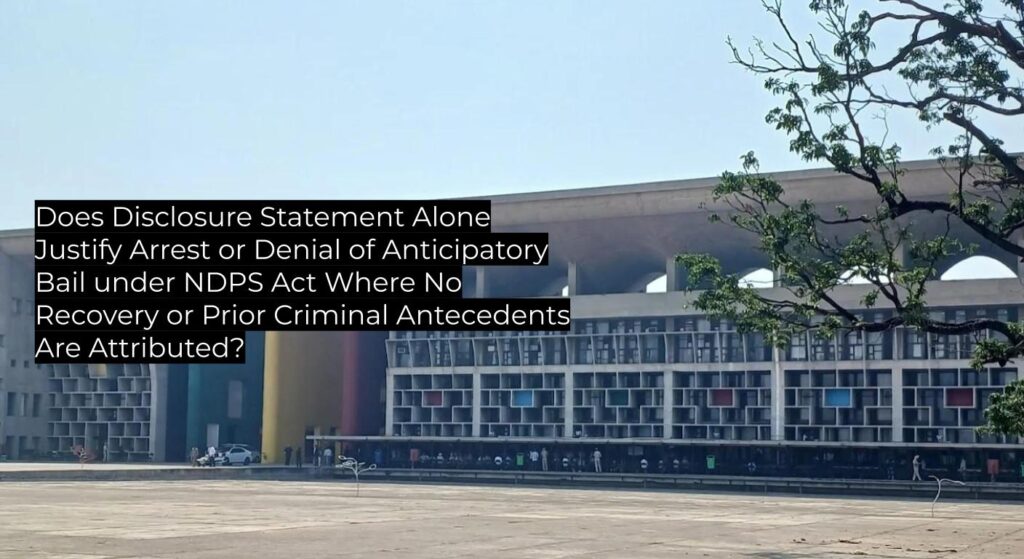
Court holds that anticipatory bail can be confirmed under Section 482 BNSS, 2023, even in NDPS Act cases, where the accused was not present at the scene, has no prior criminal record, and is only implicated by a disclosure statement. The judgment upholds previous precedent, specifically referencing Ashu v. State of Punjab and Jugraj Singh v. State of Punjab, and provides binding authority within its jurisdiction.
Summary
| Category | Data |
|---|---|
| Case Name | CRM-M/10045/2025 of LOVEPREET SINGH ALIAS LOVE Vs STATE OF PUNJAB |
| CNR | PHHC010275902025 |
| Date of Registration | 19-02-2025 |
| Decision Date | 01-09-2025 |
| Disposal Nature | ALLOWED |
| Judgment Author | MR. JUSTICE SUMEET GOEL |
| Court | High Court of Punjab and Haryana |
| Precedent Value | Binding on subordinate courts within jurisdiction; persuasive elsewhere |
| Overrules / Affirms | Affirms prior High Court and Supreme Court judgments |
| Type of Law | Criminal Law; Bail; NDPS Act; Procedure under BNSS |
| Questions of Law | Whether anticipatory bail is maintainable under Section 482 BNSS, 2023 for NDPS Act offences when accused is not apprehended at the spot and lacks prior criminal antecedents. |
| Ratio Decidendi |
The Court held that anticipatory bail can be confirmed under Section 482 BNSS, 2023, even in grave offences under the NDPS Act, when the accused has not been apprehended at the spot, is implicated only by a disclosure statement, and has no prior criminal record. The actual involvement of the petitioner was not established by any direct evidence or prior information. The petitioner’s cooperation with the investigation, absence of need for further custodial interrogation, and specific facts of being named only in co-accused’s disclosure justified the confirmation of interim bail. The Court relied on prior judgments (Ashu v. State of Punjab; Jugraj Singh v. State of Punjab) to reaffirm this approach. Bail was made subject to conditions under Section 482(2) BNSS, 2023, and not granted as an indefinite or blanket order. |
| Judgments Relied Upon |
|
| Logic / Jurisprudence / Authorities Relied Upon | The Court highlighted the absence of direct evidence, lack of prior criminal antecedents, and procedural safeguards under Section 482(2) BNSS, along with authoritative precedents supporting anticipatory bail in similar circumstances. |
| Facts as Summarised by the Court | The petitioner was granted interim anticipatory bail as he was not apprehended at the spot; his involvement in the alleged offence under NDPS Act was based solely on the co-accused’s disclosure statement. There was no prior criminal record against him. The petitioner joined the investigation and was not required for further custodial interrogation. |
Practical Impact
| Category | Impact |
|---|---|
| Binding On | All subordinate courts within the jurisdiction of the Punjab & Haryana High Court |
| Persuasive For | Other High Courts, Supreme Court |
| Follows |
|
What’s New / What Lawyers Should Note
- Reaffirms that being named only in a co-accused’s disclosure statement—without direct evidence or prior information—is insufficient to deny anticipatory bail under Section 482 BNSS, 2023, in NDPS cases.
- Lack of prior criminal antecedents and non-apprehension at the scene of offence are critical factors supporting anticipatory bail.
- Court confirms that bail orders under Section 482 BNSS, 2023, can be made absolute if the accused has cooperated with the investigation and custodial interrogation is not required.
- Any such bail order is not a “blanket” protection and is strictly confined to the FIR in question.
- State/complainant retains liberty to seek cancellation of bail on violation of conditions or for sufficient cause.
Summary of Legal Reasoning
- The Court considered the absence of direct evidence implicating the petitioner (not apprehended at the spot; implication based solely on disclosure statement).
- State acknowledged no prior criminal antecedents of the petitioner, nor any specific secret information against him.
- The petitioner’s cooperation by joining the investigation and the State’s statement that further custodial interrogation was not needed were viewed as key mitigating factors.
- The Court relied on the rationale in CRM-M-54032-2024 ‘Ashu v. State of Punjab’ and SLP (Crl.) No.9190/2025 ‘Jugraj Singh v. State of Punjab’, wherein similar facts warranted grant or confirmation of anticipatory bail.
- Stipulated conditions as per Section 482(2) BNSS, 2023, ensuring limited scope and future recourse for the State/complainant in case of breach.
- Emphasized that the current bail order pertains only to the present FIR and is not to be construed as a blanket or perpetual immunity.
Arguments by the Parties
Petitioner
- Petitioner was not apprehended at the spot.
- Implicated only on the basis of the co-accused’s disclosure statement.
- No prior criminal antecedents.
- Has already joined investigation.
Respondent (State)
- Confirmed petitioner was not apprehended at the spot.
- Acknowledged no prior criminal record or specific secret information against the petitioner.
- Stated the accused joined investigation and is not required for further custodial interrogation.
Factual Background
The case concerns registration of an FIR under Sections 21(c), 25, 27-A, 61, 85 (Section 29) of the NDPS Act, 1985 at Police Station Jandiala, Amritsar. The petitioner was not apprehended at the crime scene; instead, his name surfaced only in the co-accused’s disclosure statement. There was no prior criminal record against him. During the pendency of interim anticipatory bail, the petitioner joined the investigation.
Statutory Analysis
- Analysis centered on Section 482 of the BNSS, 2023—confirming that anticipatory bail can be granted at the court’s discretion in appropriate circumstances, even in NDPS Act cases.
- Section 482(2) of BNSS, 2023 explicitly empowers the Court to impose conditions and grant interim as well as absolute anticipatory bail, subject to safeguards.
- The order clarifies that such relief does not amount to a blank cheque and is strictly confined to the particular FIR.
- No further statutory sections discussed or interpreted within the judgment.
Procedural Innovations
- Affirmed the practice of granting liberty to the State/complainant to seek cancellation/recall of bail upon violation of any condition.
- Order makes explicit that bail protection is not “blanket” and applies only to the specific FIR.
Alert Indicators
- ✔ Precedent Followed – When existing law is affirmed.
Citations
- CRM-M-54032-2024 ‘Ashu Vs. State of Punjab’
- SLP (Crl.) No.9190/2025 ‘Jugraj Singh Vs. State of Punjab’