


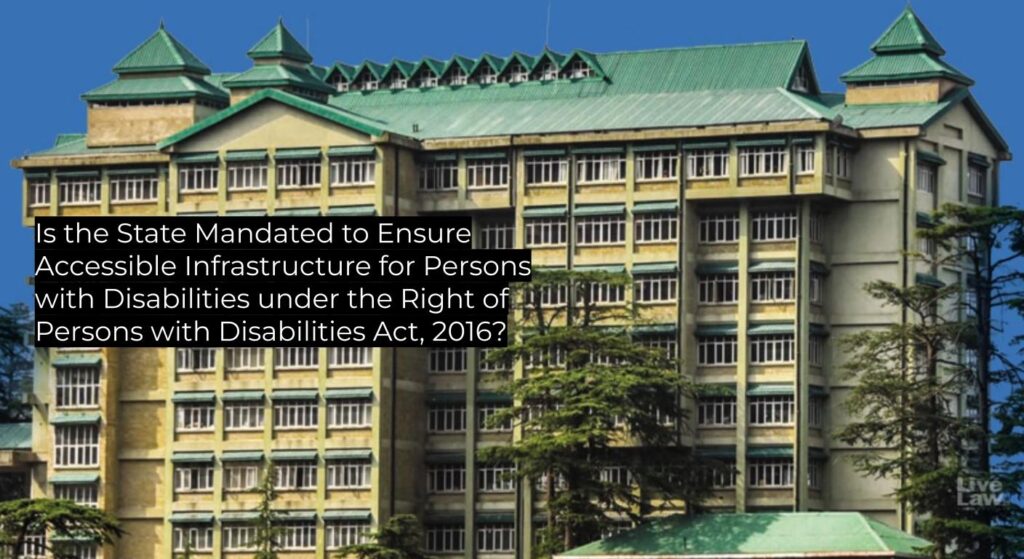
The High Court expressly directs State authorities to provide barrier-free infrastructure as required by Sections 3 and 16 of the Right of Persons with Disabilities Act, 2016. This decision upholds the statutory right of individuals with disabilities to accessible public facilities and reaffirms the binding nature of these duties for all State functionaries in Himachal Pradesh.
Summary
| Category | Data |
|---|---|
| Case Name | CWP/13466/2024 of TANYA SHARMA Vs THE STATE OF HP AND OTHERS |
| CNR | HPHC010582782024 |
| Date of Registration | 22-11-2024 |
| Decision Date | 15-10-2025 |
| Disposal Nature | Disposed Off |
| Judgment Author | Hon’ble Mr. Justice Ajay Mohan Goel |
| Court | High Court of Himachal Pradesh |
| Bench | Single Judge Bench |
| Precedent Value | Binding on subordinate courts in Himachal Pradesh |
| Type of Law | Constitutional/Disability Rights Law/Administrative Law |
| Questions of Law | Whether the State is legally bound to provide accessible infrastructure and essential facilities to persons with disabilities, as mandated by the Right of Persons with Disabilities Act, 2016? |
| Ratio Decidendi |
The court held that statutory duties under Sections 3 and 16 of the Right of Persons with Disabilities Act, 2016 require the State to ensure barrier-free accessibility to public facilities for persons with disabilities. In light of the State’s undertaking to execute the infrastructural works and secure necessary funds, the court directed the authorities to complete the construction of the access road by a specified deadline, thus securing the petitioner’s statutory and constitutional rights. |
| Facts as Summarised by the Court |
The petitioner, a person with cerebral palsy, sought mandamus directing the State to construct a link road for barrier-free access to education and medical facilities, invoking provisions of the Right of Persons with Disabilities Act, 2016. The State indicated administrative action to prepare estimates, secure funds, and direct officials to commence work. |
Practical Impact
| Category | Impact |
|---|---|
| Binding On | All subordinate courts in Himachal Pradesh |
| Persuasive For | Other High Courts and public authorities regarding disability accessibility obligations |
What’s New / What Lawyers Should Note
- The judgment affirms the binding obligation of State authorities under the Right of Persons with Disabilities Act, 2016, to ensure accessible public infrastructure.
- Sections 3 and 16 of the Act are directly enforceable through writ petitions where the State fails to provide accessibility.
- Direction to the authorities includes both initiation of works and securing of required funds, with a fixed completion timeline.
- Lawyers may rely on this precedent to seek time-bound court directions against administrative inaction in similar contexts.
Summary of Legal Reasoning
- The court considered the petitioner’s statutory rights under Sections 3 and 16 of the Right of Persons with Disabilities Act, 2016, which require the State to provide for barrier-free access to essential services.
- Upon ascertaining administrative measures and assurances from the respondent-State, including preparation of estimates, initiation of construction, and requests for fund allocation, the court found no further impediment to granting relief.
- The writ was accordingly disposed of by directing the State machinery to complete the infrastructure work within a fixed timeframe, reinforcing the statutory mandate.
- The court’s approach was to ensure direct enforcement of statutory provisions pertaining to accessibility for persons with disabilities.
Arguments by the Parties
Petitioner
- Sought writ of mandamus directing the State to build a link road to her house per the sanctioned order to enable access to education and medical institutions.
- Invoked Sections 3 and 16 of the Right of Persons with Disabilities Act, 2016, citing barrier-free access as a statutory right.
- Requested provision of all necessary facilities related to her disability (cerebral palsy) including physical access to public services.
Respondents (State Authorities)
- Submitted an affidavit stating that a fresh estimate for the road construction had been prepared.
- Stated that the Block Development Officer was instructed to initiate construction and had sought necessary police and administrative support.
- Affirmed that steps were being taken to secure required funds from the Deputy Commissioner.
Factual Background
The petitioner, suffering from cerebral palsy and permanently restricted to a wheelchair, filed for a writ of mandamus to direct the State to construct a sanctioned link road to her residence, as the lack of access prevented her from reaching education and medical institutions. The petition invoked statutory rights under the Right of Persons with Disabilities Act, 2016. During proceedings, the State authorities prepared a fresh estimate, initiated construction steps, and moved to allocate the necessary funds.
Statutory Analysis
- The judgment engages with Sections 3 and 16 of the Right of Persons with Disabilities Act, 2016.
- Section 3 sets out equality and non-discrimination principles for persons with disabilities.
- Section 16 requires appropriate government action to ensure access to educational institutions for children with disabilities, including necessary infrastructure adaptations.
- The court’s order applies these statutory mandates directly, reinforcing their enforceability in administrative action and policy implementation.
Procedural Innovations
- The court required an affidavit from the SDM to clarify administrative impediments, funding, and land-related issues before passing final directions—ensuring transparency and accountability.
- Set a fixed deadline for completing the construction and fund allocation processes, promoting prompt enforcement of statutory mandates.
Alert Indicators
- ✔ Precedent Followed – The judgment affirms and applies existing statutory obligations regarding accessibility for persons with disabilities as mandated by the Right of Persons with Disabilities Act, 2016.