


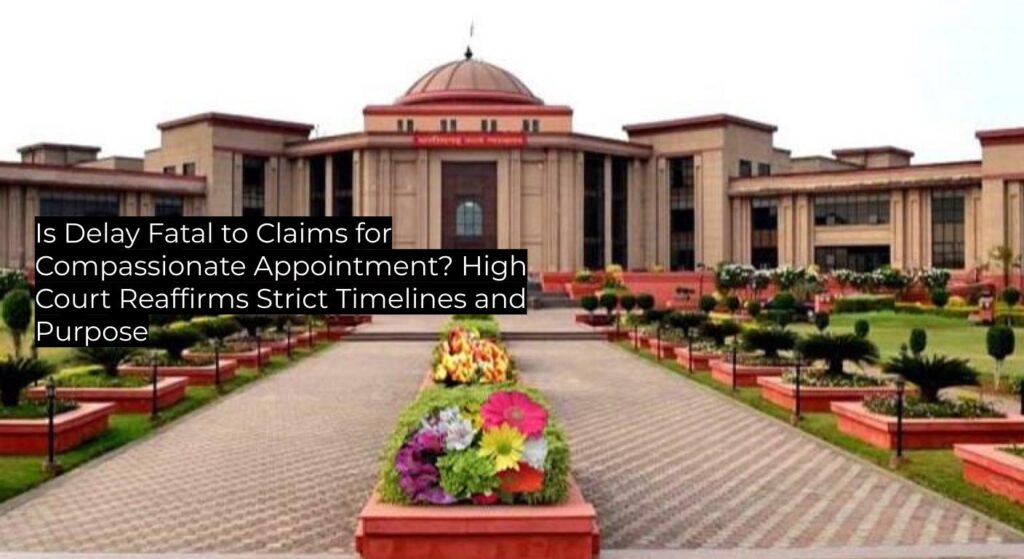
Chhattisgarh High Court upholds that compassionate appointment is solely to provide immediate relief to families of deceased employees, and claims made after considerable delay—where the family has already survived for years—are not maintainable. The Court strictly applies Supreme Court precedents, affirming that delayed claims defeat the object of compassionate appointment and must be rejected. This decision maintains existing precedent and serves as binding authority within Chhattisgarh for service law matters concerning compassionate appointment.
Summary
| Category | Data |
|---|---|
| Case Name | WA/763/2025 of SMT. ASHA DEVI Vs STATE OF CHHATTISGARH |
| CNR | CGHC010432982025 |
| Date of Registration | 17-10-2025 |
| Decision Date | 27-10-2025 |
| Disposal Nature | DISMISSED |
| Judgment Author | HON’BLE THE CHIEF JUSTICE, HON’BLE SHRI JUSTICE BIBHU DATTA GURU |
| Court | High Court of Chhattisgarh at Bilaspur |
| Bench | Division Bench (Chief Justice Ramesh Sinha & Justice Bibhu Datta Guru) |
| Precedent Value | Binding within territorial jurisdiction of Chhattisgarh High Court |
| Overrules / Affirms | Affirms the principles laid down by the Supreme Court in State of Maharashtra & Another v. Ms. Madhuri Maruti Vidhate, AIR Online 2022 SC 471 |
| Type of Law | Service Law — Compassionate Appointment, Government Service |
| Questions of Law | Whether compassionate appointment can be claimed after a long delay, when the family of the deceased employee has already survived for several years and the original object of immediate relief no longer exists. |
| Ratio Decidendi |
The Court reiterated that the purpose of compassionate appointment is to provide immediate financial assistance to the bereaved family to overcome the crisis caused by the sudden demise of the employee. Once several years have elapsed, and when the family has already survived for a long period without such support, the object of the scheme is defeated, and the claim cannot be entertained. Compassionate appointment is not a vested right or a substitute for regular recruitment and must be strictly construed as an exception. The application of policies must be based on the settled legal position that only the policy prevailing at the time of death is relevant, but delay and survival of the family remain fatal to the grant of appointment on compassionate grounds. |
| Judgments Relied Upon | State of Maharashtra & Another v. Ms. Madhuri Maruti Vidhate, AIR Online 2022 SC 471 |
| Logic / Jurisprudence / Authorities Relied Upon by the Court | Compassionate appointment is an exception to the general appointment rules intended only for immediate crisis, not as ongoing entitlement; strict construction is warranted (as laid down by the Supreme Court in cited precedent). |
| Facts as Summarised by the Court | Petitioner’s father died in harness in 1999 as Assistant Teacher; petitioner applied for compassionate appointment in 2012, years after attaining majority. Application rejected due to policy requiring application within three years of death. Writ petition dismissed by Single Judge; appeal also dismissed. |
Practical Impact
| Category | Impact |
|---|---|
| Binding On | All subordinate courts and authorities within the territorial jurisdiction of the Chhattisgarh High Court |
| Persuasive For | Other High Courts and government authorities considering similar cases |
| Follows | State of Maharashtra & Another v. Ms. Madhuri Maruti Vidhate, AIR Online 2022 SC 471 |
What’s New / What Lawyers Should Note
- Reaffirms that delay in seeking compassionate appointment, where family has already survived for years, is fatal to the claim.
- Clearly establishes that compassionate appointment is for immediate relief only, not as a substitute for general recruitment.
- Policies applicable to the claim are to be determined as per the law, but delay and the changed family circumstance override mere policy compliance.
- Provides clear precedent to government authorities to reject delayed claims, even if the policy at the time of death might otherwise permit.
Summary of Legal Reasoning
- The Division Bench examined the factual matrix: the death occurred in 1999, and the application was made only in 2012 after the petitioner attained majority.
- The core judicial reasoning relied on the Supreme Court’s decision in State of Maharashtra & Another v. Ms. Madhuri Maruti Vidhate, holding that compassionate appointment is an exception, intended solely for immediate crisis relief.
- The judgment emphasized that once the family has already survived for a long period, the object of the scheme is frustrated and delayed claims cannot be entertained.
- The Court agreed with the Single Judge’s proper appreciation of settled law and factual circumstances and refused to interfere with a lawful rejection, noting the lack of any perversity, illegality, or jurisdictional error.
- The Bench also outlined that the scope of intra-court appellate review is narrow, reserved only for clear errors, which were not present in this case.
Arguments by the Parties
Petitioner
- Asserted that application for compassionate appointment was promptly made after attaining majority, as per the policy prevailing at the time of the father’s death.
- Argued that subsequent policies (2003) should not have been applied retrospectively.
- Criticized authorities for wrongfully applying the later policy and failing to communicate rejection.
- Cited Supreme Court decisions (Canara Bank v. Ajith Kumar G.K., Indian Bank v. Promila, State of Madhya Pradesh v. Ashish Awasthi) that the policy prevailing on the date of death is the relevant one.
Respondent (State)
- Contended that father died in 1999, but application was not filed until 2012, an inordinate delay.
- Argued that cause of action arose in undivided Madhya Pradesh and hence Chhattisgarh High Court lacked jurisdiction.
- Emphasized that the family had already survived many years, so the purpose of compassionate appointment no longer survives.
Factual Background
The petitioner’s father, employed as an Assistant Teacher, died in harness in June 1999. The petitioner’s mother had died prior to 2012, leaving behind three minor daughters. The petitioner applied for compassionate appointment in May 2012, after attaining majority. The application was rejected in August 2012, citing the 2003 policy mandating filing within three years of death. The petitioner filed a writ petition (WPS No. 6088/2021), challenging the 2012 and subsequent 2021 rejection orders, but the petition was dismissed by the Single Judge, leading to this appeal.
Statutory Analysis
- The Court discussed the compassionate appointment policies of 1994 and 2003.
- Reiterated the legal principle that only the policy prevailing at the time of the employee’s death is relevant for compassionate appointment claims, as expounded in Supreme Court judgments.
- No further provisions were interpreted or read down/expanded.
Dissenting / Concurring Opinion Summary
No separate dissenting or concurring opinions were recorded; both judges concurred.
Procedural Innovations
No new procedural innovations or directions were introduced in the judgment.
Alert Indicators
- ✔ Precedent Followed – Existing Supreme Court law is strictly affirmed and applied.