


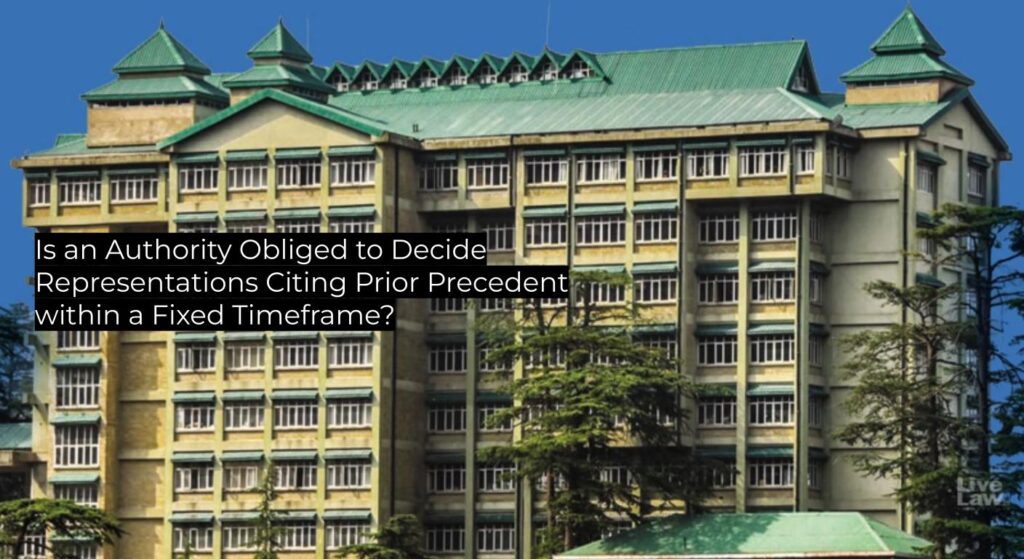
The Himachal Pradesh High Court reaffirmed that authorities must consider and decide pending representations—especially where claimants rely on earlier binding judgments—within a specified period, but without examining the merits or granting substantive relief. This approach upholds existing precedent and only provides limited procedural guidance for future similar writ petitions.
Summary
| Category | Data |
|---|---|
| Case Name | CWP/16292/2025 of SATINDRA RANA Vs STATE OF HP AND ANOTHER |
| CNR | HPHC010635432025 |
| Date of Registration | 14-10-2025 |
| Decision Date | 15-10-2025 |
| Disposal Nature | Disposed Off |
| Judgment Author | Hon’ble Ms. Justice Jyotsna Rewal Dua |
| Court | High Court of Himachal Pradesh, Shimla |
| Bench | Single Judge (Ms. Justice Jyotsna Rewal Dua) |
| Precedent Value | Weak (procedural direction to decide representation; not a merits ruling) |
| Overrules / Affirms | Affirms obligation to consider representations in light of binding judgments |
| Type of Law | Administrative Law / Procedure under Writ Jurisdiction |
| Questions of Law | Whether authority is bound to timely decide representations that cite previous binding High Court rulings |
| Ratio Decidendi |
The Court declined to examine the merits of the petitioners’ claims, but directed the competent authority to consider and decide the petitioners’ respective representations (which seek the benefit of an earlier binding judgment) in accordance with law. The authority was further directed to specifically consider the cited precedent (Ranjit Singh & Ors. v. State of H.P., CWP No.2500 of 2021) while doing so. The decision must be rendered within six weeks, and communicated to the petitioners. This course was adopted with the consent of parties and without adjudicating substantive rights. Such a procedural direction is consistent with settled institutional practice where representation-based claims are raised. |
| Judgments Relied Upon | Ranjit Singh & Ors. v. State of H.P. & Ors., CWP No.2500 of 2021 (decided 07.07.2023) |
| Logic / Jurisprudence / Authorities Relied Upon by the Court | Practice of directing authorities to decide pending representations in light of prior binding precedent |
| Facts as Summarised by the Court | Petitioners’ representations, seeking the benefit of Ranjit Singh & Ors. v. State of H.P. & Ors., were pending and undecided by the respondent authorities. Petitioners requested directions for prompt consideration, with which the State was not averse. |
Practical Impact
| Category | Impact |
|---|---|
| Binding On | Authorities within the State of Himachal Pradesh regarding consideration of representations |
| Persuasive For | Other High Courts for handling similar writ petitions on pending representations |
| Follows | Ranjit Singh & Ors. v. State of H.P. & Ors., CWP No.2500 of 2021 |
What’s New / What Lawyers Should Note
- The High Court disposed of writ petitions without merits adjudication, simply directing authorities to decide pending representations in accordance with binding precedent.
- The order reaffirms the practice that authorities must specifically consider cited High Court judgments when deciding petitions/representations.
- Lawyers can seek similar orders for prompt disposal of representations based on existing precedents.
- No finding on substantive entitlement; only a direction to follow procedural fairness and precedent-awareness by the authority.
Summary of Legal Reasoning
- The Court noted that the petitioners’ primary grievance was administrative inaction on their representations seeking the benefit of Ranjit Singh & Ors. v. State of H.P. & Ors.
- Petitioners, through counsel, stated satisfaction with a direction for time-bound consideration of their representations; the State did not oppose this.
- The Court exercised its writ jurisdiction not to assess merits but to require the authority to decide the representations within six weeks, specifically taking the prior judgment into account.
- This process ensures administrative accountability while avoiding premature judicial determination of rights.
- The Court relied on established legal practice of addressing procedural grievances by requiring consideration of representations, especially when earlier precedent is cited.
Arguments by the Parties
Petitioners
Their representations seeking application of Ranjit Singh & Ors. v. State of H.P. & Ors. remained undecided. Requested that respondents/competent authority be directed to consider and decide their representations within a fixed timeline.
Respondents (State)
Not averse to the request for time-bound consideration of the petitioners’ representations.
Factual Background
Petitioners submitted written representations to the government authorities, claiming entitlement to benefits in line with the decision in Ranjit Singh & Ors. v. State of H.P. & Ors. These representations had not been decided by the authorities. The petitioners sought intervention from the High Court for prompt and considered disposal of their representations, limited to procedural relief and not merits adjudication.
Statutory Analysis
No specific statutory provisions were interpreted by the Court. The order is grounded in the High Court’s inherent and writ jurisdiction to address grievances of administrative inaction, and the expectation that authorities must consider prior binding judgments when deciding related representations.
Dissenting / Concurring Opinion Summary
No dissenting or concurring opinions are recorded in the judgment.
Procedural Innovations
- The Court permitted early hearing and disposal with the consent of counsel for both parties.
- The Court issued a direction to the administrative authority to specifically “consider” a prior relevant judgment when deciding the representation.
- Timeline of six weeks prescribed for compliance and communication of the decision to petitioners.
Alert Indicators
- ✔ Precedent Followed – Existing practice of requiring administrative authorities to consider representations in light of relevant binding judgments is reaffirmed.