


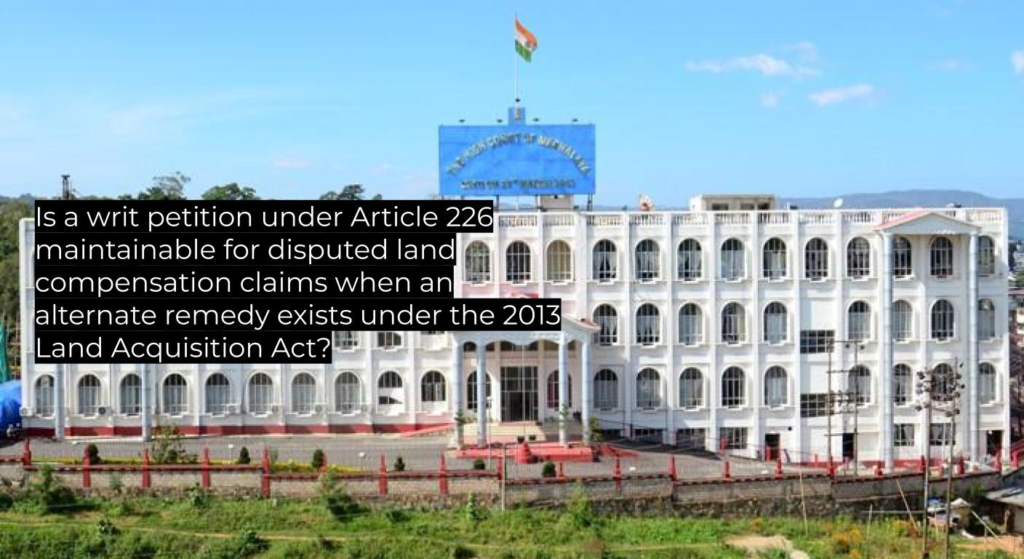
High Court of Meghalaya dismisses challenge to compensation entitlement, affirming that Article 226 writs cannot supplant statutory remedies under the Right to Fair Compensation and Transparency in Land Acquisition, Rehabilitation and Resettlement Act 2013; upholding existing precedent and binding on subordinate courts in land acquisition disputes.
Summary
| Category | Data |
|---|---|
| Case Name | WP(C) No. 341 of 2025 of Smti Worda Nongbsap Vs Union of India and 9 Ors. |
| CNR | MLHC010010522025 |
| Decision Date | 18-08-2025 |
| Disposal Nature | Dismissed at motion stage |
| Judgment Author | Hon’ble Mr. Justice H. S. Thangkhiew |
| Court | High Court of Meghalaya |
| Bench | Single-Judge Bench |
| Type of Law | Land acquisition & writ jurisdiction |
| Questions of Law | Maintainability of writ petition under Article 226 when alternate remedy exists under the 2013 Act and the dispute involves factual entitlement to compensation |
| Ratio Decidendi | The High Court held that where the Right to Fair Compensation and Transparency in Land Acquisition, Rehabilitation and Resettlement Act, 2013 provides an adequate statutory remedy and the dispute is one of factual entitlement to compensation, a writ petition under Article 226 is not maintainable and can be dismissed at the motion stage. |
| Logic / Jurisprudence / Authorities Relied Upon by the Court | The court applied the principle that writ jurisdiction yields to statutory remedies, observed that the 2013 Act provides the proper forum for disputes over compensation, and declined to entertain the petition involving disputed facts. |
| Facts as Summarised by the Court | The petitioner claimed ownership of a plot known as Khri Blei at Dewsaw Village and alleged unawareness of its acquisition; respondent 8 allegedly misrepresented title to receive compensation; petitioner sought direction for the Deputy Commissioner to take action against respondent 8. |
| Citations | 2025 MLHC 735 |
What’s New / What Lawyers Should Note
- Confirms that Article 226 writs are not maintainable where the Right to Fair Compensation and Transparency in Land Acquisition, Rehabilitation and Resettlement Act 2013 provides an adequate statutory remedy for disputes over compensation.
- Reinforces that writ petitions involving disputed questions of fact can be dismissed at the motion-hearing stage without examining merits.
- Emphasizes the need to exhaust alternative statutory remedies before invoking high-court writ jurisdiction in land acquisition matters.
Summary of Legal Reasoning
- The petitioner challenged the withdrawal of compensation paid for the plot Khri Blei, alleging fraudulent representation by respondent 8.
- The respondent government contended that the 2013 Act offers an adequate remedy for disputes over entitlement to compensation.
- The court examined the statutory scheme and noted that the dispute was one of primary fact and title.
- Hon’ble Justice Thangkhiew held that in the presence of an alternative remedy under the 2013 Act, writ jurisdiction under Article 226 cannot be invoked for factual disputes.
- The petition was therefore dismissed at the motion-stage without further adjudication on the merits.
Arguments by the Parties
Petitioner
- The petitioner was unaware that her land plot Khri Blei had been acquired.
- Respondent 8 misrepresented title through fraudulent means and wrongfully received compensation.
- A writ should issue directing the Deputy Commissioner to take action against respondent 8 for illegal withdrawal of compensation.
Respondents 1–5
- The writ petition is misdirected as the Right to Fair Compensation and Transparency in Land Acquisition, Rehabilitation and Resettlement Act 2013 provides an adequate remedy for entitlement disputes.
- The petition involves a disputed question of fact, rendering Article 226 relief inappropriate.
Factual Background
Smti Worda Nongbsap alleged that she held title to a plot known as Khri Blei in Dewsaw Village but was unaware of its acquisition under the Land Acquisition Act. Respondent 8 is said to have misrepresented title and received the compensation amount. Upon discovering this, the petitioner sought a high-court writ directing the Deputy Commissioner to initiate action against respondent 8 for illegal withdrawal of compensation. Respondents 1–5 opposed the petition, asserting that the 2013 Act provides the proper statutory forum for resolution of compensation entitlement disputes.
Statutory Analysis
- The court recognized the Right to Fair Compensation and Transparency in Land Acquisition, Rehabilitation and Resettlement Act 2013 as the exclusive statutory framework for compensation disputes.
- No specific sections were interpreted; the analysis focused on the availability of an alternative remedy under the Act for disputes over entitlement to compensation.
- It affirmed the principle that writ jurisdiction under Article 226 should not supplant detailed statutory procedures where factual disputes are concerned.
Dissenting / Concurring Opinion Summary
No concurring or dissenting opinions were recorded.
Procedural Innovations
The judgment does not introduce new procedural innovations or guidelines.
Alert Indicators
- ✔ Precedent Followed
Citations
- 2025 MLHC 735 (para 9)