


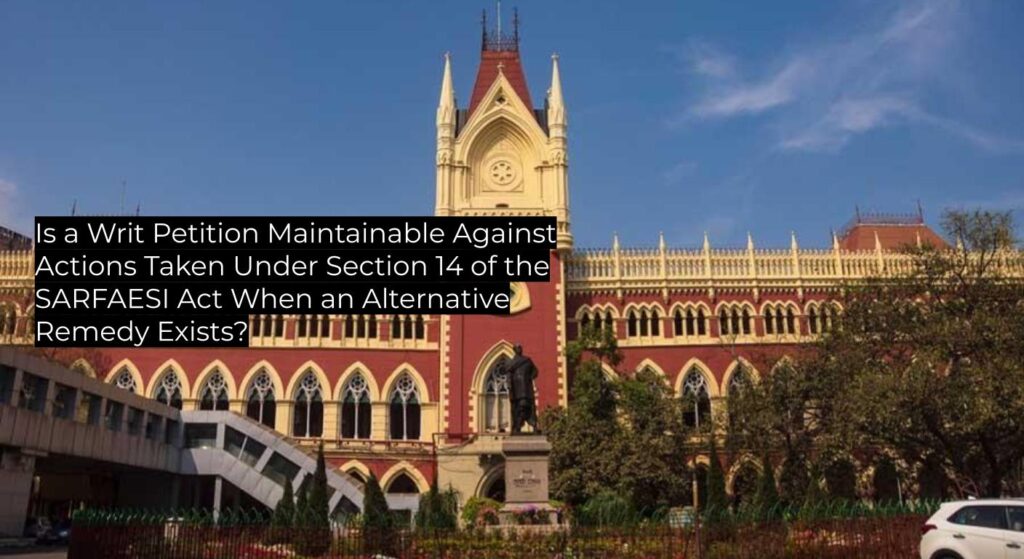
The Calcutta High Court reiterated that writ jurisdiction under Article 226 should not be exercised to challenge proceedings initiated under Section 14 of the Securitization and Reconstruction of Financial Assets and Enforcement of Security Interest Act, 2002, where an efficacious alternative remedy is available. This judgment consolidates the established legal position and is binding authority within West Bengal for banking and financial sector disputes involving SARFAESI actions.
Summary
| Category | Data |
|---|---|
| Case Name | WPA/22369/2019 of MOUSUMI CHETIA Vs UCO BANK & ORS |
| CNR | WBCHCA0492092019 |
| Date of Registration | 29-11-2019 |
| Decision Date | 01-09-2025 |
| Disposal Nature | DISMISSED |
| Judgment Author | HON’BLE JUSTICE PARTHA SARATHI CHATTERJEE |
| Court | Calcutta High Court |
| Bench | Single Judge (Justice Partha Sarathi Chatterjee) |
| Precedent Value | Binding precedent for maintainability issues within jurisdiction |
| Type of Law | Administrative Law / Banking Law (SARFAESI Act) |
| Questions of Law | Whether writ jurisdiction can be invoked to challenge actions of District Magistrate under Section 14 of the SARFAESI Act despite the availability of an alternative statutory remedy. |
| Ratio Decidendi |
|
| Facts as Summarised by the Court |
|
Practical Impact
| Category | Impact |
|---|---|
| Binding On | All subordinate courts within the jurisdiction of the Calcutta High Court |
| Persuasive For | Other High Courts considering maintainability of writ petitions challenging SARFAESI actions under Section 14 |
What’s New / What Lawyers Should Note
- The court restated and applied the bar on writ jurisdiction under Article 226 when a detailed statutory remedy exists for actions taken under Section 14 of the SARFAESI Act.
- Highlights the necessity for aggrieved parties to exhaust alternative remedies prior to invoking writ jurisdiction.
- Dismissal at the threshold for want of maintainability can occur even if the petitioner is absent on the date of hearing.
Summary of Legal Reasoning
- The challenge in the writ petition pertained to the action of the District Magistrate under Section 14 of the SARFAESI Act.
- The court, noting the absence of the petitioner, nonetheless proceeded to examine the maintainability of the petition.
- Citing the existence of an efficacious alternative remedy (prescribed procedure under the SARFAESI Act itself), the court dismissed the writ petition without going into the merits.
- The decision aligns with the judicial restraint typically shown by High Courts in interfering with matters where statutory remedies are provided.
Arguments by the Parties
Petitioner
- No arguments presented as the petitioner or counsel was not present at the hearing.
Respondent
- No arguments noted in the text of the judgment.
Factual Background
The writ petition was filed to challenge the action taken by the District Magistrate under Section 14 of the Securitization and Reconstruction of Financial Assets and Enforcement of Security Interest Act, 2002. At the time of hearing, the petitioner was unrepresented. The court considered the issue of maintainability based on the legal position regarding alternative remedies and dismissed the petition accordingly.
Statutory Analysis
- The relevant provision analyzed was Section 14 of the SARFAESI Act, which empowers the District Magistrate to assist secured creditors in taking possession of secured assets.
- The court’s reasoning was that the SARFAESI Act provides its own remedy, precluding writ jurisdiction under Article 226 in such cases.
Dissenting / Concurring Opinion Summary
None; the judgment was delivered by a single judge without dissent or concurrence.
Procedural Innovations
- The court proceeded to consider the maintainability at the threshold even in the absence of the petitioner, demonstrating that courts may dismiss writ petitions ex parte when fundamental legal bars (such as existence of alternative remedy) are evident.
Alert Indicators
- ✔ Precedent Followed – The judgment reaffirms the established legal principle barring writ petitions where statutory remedies exist.