


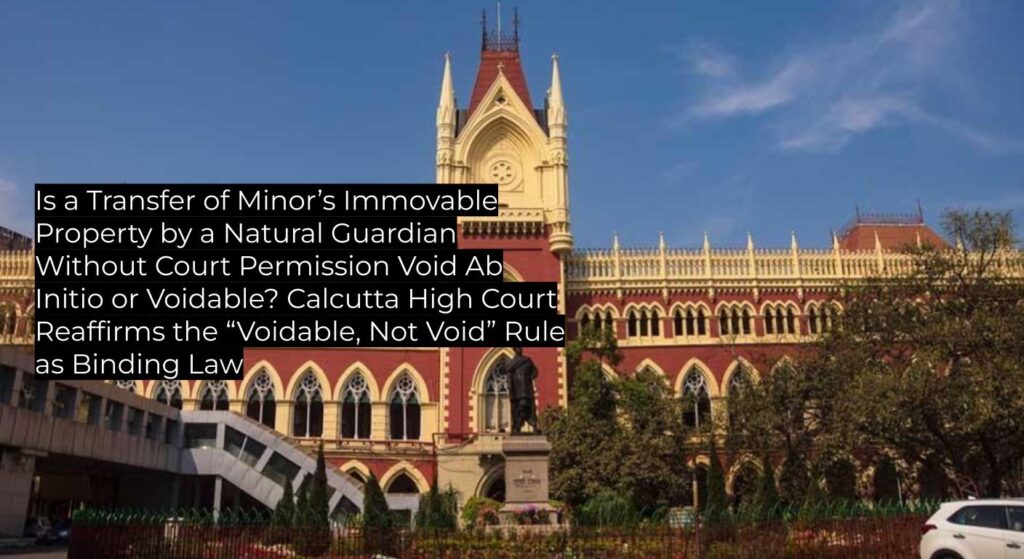
The Calcutta High Court has clarified and reaffirmed that a sale of a minor’s immovable property by a natural guardian without prior court permission is not void ab initio but only voidable at the instance of the minor or someone claiming under them. The judgment upholds settled statutory interpretation under Section 8(3) of the Hindu Minority and Guardianship Act, 1956, and provides binding authority on mutation proceedings in West Bengal.
Summary
| Category | Data |
|---|---|
| Case Name | WPLRT/166/2025 of ARGHA ASH Vs STATE OF WEST BENGAL AND ORS.; CNR WBCHCA0454632025 |
| Date of Registration | 20-09-2025 |
| Decision Date | 27-10-2025 |
| Disposal Nature | ALLOWED |
| Judgment Author | HON’BLE JUSTICE SABYASACHI BHATTACHARYYA |
| Concurring or Dissenting Judges | HON’BLE JUSTICE UDAY KUMAR |
| Court | Calcutta High Court |
| Bench | Division Bench: Sabyasachi Bhattacharyya, Uday Kumar |
| Precedent Value | Binding authority within the jurisdiction of the Calcutta High Court |
| Overrules / Affirms | Affirms statutory interpretation under Section 8(3) of the Hindu Minority and Guardianship Act, 1956 |
| Type of Law | Hindu Minority and Guardianship Law; Land Mutation Proceedings |
| Questions of Law |
|
| Ratio Decidendi | The court held that a transfer of immovable property belonging to a minor by a natural guardian without prior court permission, as required under Section 8(2) of the Hindu Minority and Guardianship Act, 1956, is not void ab initio. Section 8(3) expressly states that such transfers are only voidable at the instance of the minor or anyone claiming under them. Consequently, mutation authorities cannot refuse mutation merely because court permission was absent at the time of transfer unless the minor seeks to void it. Mutation authorities are to verify only the registered status of the deed, not adjudicate title or legality of transfer. |
| Logic / Jurisprudence / Authorities Relied Upon by the Court | Based on direct textual interpretation of Sections 8(1), 8(2), and 8(3) of the Hindu Minority and Guardianship Act, 1956. |
| Facts as Summarised by the Court | Mutation was refused as the transferred property originally belonged to minors, and no permission of the court was obtained prior to transfer. The authorities and Tribunal took the stand that such transfer was void under Section 8. Petitioners challenged the refusal on the basis that only the minor after attaining majority—or their successors—can void such a transfer. |
Practical Impact
| Category | Impact |
|---|---|
| Binding On | All subordinate courts and mutation authorities within Calcutta High Court’s jurisdiction |
| Persuasive For | Other High Courts and mutation authorities outside the jurisdiction |
| Follows | The statutory scheme and settled interpretation of Section 8(3) of the Hindu Minority and Guardianship Act, 1956 |
What’s New / What Lawyers Should Note
- Clarifies and reiterates that a transfer of immovable property by a natural guardian without court permission under Section 8(2) of the 1956 Act is voidable, not void ab initio.
- Mutation authorities cannot refuse mutation solely because of lack of prior court permission for transfer by a minor’s guardian.
- Only the minor (after attaining majority) or a person claiming under them has the standing to challenge such a transfer as voidable; mutation authorities cannot act suo motu.
- Mutation officers are to check the factum of registered deed, not scrutinize title or alleged illegality.
- The order is explicitly subject to any future challenge by the minor (now major), ensuring no prejudice to their substantive rights.
Summary of Legal Reasoning
- The court analyzed Sections 8(1), 8(2), and 8(3) of the Hindu Minority and Guardianship Act, 1956.
- Section 8(2): Mandates previous court permission for certain transactions by natural guardians of minors.
- Section 8(3): Clearly states any disposal in contravention of Section 8(1) or 8(2) is “voidable at the instance of the minor or any person claiming under him,” not void ab initio.
- The court interpreted Section 8(3) as an “umbrella provision” that qualifies Sections 8(1) and (2), giving exclusive standing to minors or their successors.
- The judgment emphasizes that the apparent rigidity of Section 8(2) is overridden by the qualifying statement in Section 8(3).
- Therefore, the transfer does not become void ab initio but is susceptible to being set aside if and only if the minor or their successor takes action.
- The role of mutation authorities is limited to examining the existence of a registered transfer deed, and not to adjudicate on title or legality.
- The refusal of mutation by the Tribunal and lower authorities was erroneous and not in accordance with law.
Arguments by the Parties
Petitioner
- Even if the property owners were minors at the time of transfer, there is no evidence that they moved court to void the transfer after attaining majority.
- Only a minor or someone claiming under them can seek to set aside the transfer as voidable.
- Mutation should be granted if a valid registered deed exists.
Respondent (State)
- A combined reading of Sections 8(2) and 8(3) of the 1956 Act shows there cannot be a valid transfer of a minor’s property without prior court permission.
- Stress on the mandatory language of Section 8(2) to argue such transfer is void.
Factual Background
The dispute concerned refusal to mutate property in favour of the petitioners by mutation authorities and the West Bengal Land Reforms and Tenancy Tribunal. The property had originally belonged to minors and was transferred without prior permission of the court, leading authorities to treat the transfer as void. The petitioners challenged this, arguing that only the minor after attaining majority—or anyone claiming under them—could seek to have the transfer set aside.
Statutory Analysis
- The court analyzed Sections 8(1), 8(2), and 8(3) of the Hindu Minority and Guardianship Act, 1956.
- Section 8(2): Mandates previous court permission for certain transactions by natural guardians of minors.
- Section 8(3): Clearly states any disposal in contravention of Section 8(1) or 8(2) is “voidable at the instance of the minor or any person claiming under him,” not void ab initio.
- The court interpreted Section 8(3) as an “umbrella provision” that qualifies Sections 8(1) and (2), giving exclusive standing to minors or their successors.
- The judgment emphasizes that the apparent rigidity of Section 8(2) is overridden by the qualifying statement in Section 8(3).
- Therefore, the transfer does not become void ab initio but is susceptible to being set aside if and only if the minor or their successor takes action.
- The role of mutation authorities is limited to examining the existence of a registered transfer deed, and not to adjudicate on title or legality.
- The refusal of mutation by the Tribunal and lower authorities was erroneous and not in accordance with law.
Dissenting / Concurring Opinion Summary
Justice Uday Kumar concurred fully with the reasoning and outcome; no separate or dissenting opinion is recorded.
Procedural Innovations
None indicated in the judgment.
Alert Indicators
- ✔ Precedent Followed – The judgment affirms existing statutory interpretation under the 1956 Act.