


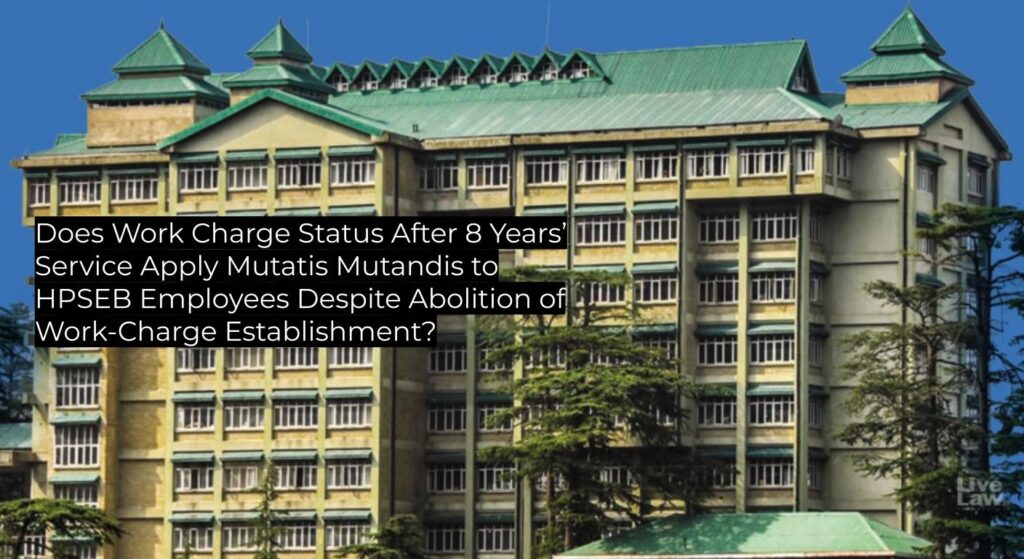
The Himachal Pradesh High Court reaffirms that directions for grant of work-charge status after 8 years’ continuous service, as set out by the Supreme Court in Surajmani and Nanak Chand, apply to HPSEB employees even after abolition of the work-charge establishment. The decision maintains existing precedent and provides binding authority for similar employment claims in the public sector.
Summary
| Category | Data |
|---|---|
| Case Name | CWP/16244/2025 of HUKAM CHAND Vs THE HPSEBL AND ANOTHER |
| CNR | HPHC010618042025 |
| Date of Registration | 14-10-2025 |
| Decision Date | 17-10-2025 |
| Disposal Nature | Disposed Off |
| Judgment Author | HON’BLE MS. JUSTICE JYOTSNA REWAL DUA |
| Court | High Court of Himachal Pradesh |
| Bench | Single Judge Bench |
| Precedent Value | Binding for similar matters in the State and persuasive in comparable contexts elsewhere |
| Overrules / Affirms | Affirms Supreme Court precedents in Nanak Chand, Surajmani, and Ashwani Kumar |
| Type of Law | Service Law / Employment Law – Public Sector Undertakings |
| Questions of Law | Whether HPSEB employees are entitled to work-charge status after 8 years’ service, post-abolition of work establishment? |
| Ratio Decidendi | The High Court held that the Supreme Court’s directions as to grant of work-charge status after 8 years’ service, as laid down in Surajmani (and further clarified in Nanak Chand), remain applicable to HPSEB employees notwithstanding the Board’s abolition or revision of the work-charge establishment. Relief is restricted to notional benefits, as explained in prior Supreme Court directions. |
| Judgments Relied Upon |
|
| Logic / Jurisprudence / Authorities Relied Upon by the Court | The High Court quoted and adopted the Supreme Court’s ratio, interpreting employment standing orders and the continued applicability of earlier directions despite changes in the relevant establishment’s administrative structure. |
| Facts as Summarised by the Court | Multiple petitioners sought direction for grant of work-charge status from the date of completion of 8 years’ service. They argued their cases were covered by Supreme Court precedents. The respondent Board contended that the relevant establishment had been abolished in 1986, but the Supreme Court rejected this distinction. |
Practical Impact
| Category | Impact |
|---|---|
| Binding On | All subordinate courts in Himachal Pradesh, public sector authorities, and HPSEB in similar matters |
| Persuasive For | Other High Courts, tribunals, and public sector organizations with similar service law disputes |
| Follows |
|
What’s New / What Lawyers Should Note
- Reiterates that Supreme Court directions for conferment of work-charge status after 8 years of continuous service apply to HPSEB employees even if the Board has administratively abolished or revised the work-charge establishment.
- Relief limited to notional benefits, as clarified in Ashwani Kumar and Surajmani.
- Implementation to be considered by HPSEB within a fixed timeline (six weeks as per this order).
- Lawyers dealing with public service employment disputes in Himachal Pradesh can treat this decision as a binding precedent for similar reliefs.
Summary of Legal Reasoning
- The High Court recognized that the present petitions seek relief already granted by the Supreme Court in Nanak Chand and Surajmani, both concerning conferment of work-charge status after completion of 8 years’ service.
- It specifically cited the Supreme Court’s reasoning that the abolition or revision of work-charge establishment in HPSEB after 1986 does not change the legal entitlement flowing from earlier service rules or judgments.
- The High Court recited the operative portions of Surajmani (and in turn, Ashwani Kumar and Mool Raj Upadhyaya), emphasizing that the doctrine and directions in those cases are to operate “mutatis mutandis” for HPSEB.
- The High Court’s reasoning strictly follows Supreme Court precedent and applies those directions to the petitions before it.
- The court did not consider any need to distinguish on facts or law and disposed of the petitions with directions for compliance with the Supreme Court’s judgment.
Arguments by the Parties
Petitioner:
- Sought work-charge status from the date of completion of 8 years’ service.
- Claimed entitlement as per Supreme Court decisions (Nanak Chand, Surajmani).
- Requested incidental benefits as a result of such status.
Respondent (HPSEB):
- Contended that work-charge establishment had been abolished in 1986 and revised in 1987, implying inapplicability of Surajmani.
- Argued administrative changes excused application of previous judicial directions.
Factual Background
- Multiple writ petitions were filed by employees of HPSEB seeking grant of work-charge status from the date they completed 8 years’ continuous service.
- Relief claimed was based on existing Supreme Court judgments granting similar status to other state employees.
- The respondent HPSEB contended that their work-charge establishment had been abolished or revised, but this objection had already been rejected by the Supreme Court in the cited cases.
Statutory Analysis
The judgment refers to the Standing Orders of the Himachal Pradesh State Electricity Board Industrial Establishment framed under the Factories Act, 1948, noting that different classes of workmen (including work-charged) were contemplated by Clause 5(b).
No specific statutory provision was interpreted beyond this context, with the primary legal analysis centering on the continued operation of Supreme Court judgments.
Procedural Innovations
- The High Court directed the respondent-Board to consider and decide on the petitioners’ claims in light of the Supreme Court’s judgments within six weeks.
- Otherwise, no new procedure, evidentiary innovation, or guidelines were created.
Alert Indicators
- ✔ Precedent Followed – When existing law is affirmed.