


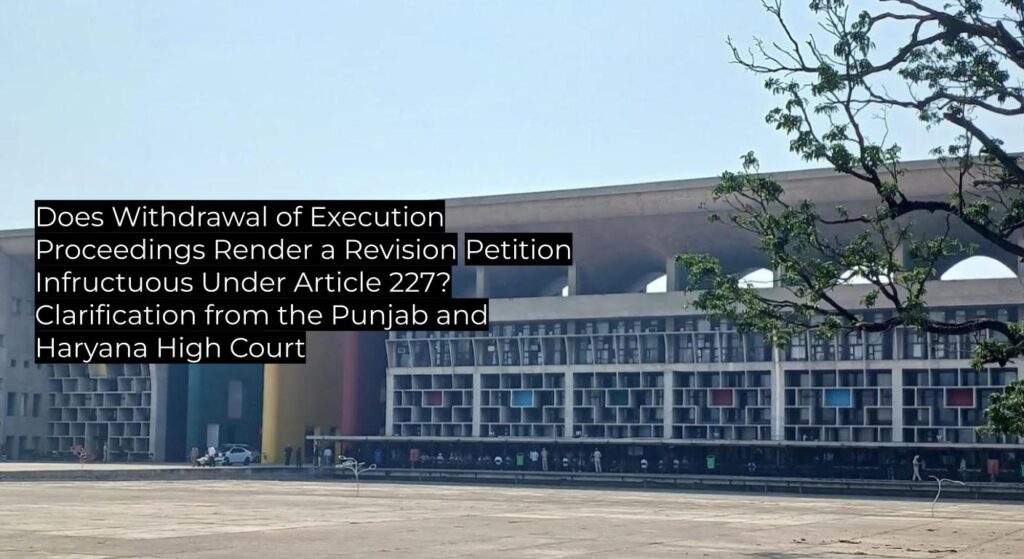
The High Court clarified that when execution proceedings are withdrawn, any pending revision petition challenging orders in those proceedings under Article 227 of the Constitution becomes infructuous and should be disposed of accordingly. This case reaffirms established procedure and is of binding value for subordinate courts in similar family law matters.
Summary
| Category | Data |
|---|---|
| Case Name | CR/1841/2021 of NIRMAL JEET SINGH Vs JASLEEN KAUR |
| CNR | PHHC010814632021 |
| Date of Registration | 07-09-2021 |
| Decision Date | 01-09-2025 |
| Disposal Nature | DISPOSED OF |
| Judgment Author | MR. JUSTICE VIKAS BAHL |
| Court | High Court of Punjab and Haryana |
| Bench | Single Judge (Hon’ble Mr. Justice Vikas Bahl) |
| Precedent Value | Binding on subordinate courts |
| Overrules / Affirms | Affirms existing principle regarding infructuous petitions |
| Type of Law | Civil / Family Law / Procedural Law |
| Questions of Law | Whether withdrawal of execution proceedings renders a revision petition under Article 227 infructuous. |
| Ratio Decidendi |
The Court held that since the execution proceedings, which were subject-matter of the revision petition, have been withdrawn, there is no subsisting lis for the Court to adjudicate. Consequently, the revision petition has become infructuous and is disposed of accordingly. This upholds the principle that courts should not decide academic or supervened issues where the substantive controversy no longer survives. |
| Facts as Summarised by the Court |
Execution proceedings before the Family Court, Patiala were challenged via a revision petition. During pendency, the execution was withdrawn by order dated 08.07.2025, rendering the revision infructuous. |
Practical Impact
| Category | Impact |
|---|---|
| Binding On | All subordinate courts under the jurisdiction of the Punjab and Haryana High Court |
| Persuasive For | Other High Courts |
| Overrules | None stated |
| Distinguishes | None stated |
| Follows | Established principle that infructuous petitions should be disposed of as such |
What’s New / What Lawyers Should Note
- Reiterates that withdrawal of execution proceedings automatically renders any related revision petitions infructuous.
- Lawyers should promptly bring such withdrawals to the Court’s notice to seek disposal on grounds of infructuousness.
- Clarifies procedural economy to prevent courts from deciding supervened or academic matters.
- The Court took up and disposed the matter forthwith upon the withdrawal being brought to its notice.
Summary of Legal Reasoning
- The Court noted the withdrawal of execution proceedings as evidenced by order dated 08.07.2025.
- Since the central dispute (execution) has ceased to exist, the Court found no reason to continue or decide the revision on merits.
- Emphasized the settled law that courts do not adjudicate petitions where no live controversy survives, and such petitions should be disposed of as infructuous.
- Applied this principle to civil/family law revisions under Article 227 jurisdiction.
Arguments by the Parties
Petitioner:
- Sought setting aside of the Family Court’s order in the execution proceedings.
- After execution was withdrawn, would have no surviving grievance.
Respondent:
- No appearance recorded; proceedings disposed for want of live issue due to withdrawal of execution.
Factual Background
The petitioner filed a revision under Article 227 challenging an order passed by the Additional Principal Judge, Family Court, Patiala, related to execution proceedings. Subsequently, the execution proceedings before the Family Court were withdrawn as of 08.07.2025. In view of this development, the High Court was informed that the revision petition no longer survived and was thus rendered infructuous.
Statutory Analysis
- The Court referenced Article 227 of the Constitution of India, conferring supervisory jurisdiction over courts and tribunals.
- The application for restoration was made under Order 41 Rule 19 r/w Section 151 CPC, allowing for recall/restoration in appropriate cases.
- No detailed interpretation; principles applied to procedural facts at hand.
Dissenting / Concurring Opinion Summary
No dissenting or concurring opinions recorded; single judge decision.
Procedural Innovations
- The Court recalled an earlier order and restored the petition to its file upon application under Order 41 Rule 19 read with Section 151 CPC.
- Immediately took up and disposed the main matter as infructuous, evidencing procedural efficiency when a matter becomes non-justiciable due to supervening events.
Alert Indicators
- ✔ Precedent Followed – When existing law is affirmed.
Citations
- No SCC / AIR / MANU or neutral citations stated in the judgment.
- CNR: PHHC010814632021
- CR/1841/2021
- Decision dated: 01.09.2025