


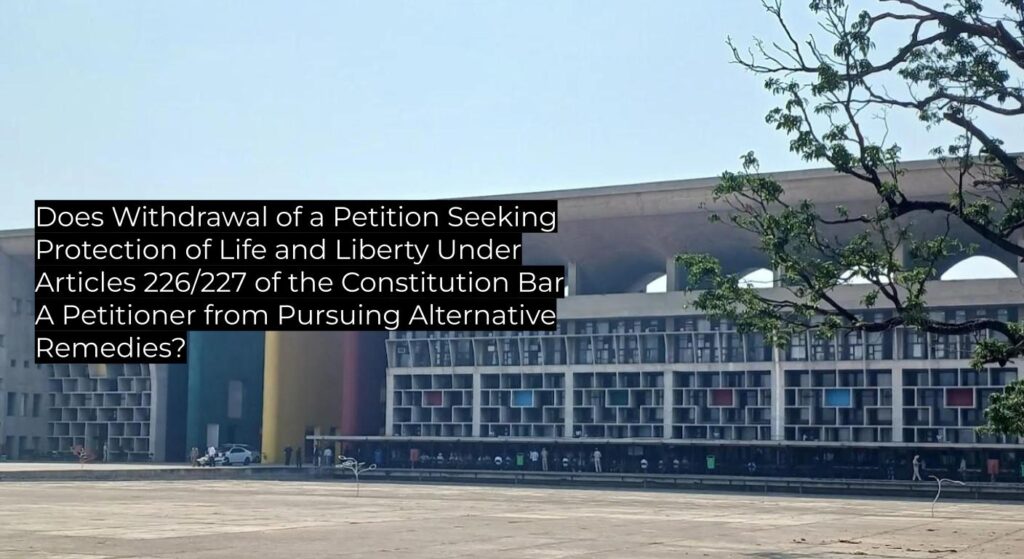
The Punjab & Haryana High Court accepts withdrawal of a habeas corpus/writ petition filed under Articles 226/227 with liberty for the petitioner to pursue alternative remedies available in law, following a status report by the police and non-objection from State counsel. The order reaffirms existing precedent without creating or overruling legal principles; it remains binding on all subordinate courts for similar procedural matters involving writ withdrawals in protection petitions.
Summary
| Category | Data |
|---|---|
| Case Name | CRWP/9446/2025 of JAGJEET SINGH Vs STATE OF PUNJAB AND ORS. |
| CNR | PHHC011382772025 |
| Date of Registration | 28-08-2025 |
| Decision Date | 31-10-2025 |
| Disposal Nature | DISPOSED OF |
| Judgment Author | MR. JUSTICE VINOD S. BHARDWAJ |
| Court | High Court of Punjab and Haryana |
| Precedent Value | Binding authority on subordinate courts regarding withdrawal and liberty to pursue alternative remedies |
| Type of Law | Constitutional Law — Writ Jurisdiction (Articles 226/227) |
| Ratio Decidendi |
|
| Facts as Summarised by the Court |
|
Practical Impact
| Category | Impact |
|---|---|
| Binding On | All subordinate courts within the jurisdiction of the Punjab & Haryana High Court |
| Persuasive For | Other High Courts in India considering withdrawal of writs seeking life and liberty protection |
| Follows | Procedural practices regarding withdrawal of writ petitions with liberty to pursue remedies |
What’s New / What Lawyers Should Note
- The Court reaffirms that withdrawal of a writ petition under Articles 226/227, with liberty to pursue alternative remedies, is permissible and does not bar the petitioner from seeking remedies elsewhere as per law.
- Such withdrawals can be allowed upon request by petitioner’s counsel, especially after status report or response from State, and where State expresses no objection.
- Petitioners should duly record in the withdrawal request their intention to avail alternative remedies to secure liberty for doing so.
Summary of Legal Reasoning
- The Court noted the writ petition was filed seeking directions under Articles 226/227 for police protection to safeguard life and liberty from private respondents.
- A status report by the Superintendent of Police was presented and made available to the petitioner’s counsel.
- On resumption of hearing, the counsel for the petitioner sought leave to withdraw the petition for the purpose of pursuing alternative remedies as available under the law.
- There was no objection to this course from the State counsel.
- The Court therefore recorded withdrawal of the petition, specifically granting liberty to seek other remedies, and disposed the matter accordingly, including any pending applications.
Arguments by the Parties
Petitioner
- Sought police protection of life and liberty.
- Later, through counsel, sought withdrawal of the petition to pursue alternative remedies as available under law.
Respondent (State)
- Filed a status report through the Superintendent of Police.
- Stated no objection to the petitioner’s request for withdrawal with liberty.
Factual Background
The petitioner filed a writ petition under Articles 226/227 of the Constitution, claiming threats to life and liberty at the hands of private respondents, and sought necessary directions to official respondents for protection. During the proceedings, a status report was submitted by the Superintendent of Police, District Sangrur. The status report was made available to petitioner’s counsel, following which counsel prayed for withdrawal of the petition with liberty to seek alternative remedies. The State did not oppose this request, and the court disposed of the petition as withdrawn.
Statutory Analysis
- The petition invoked the writ jurisdiction of the High Court under Articles 226 and 227 of the Constitution of India.
- The Court exercised its discretion to permit withdrawal with liberty, consonant with established practice under the constitutional framework.
- No interpretation or modification of statutory provisions was undertaken in the judgment.
Dissenting / Concurring Opinion Summary
No dissenting or concurring opinions are recorded in the judgment.
Procedural Innovations
No new procedural innovations or guidelines were laid down by the Court in this judgment; the order follows established practice concerning withdrawal of writ petitions.
Alert Indicators
- ✔ Precedent Followed – The judgment reaffirms the existing principle that a writ petition may be withdrawn with liberty to pursue other legal remedies, without creating or modifying substantive legal principles.