


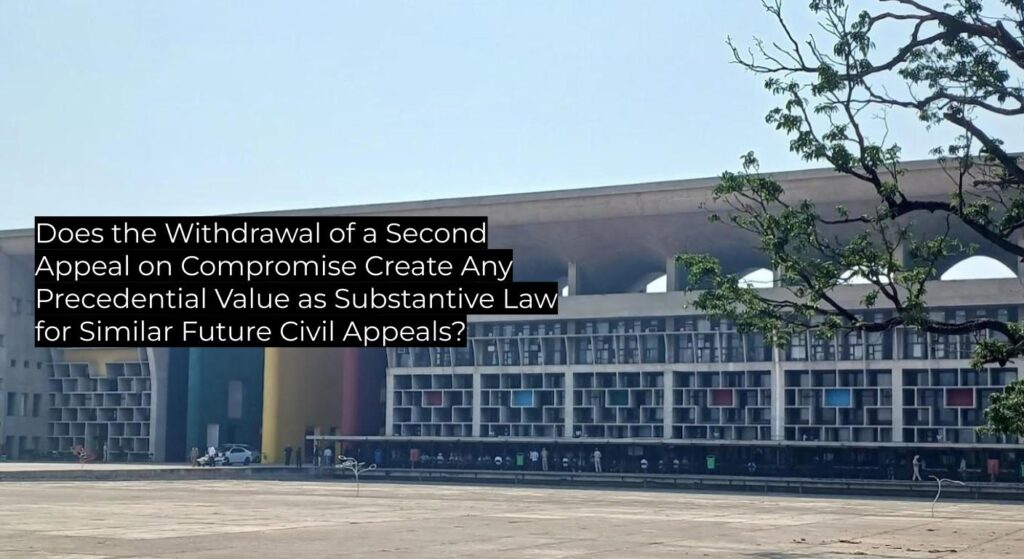
The High Court of Punjab and Haryana confirmed that withdrawal of a second appeal following a compromise between parties disposes of the case without adjudication on merits, reaffirming that such judgments set no binding or persuasive legal precedent for substantive issues in civil litigation.
Summary
| Category | Data |
|---|---|
| Case Name | RSA/4899/2017 of RAJENDER KUMAR Vs RAVINDER KUMAR |
| CNR | PHHC011302652017 |
| Date of Registration | 23-10-2017 |
| Decision Date | 30-10-2025 |
| Disposal Nature | DISMISSED |
| Judgment Author | MR. JUSTICE PARMOD GOYAL |
| Court | High Court of Punjab and Haryana |
| Bench | Single Bench (MR. JUSTICE PARMOD GOYAL) |
| Precedent Value | No precedential value on substantive legal issues (disposed on the basis of compromise/withdrawal). |
| Questions of Law | None decided—appeal dismissed as withdrawn due to compromise. |
| Ratio Decidendi |
The High Court allowed the withdrawal of the second appeal after the appellant informed the court of a compromise with the respondent. The appeal was dismissed as withdrawn in view of the compromise. No substantive legal question was decided or discussed. The order is procedural in nature and does not establish or modify any principles of law. |
| Facts as Summarised by the Court |
The appellant, through counsel, sought permission to withdraw the second appeal on the basis that a compromise had been reached with the respondent. The application for withdrawal was allowed, and the appeal was dismissed accordingly. |
Practical Impact
| Category | Impact |
|---|---|
| Binding On | Limited to the parties in this case—no binding effect on future cases. |
| Persuasive For | Not persuasive for other courts or tribunals on points of substantive law. |
What’s New / What Lawyers Should Note
- The judgment reiterates the principle that withdrawal of an appeal following compromise does not result in any determination on merits or substantive legal principle.
- No legal precedent is created with respect to the underlying dispute when an appeal is dismissed as withdrawn.
- Lawyers cannot cite this judgment for any substantive legal proposition.
- The judgment is procedural and confined to the parties involved, closing the file without addressing any legal questions.
Summary of Legal Reasoning
- The applicant-petitioner requested withdrawal of the main petition, stating that a compromise had been reached with the respondents.
- The High Court allowed the withdrawal application, disposed of the application, and took up the main case for hearing.
- On a request by the appellant’s counsel, the appeal was dismissed as withdrawn due to the compromise, and no findings were rendered on any questions of law or fact.
- The process ensured that the compromise between parties concluded the litigation without the court adjudicating on the merits.
Arguments by the Parties
Petitioner
- Learned counsel for the appellant sought permission to withdraw the appeal due to compromise with the respondent.
Respondent
- No independently recorded arguments; respondent was party to the compromise as per the statement of appellant’s counsel.
Factual Background
The matter involved a second appeal before the High Court of Punjab and Haryana. The appellant, through advocate representation, moved an application to withdraw the appeal on the grounds that a compromise had been reached with the respondent. The court, allowing the application, dismissed the appeal as withdrawn, effectively ending the litigation without pronouncing on the merits of the case.
Statutory Analysis
- No statutory interpretation or analysis is present in the judgment. The court acted on the procedural application for withdrawal under civil appellate procedure in light of the compromise and dismissed the appeal accordingly.
Dissenting / Concurring Opinion Summary
No dissenting or concurring opinions were recorded in this single-judge order.
Procedural Innovations
No new procedural innovations, guidelines, or directions were introduced in the judgment. The proceeding followed standard practice for withdrawals upon compromise.
Alert Indicators
- Precedent Followed – The decision is consistent with established practice that procedural orders on compromise do not set substantive precedent.