


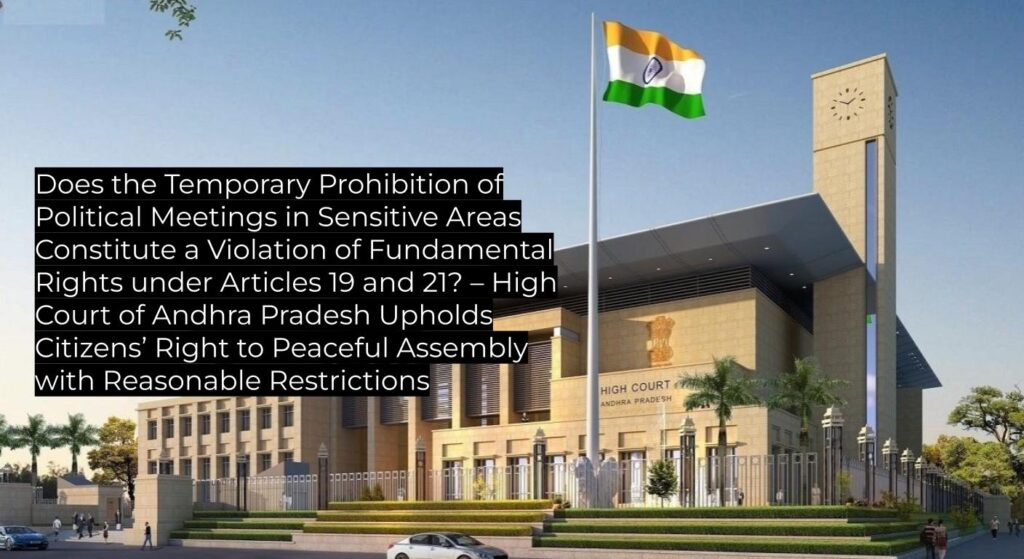
The High Court reaffirms that the State cannot impose a blanket prohibition on peaceful assembly but may enforce reasonable restrictions in the interest of public order. The judgment draws from established Supreme Court judgments, clarifying the balance between the right to protest and maintenance of law and order, and is binding authority for future similar disputes within Andhra Pradesh.
Summary
| Category | Data |
|---|---|
| Case Name | WP/21157/2025 of BODE RAMACHANDRA YADAV Vs The State of Andhra Pradesh, CNR APHC010411122025 |
| Date of Registration | 07-08-2025 |
| Decision Date | 02-09-2025 |
| Disposal Nature | DISPOSED OF NO COSTS |
| Judgment Author | Dr. Justice Venkata Jyothirmai Pratapa |
| Court | High Court of Andhra Pradesh |
| Bench | Single; Dr. Justice Venkata Jyothirmai Pratapa |
| Precedent Value | Binding on all subordinate courts in Andhra Pradesh |
| Type of Law | Constitutional Law, Police Law |
| Questions of Law | Whether denial of permission for peaceful protests in light of prohibitory orders violates the fundamental rights under Articles 19 and 21 of the Constitution of India. |
| Ratio Decidendi |
The High Court held that the fundamental right to assemble peacefully and protest, enshrined under Articles 19(1)(a), 19(1)(b), and 19(1)(d), cannot be abrogated by blanket executive prohibitions. The State may regulate the exercise of such rights by imposing reasonable restrictions in the interest of public order. The court relied on Supreme Court precedents that recognize the primacy of the right to protest, subject to law and order considerations. The petitioner was permitted to conduct a meeting with specific guidelines and restrictions, ensuring a balance between individual rights and collective safety. Prohibitory orders may limit, but not extinguish, these fundamental rights. |
| Judgments Relied Upon |
|
| Logic / Jurisprudence / Authorities Relied Upon by the Court | The jurisprudence emphasized the right to peaceful assembly and protest, established by the Supreme Court, with recognition of the State’s authority to place reasonable restrictions for maintaining public order. |
| Facts as Summarised by the Court | The petitioner, president of a political party, was agitating against a land acquisition scheme. He sought permission to hold a meeting in Karedu Village, which was denied due to prohibitory orders citing law and order concerns. Prior representations were made, and multiple cases had been registered against the petitioner. Ultimately, the court permitted a regulated meeting, balancing the petitioner’s rights with public order. |
| Citations |
|
Practical Impact
| Category | Impact |
|---|---|
| Binding On | All subordinate courts in Andhra Pradesh |
| Persuasive For | Other High Courts, Supreme Court (as precedent from a High Court) |
| Follows |
|
What’s New / What Lawyers Should Note
- The judgment expressly clarifies that the right to peaceful assembly and protest cannot be extinguished by general prohibitory orders but can be regulated through reasonable restrictions for public order.
- Reinforces that statewide or area-wide bans should be narrowly tailored; blanket executive orders prohibiting peaceful protests are not constitutionally valid without specific justifications.
- Emphasizes the obligation of authorities to consider and respond to requests for protest permissions and to make arrangements for peaceful exercise of rights.
- Establishes that courts can fashion practical, case-specific guidelines allowing protests with safeguards where necessary.
- Lawyers can cite this decision to challenge blanket prohibitory orders against peaceful protests when reasonable restrictions would suffice.
Summary of Legal Reasoning
- The High Court reaffirmed Supreme Court precedent establishing peaceful assembly and protest as core fundamental rights under Articles 19(1)(a), 19(1)(b), and 19(1)(d).
- The judgment explicitly referenced Kameshwar Prasad v. State of Bihar, where the Supreme Court recognized the right to protest as fundamental, and Himat Lal K. Shah v. Commissioner of Police, which restricted the State’s ability to prohibit assemblies absolutely.
- Citing Mazdoor Kisan Shakti Sangathan v. Union of India, the Court emphasized that the right to ventilate grievances through peaceful assembly is vital and constitutionally protected.
- The Court analyzed the imposition of restrictions and prohibitory orders, noting that such limitations must be reasonable, proportionate, and in aid of the fundamental rights, not destructive of them.
- Upon finding that the petitioner’s proposed protest was peaceful and no persuasive evidence warranted a complete ban, the Court allowed the meeting under tailored conditions, directing police authorities to ensure order and security while not stifling constitutional freedoms.
Arguments by the Parties
Petitioner
- The government’s restrictions on visiting Karedu Village and conducting meetings were violative of Articles 19 and 21.
- Prior peaceful agitations by the petitioner and his followers had been met with false cases.
- Authorities failed to consider representations seeking permission, despite High Court directions.
- The restrictions constituted an unreasonable abridgement of fundamental rights to movement, speech, and assembly.
Respondent (State)
- The petitioner attempted to block a national highway and was instigating opposition to a public land acquisition project.
- As a result, a case had been registered under Crime No.88 of 2025; there were 36 cases against the petitioner.
- Prohibitory orders under Section 163 BNSS and Section 30(A) of the Police Act were imposed in the area due to law and order concerns.
- Denial of permission was justified by prevailing security and public order requirements—the petitioner intended to agitate and could incite unrest.
- Sought dismissal of the petition.
Factual Background
The dispute arose when the petitioner, president of a political party, sought to protest the land acquisition for the Indo Solar Project in Karedu Village, Ulavapadu Mandal, by holding a peaceful meeting and supporting affected farmers. Authorities denied his request, citing prohibitory orders imposed to prevent public gatherings in the area amidst law and order concerns. Previous appeals to the authorities and an earlier writ petition had resulted in directions for the police to consider his representation, which they rejected. The petitioner, aggrieved by this continued prohibition, approached the High Court seeking relief.
Statutory Analysis
- The judgment discussed Articles 19(1)(a), 19(1)(b), and 19(1)(d) of the Constitution of India, recognizing the rights to free speech, peaceful assembly, and movement.
- The court analyzed Section 163 of BNSS and Section 30(A) of the Police Act, which empower authorities to issue prohibitory orders to maintain public order.
- The validity of these orders was examined in light of the need that such restrictions must be reasonable and cannot amount to a blanket denial of constitutional rights, as per settled constitutional jurisprudence.
Procedural Innovations
- The Court itself issued directions tailoring the conduct of the meeting: specifying timing, number of participants, police security, videography, and prohibiting provocative or caste-related issues—demonstrating judicial shaping of permission orders.
- Police were directed to take all necessary precautions and to act in accordance with law should any untoward incident occur.
Alert Indicators
- ✔ Precedent Followed – Supreme Court judgments on fundamental rights to assembly and protest were reaffirmed and followed.
Citations
- Kameshwar Prasad v. State of Bihar, (1962) Supp 3 SCR 369
- Himat Lal K. Shah v. Commissioner of Police, Ahmedabad, (1973) 1 SCC 227
- Mazdoor Kisan Shakti Sangathan v. Union of India, AIR 2018 SC 3476 = 2018 (10) SCJ 685