


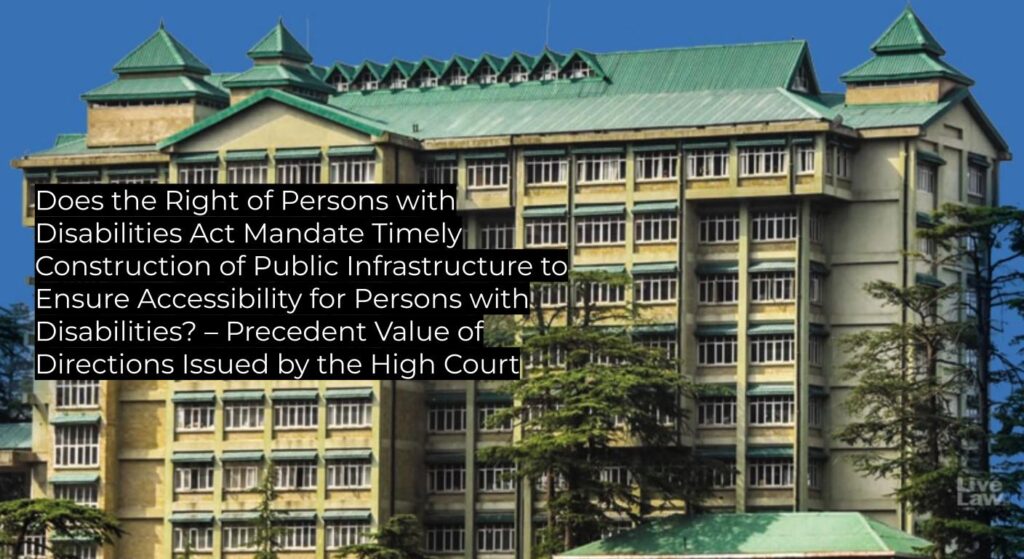
The Himachal Pradesh High Court affirms that under Sections 3 and 16 of the Right of Persons With Disabilities Act, 2016, public authorities are obligated to provide accessible infrastructure such as roads for persons with disabilities. This decision upholds the enforceability of statutory rights under the Act and directs time-bound action, reinforcing existing obligations rather than creating new law. The directions serve as binding precedent for subordinate courts within the jurisdiction and persuasive authority elsewhere for expeditious implementation of such statutory duties.
Summary
| Category | Data |
|---|---|
| Case Name | CWP/13466/2024 of TANYA SHARMA Vs THE STATE OF HP AND OTHERS |
| CNR | HPHC010582782024 |
| Date of Registration | 22-11-2024 |
| Decision Date | 15-10-2025 |
| Disposal Nature | Disposed Off |
| Judgment Author | Hon’ble Mr. Justice Ajay Mohan Goel |
| Court | High Court of Himachal Pradesh |
| Bench | Single Judge Bench – Hon’ble Mr. Justice Ajay Mohan Goel |
| Precedent Value | Binding within territorial jurisdiction; persuasive authority elsewhere |
| Type of Law | Administrative Law, Disability Rights Law |
| Questions of Law | Whether state authorities are mandatorily required to construct accessible infrastructure (road) under the Disabilities Act? |
| Ratio Decidendi |
The court held that provisions of the Right of Persons With Disabilities Act, 2016 obligate authorities to ensure accessibility for persons with disabilities. On admission of the obligation in an affidavit by the State, the court ordered time-bound completion of the road construction, thus operationalising Sections 3 and 16 of the Act. The decision exemplifies court’s power to enforce statutory rights for the disabled, mandating prompt administrative action. |
| Facts as Summarised by the Court |
The petitioner, suffering from cerebral palsy and wheelchair-bound, sought a writ to direct state authorities to expeditiously construct a sanctioned link road to provide her access to educational and medical facilities, citing the Disabilities Act. The administration admitted the duty and outlined ongoing steps, including allocation of funds and start of construction. The court ordered completion of the work by a set deadline. |
Practical Impact
| Category | Impact |
|---|---|
| Binding On | All subordinate courts in Himachal Pradesh |
| Persuasive For | Other High Courts, Supreme Court, and relevant State/local authorities outside the State |
| Follows | Enforces obligations under Sections 3 and 16, Right of Persons With Disabilities Act, 2016 |
What’s New / What Lawyers Should Note
- The judgment unequivocally operationalises Sections 3 and 16 of the Right of Persons With Disabilities Act, 2016, confirming the authorities’ mandatory duty to provide accessible infrastructure when demanded by persons with disabilities.
- The court accepted a government affidavit as assurance of compliance, but added judicial directions with a time-bound deadline for completion of work.
- Lawyers may cite this as precedent to secure specific, time-bound implementation of accessibility infrastructure for their clients under the Disabilities Act.
- The court’s approach signals proactive enforcement of disability rights without prolonged adversarial litigation once statutory obligation is acknowledged.
Summary of Legal Reasoning
- The court examined the petitioner’s prayer for expeditious construction of an accessible road, invoking Sections 3 and 16 of the Disabilities Act.
- The State’s affidavit admitted the duty to construct the road and described steps initiated: a new cost estimate, directions for commencing work, and a request for allocation of remaining funds.
- Upon State’s admission, the court found no further fact-finding or adversarial process necessary, and ordered the administration to act as per the affidavit and complete the road by a specific date.
- The court’s reasoning affirms the enforceability of the Disabilities Act and its operational effect via writ jurisdiction, ensuring statutory rights translate into immediate administrative action.
Arguments by the Parties
Petitioner
- Sought mandamus to direct construction of a link road enabling access to education and medical institutions, based on Sections 3 and 16 of the Right of Persons With Disabilities Act, 2016.
- Emphasised lifelong wheelchair restriction due to cerebral palsy and lack of accessible transport infrastructure.
- Requested extension of all facilities to enable equal access as contemplated by the Act.
Respondent (State)
- Admitted via affidavit obligation to construct the road.
- Set forth steps already undertaken: preparation of fresh estimate, initiation instructions to competent authority, request for police assistance if needed, and correspondence for allocation of further funds.
Factual Background
The petitioner, suffering from cerebral palsy and confined to a wheelchair, filed a writ petition seeking urgent construction of a sanctioned link road from Jatoli Garog Road to her house in order to access essential educational and medical facilities. She relied on Sections 3 and 16 of the Right of Persons With Disabilities Act, 2016, arguing the State was statutorily obligated to ensure such accessibility. During petition proceedings, the State authorities submitted an affidavit outlining concrete steps underway for construction, including detailed estimates, administrative instructions, and requests for resource allocation. The court ordered completion of the work by a set deadline.
Statutory Analysis
- Section 3 of the Right of Persons With Disabilities Act, 2016: Provides the fundamental right to equality and non-discrimination for persons with disabilities, including necessary adjustments and modifications to facilitate access.
- Section 16: Mandates Governments to ensure barrier-free infrastructure and the creation of accessible environment in public facilities, including roads, for persons with disabilities.
- The judgment does not reinterpret or narrow the statutory text, but enforces its mandatory character by ordering immediate and time-bound compliance with admitted obligations.
Dissenting / Concurring Opinion Summary
No dissenting or concurring opinions are recorded in the judgment.
Procedural Innovations
No procedural innovations introduced. The court followed established practice of seeking affidavit from authorities, then directing time-bound compliance based on admitted obligations.
Alert Indicators
- ✔ Precedent Followed – The judgment implements and affirms the statutory mandate of the Right of Persons With Disabilities Act, 2016, reinforcing the authority of existing law.