


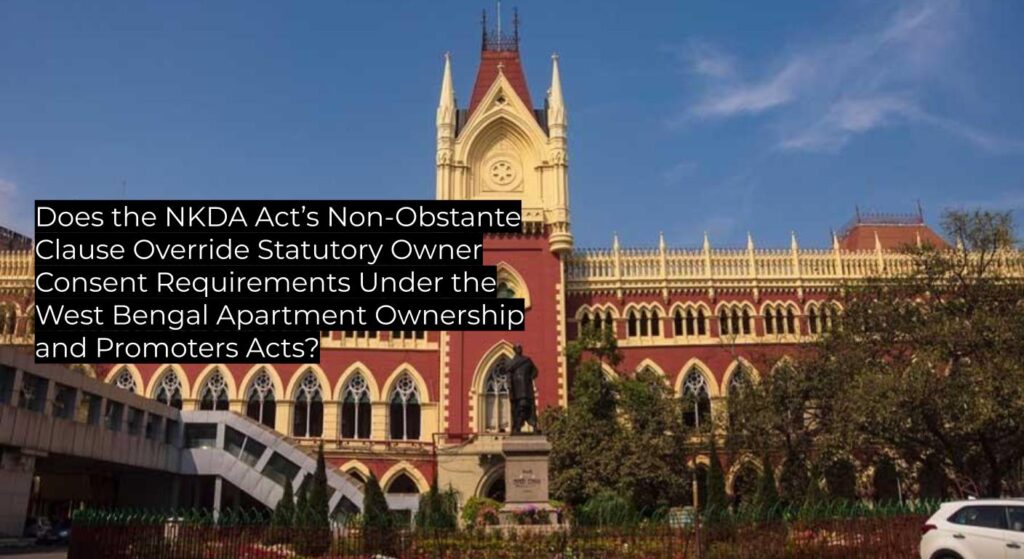
The Calcutta High Court holds (29-08-2025) that Section 184 of the NKDA Act 2007 does not bar application of the West Bengal Apartment Ownership Act 1972 or the West Bengal Promoters Act 1993; revised sanction plans require proof of exclusive construction rights, including written consent of existing flat owners, and absence of such consent renders plans void.
Summary
| Category | Data |
|---|---|
| Case Name | MAT/2420/2023 of RANJAN KUMAR PRASAD AND ORS Vs NEW TOWN KOLKATA DEVELOPMENT AUTHORITY AND ORS |
| CNR | WBCHCA0586352023 |
| Date of Registration | 12-12-2023 |
| Decision Date | 29-08-2025 |
| Disposal Nature | ALLOWED |
| Judgment Author | Hon’ble Justice Rajasekhar Mantha |
| Concurring or Dissenting Judges | Hon’ble Justice Ajay Kumar Gupta (concurring) |
| Court | Calcutta High Court, Appellate Side (Division Bench) |
| Bench | Division Bench |
| Precedent Value | Binding on Municipal/Development Authorities and subordinate courts in West Bengal for interplay of development statutes and apartment-ownership law |
| Overrules / Affirms |
|
| Type of Law | Municipal law; property law; statutory interpretation; constitutional right to property |
| Questions of Law | Whether Section 184 (non-obstante clause) of the NKDA Act 2007 overrides Sections 2–12 of the West Bengal Apartment Ownership Act 1972 and Sections 3, 8 of the West Bengal Building (Promoters) Act 1993 so as to permit sanction of a revised plan without the written consent of existing apartment owners? |
| Ratio Decidendi |
|
| Judgments Relied Upon |
|
| Logic / Jurisprudence / Authorities Relied Upon by the Court |
|
| Facts as Summarised by the Court | In 2007 NKDA sanctioned a 15-tower residential complex; flat owners registered under WB Apartment Ownership Act 1972, acquiring undivided land shares. In 2015 a new promoter obtained a revised NKDA sanction for a 16th 26-floor tower and commercial plaza without existing owners’ knowledge or consent, diluting their undivided shares. Competent/Appellate Authorities under the 1972 Act rejected promoter’s Form B amendment for lack of sole-owner status and consent. A Single Bench held NKDA’s non-obstante clause bars application of the 1972 Act; Division Bench reversed, cancelling the revised plan and ordering demolition and compensation. |
| Citations | (2021) 10 SCC 1; (2021) 8 SCC 599; (2007) 9 SCC 220; (2024) SCC OnLine Cal 2528; (2004) 8 SCC 733; (2022) SCC OnLine SC 1207; (2013) 5 SCC 470; AIR 1991 Ker 162 (FB) |
Practical Impact
| Category | Impact |
|---|---|
| Binding On | All municipal/development authorities, subordinate courts and tribunals in West Bengal |
| Persuasive For | Other High Courts and administrations interpreting non-obstante clauses vis-à-vis sector-specific statutes |
| Overrules | Single Bench decision in WPA 15903 of 2018 (MAT 2420 of 2023) that Section 184 NKDA Act overrides Apartment Ownership Act |
| Distinguishes | Municipal-authority cases resisting external statute compliance (e.g., Shelter Projects, Calcutta Metropolitan Dev. Auth. cases) |
| Follows | Forum for People’s Collective Efforts v. State of West Bengal, (2021) 8 SCC 599 |
What’s New / What Lawyers Should Note
- Clarifies that a non-obstante clause in a development authority Act does not displace separate statutes conferring rights on apartment owners and regulating promoters.
- Confirms that development authorities must ascertain exclusive construction rights—including written consent under Section 7 Apartment Ownership Act 1972 and Section 8 Promoters Act 1993—before granting or revising building sanctions.
- Establishes that a revised sanction plan obtained without existing owners’ consent and by misrepresentation is void ab initio and cancellable under Section 81 NKDA Act 2007.
- Affirms that additional-structure construction sans owner consent violates Article 300A’s guarantee of property rights and must be demolished, not regularised by compensation.
- Holds engineers and NKDA officers liable for departmental and criminal proceedings when involved in sanctioning illegal plans.
Summary of Legal Reasoning
- Scope & Statutory Interplay: The NKDA Act 2007, Apartment Ownership Act 1972 and Promoters Act 1993 regulate complementary fields—building-plan sanction, individual apartment-ownership rights and promoter duties respectively—and must be read harmoniously under the material-inconsistency test.
- Non-Obstante Clause: Section 184 NKDA Act gives overriding effect only over conflicting laws; no conflict arises as all three statutes share the common subject of regulating construction on multi-owner land.
- Owner-Consent Precondition: Sections 7, 10 and 10A of the Apartment Ownership Act 1972 (and Rules 3–5 of 1974) bar any material addition—such as a new 16th tower—without written consent of all existing apartment owners.
- Promoter-Duty & Proof of Title: Sections 3 and 8 of the Promoters Act 1993 require promoters to secure title or express owner-authorisation for any construction beyond a sanctioned plan; they also prohibit unilateral additions.
- Cancellation & Demolition: Section 81 of the NKDA Act empowers cancellation of any sanction procured by misrepresentation or suppression of material facts; Section 82 enables demolition of unauthorised works.
- Article 300A Right: The dilution of undivided land rights without notice or owner consent infringes the constitutional right to property—notice, hearing, reasoned decision, public-purpose and compensation requirements—and cannot be remedied by mere monetary compensation.
Arguments by the Parties
Petitioners (Flat Owners of 15 Towers)
- Construction of the 16th tower is illegal without written consent, violating Sections 7–10A of Apartment Ownership Act and Sections 3, 8 of Promoters Act.
- NKDA failed to invoke Section 81 NKDA Act to cancel the revised plan after Form B rejection.
- Dilution of undivided land shares and open areas infringes Article 300A, requiring demolition and compensation.
Respondent No. 6 (Promoter)
- Sale deeds contain clauses permitting further clubhouse and common-area construction; purchasers purportedly agreed to future additions.
- Delay and acquiescence by petitioners disentitle them to relief.
- Even if illegality, petitioners cannot insist on demolition after significant third-party rights accrued.
Respondent NKDA
- Petitioners participated in NKDA hearings on NBC-guideline violations, thus acquiesced.
- The Apartment Ownership Act has no application to NKDA’s grant of sanctions.
- Case may be referred to the State under Section 180 NKDA Act for opinion on statute-statute conflict.
Respondents (Purchasers of 16th Tower)
- No suppression: revised plan added common facilities and reduced only a small portion of open-area share.
- Petitioners guilty of material fact suppression regarding overall plan.
- Clauses of consent in sale agreements preclude statutory-consent requirement.
- Single Bench’s view is one of two possible interpretations; no palpable infirmity.
Factual Background
In 2007 NKDA sanctioned a 15-tower residential project; flat owners executed sale deeds and filed Form A under the West Bengal Apartment Ownership Act 1972 to define their undivided land shares. In 2015 a new promoter obtained a revised NKDA sanction for a 16th 26-floor tower and a commercial complex—without the consent or knowledge of existing owners—thereby reducing each owner’s shared land and open areas. Competent and Appellate Authorities under the 1972 Act rejected the promoter’s Form B; a Single Bench held the NKDA Act’s non-obstante clause barred further statutory application. The Division Bench reversed, cancelling the revised plan and ordering demolition and restitution.
Statutory Analysis
- NKDA Act 2007
- Section 71–75 (sanction preconditions; documentation of exclusive construction rights)
- Section 81 (cancellation for misrepresentation/suppression)
- Section 82 (demolition or alteration orders)
- Section 184 (non-obstante clause; limited override)
- West Bengal Apartment Ownership Act 1972 & Rules 1974
- Section 2 (application); Section 7 (prohibitory bar against structural additions sans owner consent)
- Section 10–10A (Form A/B declarations, amendments; mandatory building-plan production and notice to co-owners)
- Rule 3, 4, 5 (forms, amendment conditions, consent requirements)
- West Bengal Promoters Act 1993
- Section 2(g), 3 (promoter registration, permission preconstruction, proof of title or owner-authorization)
- Section 8 (prior consent for alterations or additional structures; no alternative remedy of compensation)
- Constitution: Article 300A (no deprivation of property save by authority of law, incorporating notice, hearing, reasoned decision and acquisition-for-public-purpose requirements)
Dissenting / Concurring Opinion Summary
No dissenting opinion was filed; Hon’ble Justice Ajay Kumar Gupta concurred with the majority.
Procedural Innovations
This decision demonstrates that Division Benches may entertain letter-patent appeals to correct statutory-interpretation errors in municipal law, especially where constitutional property rights under Article 300A are at stake.
Alert Indicators
- ✔ Precedent Followed – Affirms principles from Supreme Court judgments on statute interplay and property rights under Article 300A.
- ✔ Breaking Precedent – Overrules Single Bench decision that had excluded application of Apartment Ownership Act under NKDA Act.
Citations
- Supertech Ltd. v. Emerald Court Owner Resident Welfare Assn., (2021) 10 SCC 1
- Forum for People’s Collective Efforts v. State of West Bengal, (2021) 8 SCC 599
- Jayantilal Investments v. Madhuvihar CHS, (2007) 9 SCC 220
- Dev All (P) Ltd. v. Kolkata Municipal Corporation, (2024) SCC OnLine Cal 2528
- Vikas Singh v. Government of NCTD, (2022) SCC OnLine SC 1207
- Friends Colony Development Committee v. State of Orissa, (2004) 8 SCC 733
- Basheshar Nath v. CIT, (1958) SCC OnLine SC 7