


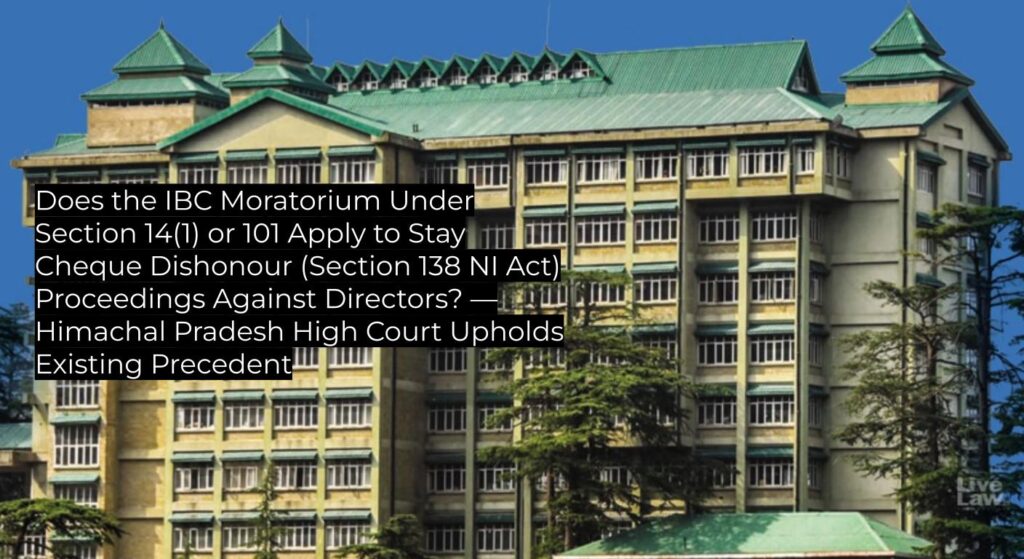
IBC moratorium provisions do not bar continuation of Section 138 NI Act proceedings against natural persons (directors/guarantors); protection extends only to the corporate debtor (company). Judgment aligns with and affirms Supreme Court and other High Court precedents, reinforcing binding authority on this legal question.
Summary
| Category | Data |
|---|---|
| Case Name | CRMMO/1107/2024 of M/S HARI RAM MOTORS PVT LTD AND OTHERS Vs SBI |
| CNR | HPHC010551902024 |
| Date of Registration | 12-11-2024 |
| Decision Date | 30-10-2025 |
| Disposal Nature | Dismissed |
| Judgment Author | HON’BLE MR. JUSTICE RAKESH KAINTHLA |
| Court | High Court of Himachal Pradesh |
| Bench | Single Judge Bench — HON’BLE MR. JUSTICE RAKESH KAINTHLA |
| Precedent Value | Binding authority for courts in Himachal Pradesh; persuasive for other jurisdictions |
| Overrules / Affirms | Affirms existing Supreme Court and High Court precedents |
| Type of Law | Criminal and Insolvency Law |
| Questions of Law |
|
| Ratio Decidendi |
The moratorium under Sections 14(1) and 101 of the Insolvency and Bankruptcy Code, 2016, applies only to the corporate debtor (the company), not to its directors or natural persons implicated under Section 138/141 NI Act. The proceedings against directors/guarantors for cheque dishonour continue irrespective of insolvency/liquidation proceedings against the company. Inordinate delay and non-use of alternative remedies such as revision petitions further disentitle petitioners from relief under Section 482 CrPC. Exceptional circumstances alone can justify quashing cognisance after charges or notices are framed, and such circumstances were not shown here. |
| Judgments Relied Upon |
|
| Logic / Jurisprudence / Authorities Relied Upon by the Court | Sections 14, 96, 101 of IBC apply a moratorium to the “corporate debtor” only, with no bar on criminal prosecution of directors/signatories under Section 138/141 NI Act; object of NI Act would be defeated if personal responsibility could be avoided by insolvency of corporate debtor. |
| Facts as Summarised by the Court | Petitioners (a company and directors) were subjected to Section 138 NI Act proceedings for cheque dishonour; company entered insolvency/liquidation under IBC and sought stay of trial, arguing IBC moratorium bars proceedings; trial court stayed proceedings against company but not directors; petitioners challenged this and the cognisance orders, arguing for full stay/quashing. |
Practical Impact
| Category | Impact |
|---|---|
| Binding On | All subordinate courts in Himachal Pradesh |
| Persuasive For | Other High Courts, Supreme Court |
| Follows |
|
What’s New / What Lawyers Should Note
- Reaffirms that IBC moratorium (Sections 14/101) applies only to corporate debtors; directors/natural persons remain prosecutable under Section 138 NI Act.
- Prosecution under Section 138/141 continues even if company is under liquidation or insolvency.
- Inordinate delay and failure to use revision remedy bars invocation of Section 482 CrPC for quashing cognisance orders, except in rare cases.
- The judgment binds subordinate courts in Himachal Pradesh; persuasive for nationwide use in cheque dishonour + IBC overlap cases.
- Specific reference to timing and procedural strategy: petitions assailing cognisance/orders must be prompt; delay/laches is fatal.
Summary of Legal Reasoning
- The court first sets out the factual basis: company’s cheque dishonoured, directors/guarantors held responsible, initiation of Section 138 NI Act proceedings.
- The accused sought to stay/quash the proceedings based on IBC moratorium, citing Sections 14(1) and 101 and liquidation orders.
- The court explores leading Supreme Court authorities: Rakesh Bhanot v. Gurdas Agro (P) Ltd., P. Mohanraj v. Shah Bros. Ispat (P) Ltd., Ajay Kumar Radheyshyam Goenka v. Tourism Finance Corpn. Of India Ltd., and Narinder Garg v. Kotak Mahindra Bank Ltd.
- Relying on these, it holds: moratorium under IBC protects corporate debtor (the company) only, not natural persons; Section 138 NI Act prosecution is essentially penal and not “action in respect of debt” so as to be stayed.
- Direct reference is made to statutory construction and legislative intent: integrity of negotiable instrument system must be preserved.
- The court then analyses the delay/laches ground using Sanyam Bhushan v. State (NCT of Delhi) and Minakshi Bala v. Sudhir Kumar: discretion under Section 482 CrPC is narrower after cognisance; alternative statutory remedies existed and were not used; mere passage of time or pendency of trial is not a reason for blanket quashment.
- No exceptional/forensic exigency shown to depart from settled practice of not allowing delayed Section 482 petitions after framing of charges.
- Accordingly, the petitions are dismissed; no case to interfere found.
Arguments by the Parties
Petitioner
- IBC moratorium in light of company’s liquidation should stay all criminal proceedings against both company and directors.
- Trial court erred in taking cognizance as complaint lacked specific averments regarding directors’ responsibility or consent/connivance.
- The complaint was inherently improbable, suggesting mala fides.
- Delay in payment should have led to instalments, not a single large cheque.
- The proceedings are motivated by mala fides and should be quashed.
Respondent (State Bank of India)
- The complaint specifically alleged that directors were responsible and acted as authorised signatories/guarantors.
- Moratorium under IBC does not protect directors/natural persons — only the company.
- Trial court’s orders to proceed against directors (but not the company) are legally correct.
- No infirmity in trial court’s order; petitions should be dismissed.
Factual Background
A company and its directors, involved in the business of automobile dealership, availed a credit facility from a nationalised bank. On defaulting, the company issued a cheque of ₹2 crore, which bounced due to insufficient funds. The bank issued statutory notice under Section 138 NI Act, which was refused by the addressee; on deemed service and non-payment, a criminal complaint was filed. Subsequently, the company entered insolvency/liquidation, leading to applications for stay of proceedings—partly allowed against the company, but not against the directors. Aggrieved, the petitioners challenged the continuance of proceedings against the directors and sought quashing of cognisance.
Statutory Analysis
- Sections 14 and 101 of the Insolvency and Bankruptcy Code, 2016: Moratorium applies to the “corporate debtor” (company), not to natural persons (directors/guarantors).
- Section 138, 141 NI Act, 1881: Criminal liability for cheque dishonour extends to those responsible for management of company.
- Section 482 CrPC: Inherent powers of High Court to quash proceedings are discretionary, to be sparingly used, particularly not when alternative remedies exist or there is unexplained delay.
- Section 313 CrPC: Statement of accused to be recorded as per order of trial court.
Alert Indicators
- ✔ Precedent Followed – Existing Supreme Court and High Court authority is affirmed and restated.