


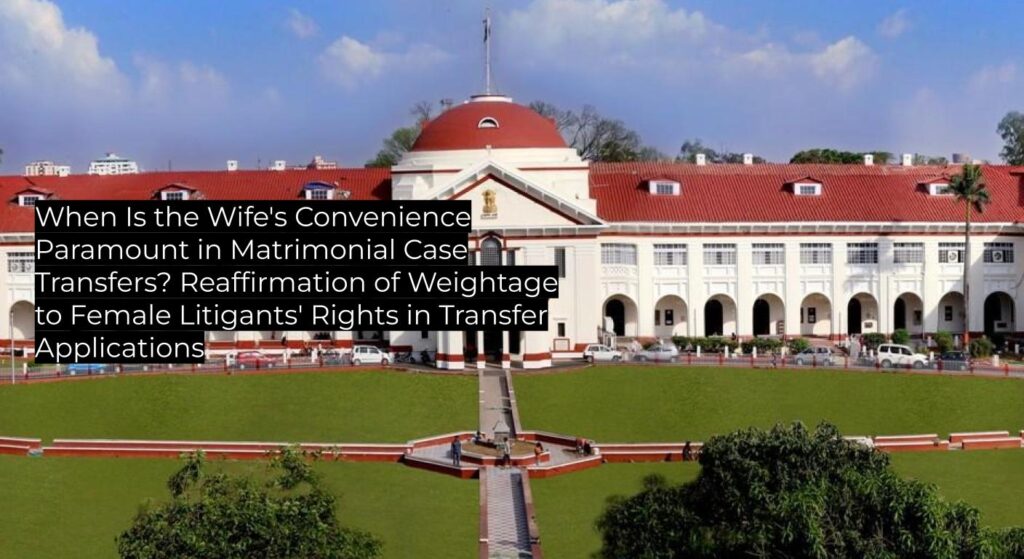
Patna High Court upholds the settled legal principle that, in matrimonial cases, the convenience of the wife/female litigant merits greater consideration for transfer petitions. The Court, drawing directly on Supreme Court precedents, affirms and applies the established approach; its holding is binding on subordinate courts and persuasive in similar future transfer matters in matrimonial disputes.
Summary
| Category | Data |
|---|---|
| Case Name | MJC/2125/2023 of Swarnima Gupta @ Anita Gupta, Vs Barun Kumar Choudhary |
| CNR | BRHC010719512023 |
| Date of Registration | 03-08-2023 |
| Decision Date | 31-10-2025 |
| Disposal Nature | ALLOWED |
| Judgment Author | MR. JUSTICE HARISH KUMAR |
| Court | Patna High Court |
| Precedent Value | Binding on Bihar subordinate courts; persuasive elsewhere |
| Overrules / Affirms | Affirms Supreme Court precedents (Sumita Singh v. Kumar Sanjay; Rajani Kishor Pardeshi v. Kishor Babulal Pardeshi) |
| Type of Law | Matrimonial Law; Civil Procedure |
| Questions of Law | Whether transfer of matrimonial proceedings should prioritise the convenience of the wife/female litigant. |
| Ratio Decidendi |
The Court held that in matrimonial transfer petitions, greater weight and consideration should be given to the convenience of the wife/female litigant. The facts highlighted the petitioner’s requirement to travel a significant distance and lack of financial support, making it reasonable to transfer the case. No material was placed by the respondent to establish hardship or raise substantial objection to the transfer. The principle reaffirmed derives support from Supreme Court judgments making wife’s convenience a paramount consideration in such transfer matters. |
| Judgments Relied Upon |
|
| Logic / Jurisprudence / Authorities Relied Upon by the Court | Supreme Court’s settled law emphasizing the convenience of female litigants for transfer of matrimonial proceedings. |
| Facts as Summarised by the Court |
After marriage in 2018, the petitioner faced dowry demands and alleged harassment, leading to criminal and maintenance proceedings in Chapra. Opposite party filed for divorce in Katihar. The petitioner, residing in Chapra, faced hardship traveling over 375 km for proceedings due to financial constraints. |
Practical Impact
| Category | Impact |
|---|---|
| Binding On | All subordinate courts in Bihar |
| Persuasive For | Other High Courts, Supreme Court |
| Follows |
|
What’s New / What Lawyers Should Note
- The judgment restates that in transfer petitions involving matrimonial matters, the convenience of the wife/female litigant is to be given paramount importance.
- Cites and follows Supreme Court authority directly; advocates can rely on this as binding precedent in Bihar and as persuasive authority elsewhere.
- Absence of counter-affidavit or substantial opposing material from the respondent strengthens the case for transfer.
- The existence of related criminal and maintenance proceedings in the proposed transferee court’s jurisdiction bolsters the argument for transfer.
Summary of Legal Reasoning
- The Court reviewed the petitioner’s claims of financial hardship, long travel distance (375 km), and the location of ongoing related proceedings (maintenance and criminal cases) within Chapra’s jurisdiction.
- The respondent did not file a counter affidavit nor did he substantively object to the facts or practicality of the transfer, even indicating willingness to attend at an alternate neutral venue.
- The Court placed reliance on Supreme Court decisions Sumita Singh v. Kumar Sanjay and Rajani Kishor Pardeshi v. Kishor Babulal Pardeshi, which establish that, in matrimonial transfer petitions, heavier weightage is to be accorded to the convenience of the wife.
- Considering all facts, absence of compelling opposing material, and judicial precedent, the Court allowed the application and ordered transfer of the matrimonial case to Chapra.
Arguments by the Parties
Petitioner:
- The petitioner, being forced to reside with aged parents and lacking financial support, faces severe inconvenience and risk in traveling approximately 375 km for each hearing.
- Maintenance and criminal proceedings linked to the marital dispute are already ongoing in Chapra, making it pragmatic to consolidate jurisdiction for convenience and safety.
Respondent:
- Asserted that the divorce case was at the final stage in Katihar and alleged the petitioner was deliberately delaying proceedings.
- Did not dispute facts set out in the transfer petition.
- Stated no objection to transfer to a “third place” if the Court saw fit.
Factual Background
The parties married on 25.06.2018. The petitioner alleged harassment over dowry, leading to the filing of a criminal complaint and a police case in Saran, as well as maintenance proceedings before the Family Court, Chapra. The respondent filed Matrimonial (Divorce) Case No. 175 of 2019 in Katihar. The petitioner, residing in Chapra and dependent on aged parents, sought transfer due to distance, lack of financial means, and threat perception, especially since related litigation was already pending in Chapra courts.
Statutory Analysis
- The Court did not interpret statutory provisions in detail but applied established legal norms from Supreme Court precedent.
- The legal analysis focused on the discretionary power to transfer cases under the Code of Civil Procedure, especially in matrimonial disputes, as shaped by the Supreme Court’s pronouncements.
- Reinforced the principle that “convenience of the wife” is a decisive factor for transfer in matrimonial proceedings.
Dissenting / Concurring Opinion Summary
No dissenting or concurring opinions were recorded in this case.
Procedural Innovations
- The Court reiterated the procedural precedent that, in the absence of substantive objection or significant difficulty presented by the respondent, transfer in favour of the wife is justified.
- No new guidelines or innovations; but reinforced the duty to consider consolidated jurisdiction for related matrimonial and criminal matters.
Alert Indicators
- ✔ Precedent Followed – Court expressly applied and affirmed existing Supreme Court authority on transfer of matrimonial cases favouring the wife’s convenience.