


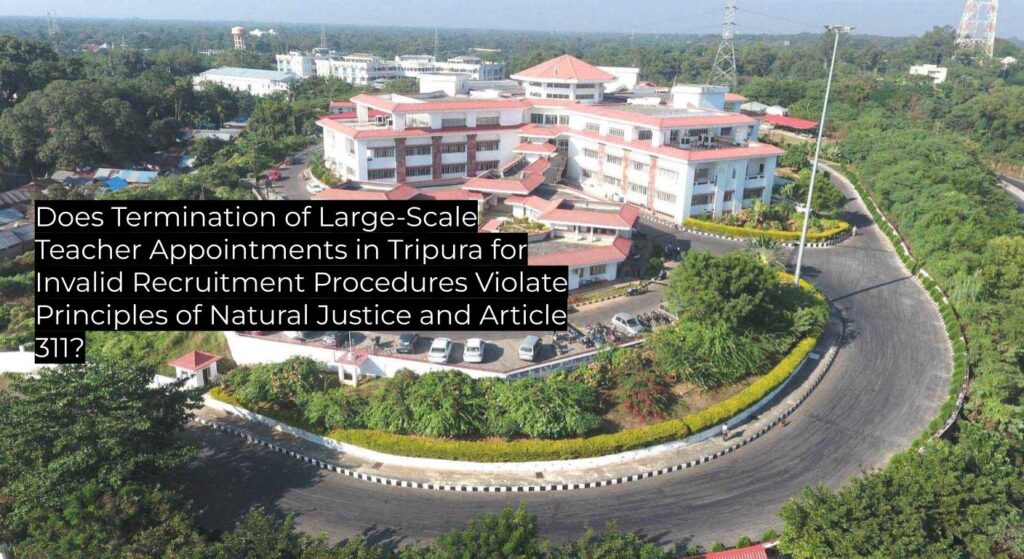
The High Court of Tripura reaffirmed and applied previous Division Bench and Full Bench precedents to hold that the mass termination of under graduate, graduate, and post graduate teachers pursuant to invalid recruitment processes did not violate principles of natural justice or Article 311, since the entire appointment process was previously adjudged illegal and set aside. This judgment is binding on subordinate courts within Tripura, confirming the established position that no further individual show cause or hearing was necessary in such circumstances.
Summary
| Category | Data |
|---|---|
| Case Name | WP(C)/699/2024 of Subhash Sinha and 702 others Vs The State of Tripura and 2 Others |
| CNR | TRHC010014832024 |
| Date of Registration | 13-11-2024 |
| Decision Date | 31-10-2025 |
| Disposal Nature | Dismissed |
| Judgment Author | HON’BLE MR. JUSTICE S. DATTA PURKAYASTHA |
| Court | High Court of Tripura |
| Bench | Single Judge |
| Precedent Value | Binding on subordinate courts in Tripura (High Court authority); persuasive for other High Courts |
| Overrules / Affirms | Affirms prior decisions: Tanmoy Nath v. State of Tripura, Bijoy Krishna Saha v. State of Tripura (DB), Pranab Deb v. State of Tripura (Full Bench) |
| Type of Law | Service Law—Government employment, natural justice, mass termination, Article 311 |
| Questions of Law |
|
| Ratio Decidendi |
The Court held that where an entire recruitment process is set aside by a judicial pronouncement (as in Tanmoy Nath and affirmed by the Supreme Court), subsequent terminations in implementation of those orders do not require individual notice, show cause, or hearing under Article 311 or CCS (CCA) Rules. The principles of natural justice are not violated in such mass termination because the appointments themselves were found void ab initio for lack of a valid selection process. Multiple Benches including Division and Full Bench have rejected similar challenges by other terminated teachers, and those decisions are binding as precedent. Further, the passage of time, lack of challenge, and public notice defeat arguments based on lack of party status or notice. Attempts to re-open issues already settled by higher Bench are an abuse of process. |
| Judgments Relied Upon |
|
| Logic / Jurisprudence / Authorities Relied Upon by the Court |
|
| Facts as Summarised by the Court |
|
Practical Impact
| Category | Impact |
|---|---|
| Binding On | All subordinate courts in Tripura, including government departments executing similar mass termination arising from set aside selection processes. |
| Persuasive For | Other High Courts, especially in analogous mass-illegality recruitments; references to this precedent are likely to be cited if large-scale selections are set aside as illegal. |
| Overrules | None (Affirms Tanmoy Nath and subsequent DB/FB precedents) |
| Distinguishes | Abul Bashar Zia Uddin v. State of Tripura (appointments made after/Tanmoy Nath, different process); Sudip Kumar Debnath case (science teachers, separate context) |
| Follows |
|
What’s New / What Lawyers Should Note
- Reaffirms that mass terminations arising from judicially set aside recruitment processes—due to illegality or policy being declared unconstitutional—do not require individual notices or proceedings under Article 311 or CCS (CCA) Rules.
- Confirms that principles of natural justice need not be individually satisfied in cases of wholesale invalid selections (“stinking, conceived in fraud, delivered in deceit”).
- Division Bench and Full Bench decisions on the same controversy are binding on Single Judge benches; legal arguments already rejected in those cases cannot be re-argued in new petitions.
- Participation in earlier litigation not necessary for appointment to be affected if representative (Order I Rule 8 CPC) public notice was given; finality of previous common judgments applies.
- Subsequent regularization or continuation on ad-hoc does not revive rights if the foundational selection was quashed.
- Serious cost warning (Rs. 25,000 per petition) for repeated, speculative, or test litigation efforts to re-open settled controversies.
Summary of Legal Reasoning
- Foundational Adjudication: The recruitment processes in 2002, 2006, and 2009 were set aside as illegal and unconstitutional in Tanmoy Nath by a Division Bench—affirmed by the Supreme Court.
- Scope of Binding Orders: All appointments undertaken under those advertisements and policies were invalid; continued engagement was only for transition, later fully terminated as per judicial orders.
- Effect of Non-Participation/Public Notice: Since notices under Order I Rule 8 CPC were published in widely circulated newspapers, affected teachers (even if not individually named or arrayed) were bound by the adjudication.
- No Violation of Natural Justice/Article 311: Termination was not for misconduct or by disciplinary process—it was in compliance with binding judicial directions. No individual hearing required; such exceptions recognised in law where fraud/illegality taint entire appointment process.
- Precedent and Judicial Discipline: Prior Division Bench and Full Bench judgments specifically addressed and rejected arguments on natural justice, regularization, and party status. A Single Bench is absolutely bound to follow those holdings; attempts to re-litigate are not permissible.
- No “Res Judicata” Needed—Precedent is Sufficient: The rule applied was not res judicata (which needs identical parties and lis) but of stare decisis: a legal finding by a higher Bench on the same legal issue is binding, including in fresh petitions by similarly situated persons.
Arguments by the Parties
Petitioner
- Appointments not governed by the challenged 2003 policy; they were recruited under other Rules/policies of 1971 & 2007.
- Were not parties in Tanmoy Nath or given notice; hence, not bound by that judgment.
- The 2003 policy was a mere memorandum, not a final “employment policy.”
- Article 311 and CCS (CCA) Rules not followed; no notice or opportunity to be heard before termination.
- Termination illegal/unconstitutional as services had been regularized and not all selections were tainted.
- Cited case law on natural justice, per incuriam decisions, and technical defects in representative proceedings.
Respondent (State)
- Recruitment was in fact made under the 2003 policy; all adverts were part of the process set aside in Tanmoy Nath.
- All arguments raised now were addressed and rejected in multiple prior High Court judgments (DB/FB).
- Public notice sufficed for binding legal effect; party status or direct participation not required.
- Termination carried out in compliance with binding judicial direction; no disciplinary case or individual inquiry required.
- Referenced and relied upon Division Bench and Full Bench precedents as conclusive.
Factual Background
In 2002, 2006, and 2009, Tripura government issued advertisements to recruit under graduate, graduate, and post graduate teachers for state schools. The recruitment process, grounded in a 2003 employment policy, led to appointments which were later challenged before the Gauhati High Court (Agartala Bench). The Division Bench in Tanmoy Nath v. State of Tripura quashed the policy and all related appointments, holding the selection illegal and unconstitutional. Supreme Court affirmed the result, with transitional protection until new selections could be completed. Affected teachers were terminated at the conclusion of this period, with some ad-hoc extension before their ultimate termination in March 2020. The present petitions were filed by a subset of those terminated, arguing lack of party status, non-application of the 2003 policy, and violation of natural justice.
Statutory Analysis
- Article 311, Constitution of India: The Court found that Article 311 (requiring notice and inquiry for termination on misconduct) did not apply—termination was due to set aside recruitment, not disciplinary process or misconduct.
- CCS (CCA) Rules, 1965: Found inapplicable as the termination was not a disciplinary action.
- Order I Rule 8, CPC: Representative action and public notice by Court sufficient for binding effect upon all similarly placed employees.
- No “reading down/reading in”: The Court applied the applicable constitutional and procedural rules as settled by precedent.
Procedural Innovations
The Court did not specify any new procedural precedent beyond application of established principles regarding representative actions (Order I Rule 8, CPC) and judicial discipline in following Division Bench or Full Bench decisions.
Alert Indicators
- Precedent Followed – Existing DB and Full Bench precedent reaffirmed and followed; no deviation from established law.