


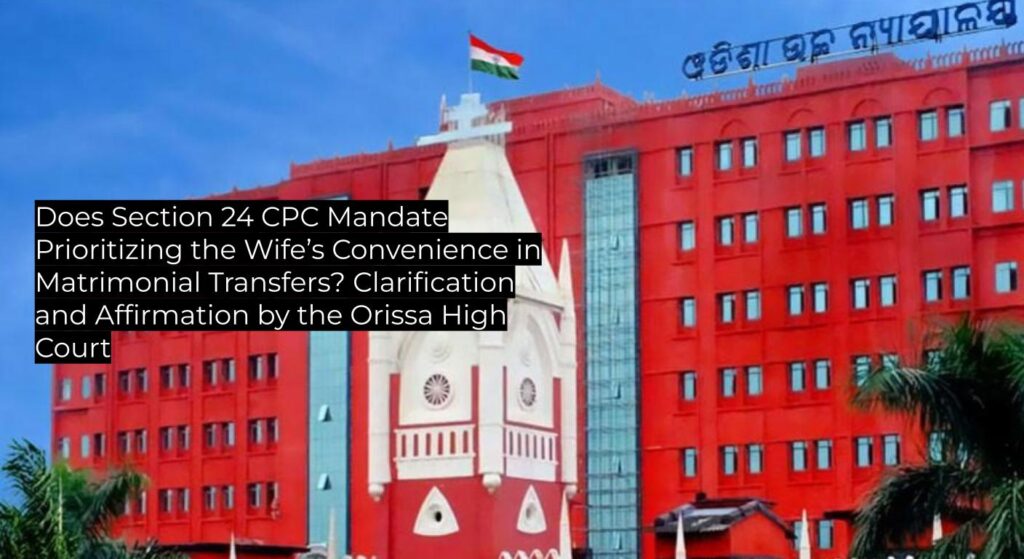
The Orissa High Court reaffirms that while exercising powers under Section 24 of the Code of Civil Procedure in matrimonial matters, the paramount consideration is the convenience of the wife. Upholding Supreme Court precedent, the judgment provides binding authority for courts in matrimonial transfer petitions, especially within Orissa’s jurisdiction.
Summary
| Category | Data |
|---|---|
| Case Name | TRP(C) No.85 of 2025, Subhalaxmi Pradhan vs Kumar Avinash |
| CNR | ODHC010202632025 |
| Date of Registration | 21-03-2025 |
| Decision Date | 17-10-2025 |
| Disposal Nature | Disposed Off |
| Judgment Author | MR. JUSTICE SANJAY KUMAR MISHRA |
| Court | Orissa High Court, Cuttack |
| Bench | Single Judge Bench (Justice Sanjay Kumar Mishra) |
| Precedent Value | Binding within the jurisdiction of the Orissa High Court |
| Overrules / Affirms | Affirms Supreme Court precedent, particularly N.C.V. Aishwarya v. A.S. Saravana Karthik Sha (2022 SCC Online SC 1199) |
| Type of Law | Civil Procedure – Matrimonial Transfer Petitions under Section 24 CPC |
| Questions of Law | Whether, in matrimonial matters, the wife’s convenience should be prioritized when deciding applications for transfer of proceedings under Section 24 CPC. |
| Ratio Decidendi |
The Court, relying upon Supreme Court precedent, reiterated that the settled law requires courts to take into account the wife’s convenience while deciding transfer petitions in matrimonial matters. This includes considering factors such as her economic standing, dependence, distance, childcare responsibilities, and threats to safety. In the instant case, the Court allowed the transfer petition, recognizing the wife’s difficulties regarding distance, safety, and care of her minor child, and directed that matters be transferred accordingly. Provision for virtual appearance was also recognized in line with modern procedure and court facilities. |
| Judgments Relied Upon | N.C.V. Aishwarya v. A.S. Saravana Karthik Sha, 2022 SCC Online SC 1199 |
| Logic / Jurisprudence / Authorities Relied Upon by the Court | The Court followed the Supreme Court’s cardinal principle that ‘the ends of justice should demand the transfer’, and in matrimonial proceedings, wife’s convenience is pivotal considering the socio-economic paradigm. |
| Facts as Summarised by the Court |
The petitioner-wife, after separation from her husband, resided in Sambalpur with her aged parents and minor child. The matrimonial proceeding was pending in Dhenkanal, over 400 km away. The petitioner cited hardship, lack of income, care duties toward her child, her child’s schooling in Sambalpur, and safety concerns at Dhenkanal. The opposite party’s counsel opposed, noting care obligations toward his ailing mother and suggesting virtual appearance. Court considered all submissions and allowed transfer to Sambalpur. |
Practical Impact
| Category | Impact |
|---|---|
| Binding On | All subordinate courts within Orissa |
| Persuasive For | Other High Courts in India; may have persuasive value before the Supreme Court |
| Follows | N.C.V. Aishwarya v. A.S. Saravana Karthik Sha (2022 SCC Online SC 1199) |
What’s New / What Lawyers Should Note
- Reaffirms that the convenience of the wife is the guiding factor in transfer petitions concerning matrimonial disputes under Section 24 CPC.
- Recognizes and accommodates virtual appearances during matrimonial proceedings subject to court’s discretion and in accordance with High Court video conferencing rules.
- Directs expeditious transfer and disposal timelines (case to be re-registered promptly and concluded preferably within six months).
- Reminds both parties to avoid unnecessary adjournments and cooperate for early disposal.
- Highlights the duty on parties to proactively seek information on case postings post-transfer.
Summary of Legal Reasoning
- The Court began by reciting the grounds of hardship, safety, and childcare advanced by the petitioner-wife for transfer of proceedings.
- The opposing party suggested the feasibility of virtual appearance and cited his own familial obligations.
- The judgment explicitly relied on the Supreme Court decision in N.C.V. Aishwarya v. A.S. Saravana Karthik Sha, reiterating that in matrimonial transfers, the wife’s convenience is generally preferred, given the socio-economic realities in Indian society.
- Applying this settled principle, and considering the petitioner’s lack of income, responsibilities, and safety concerns, the Court found sufficient cause to allow the transfer.
- The Court provided for the possibility of virtual attendance by either party via video conferencing rules, balancing technological advances with legal process requirements.
- Directions were given for swift transmission, re-registration, and disposal to minimize delay.
Arguments by the Parties
Petitioner
- Resides in Sambalpur with aged parents and minor child following separation.
- Dhenkanal is more than 400 km away, creating significant hardship to attend proceedings.
- Has no independent income; is dependent on parents.
- Child’s education is at Sambalpur, further complicating appearances.
- Alleges threat to personal safety if required to appear at Dhenkanal.
Opposite Party
- If attending court physically is difficult, an application for virtual appearance/deposition can be filed.
- Husband has to care for his own aged, ailing mother suffering from various old age ailments.
Factual Background
The petitioner-wife sought transfer of a matrimonial proceeding from Dhenkanal to Sambalpur. She currently resides in Sambalpur with her aged parents and her eight-year-old child. The distance between Sambalpur and Dhenkanal is over 400 kilometers, and she faces difficulties due to lack of income, childcare responsibilities, and safety threats. The husband opposed the transfer, highlighting his obligation to care for his ailing mother and suggesting virtual hearing as an alternative.
Statutory Analysis
- Section 24 of the Code of Civil Procedure was the central provision, empowering courts to transfer suits and proceedings to serve the ends of justice.
- The court interpreted Section 24 in line with Supreme Court guidance, emphasizing the need to prioritize the wife’s convenience in matrimonial matters.
- The Orissa High Court Video Conferencing for Courts Rules, 2020 were also referenced, enabling the parties to appear and depose virtually with court permission.
Dissenting / Concurring Opinion Summary
No dissenting or concurring opinions were present or recorded in the judgment.
Procedural Innovations
- Explicit direction for the use of video conferencing as an option for parties unable to physically appear, subject to court permission.
- Fixed timelines for transfer and disposal (case record to be transmitted within 7 days; proceeding to be disposed preferably within 6 months of receipt).
- Parties directed to themselves (or through counsel) proactively obtain information about court hearings, without waiting for formal notice.
Alert Indicators
- ✔ Precedent Followed – The judgment follows and affirms existing Supreme Court law on matrimonial transfers under Section 24 CPC.