


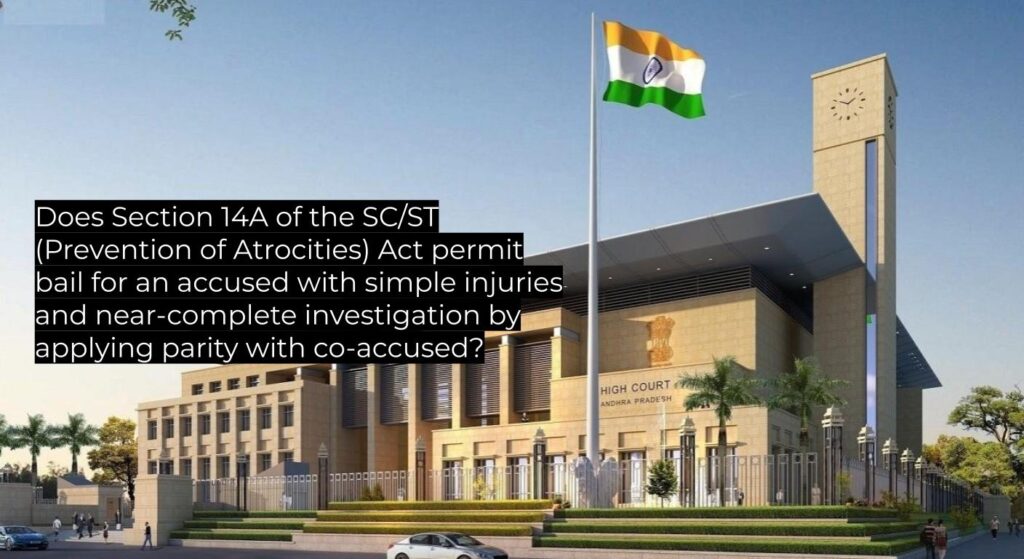
Summary
| Category | Data |
|---|---|
| Case Name | CRLA/559/2025 of Peram Ganesh Vs The State of Andhra Pradesh |
| CNR | APHC010425872025 |
| Decision Date | 02-09-2025 |
| Disposal Nature | ALLOWED |
| Judgment Author | Justice B.V.L.N. Chakravarthi |
| Court | High Court of Andhra Pradesh |
| Bench | Single-Judge Bench |
| Precedent Value | Binding on subordinate courts in Andhra Pradesh |
| Overrules / Affirms | Affirms established bail principles under Section 14A SC/ST Act |
| Type of Law | Criminal law – Bail under the Scheduled Castes and Scheduled Tribes (Prevention of Atrocities) Act, 1989 |
| Questions of Law | Whether an accused can be granted bail under Section 14A of the SC/ST Act when the victim’s injuries are simple, investigation is nearly complete, and a co-accused is on bail. |
| Ratio Decidendi |
The High Court held that when the wound certificate classifies injuries as simple and the investigation is substantially complete, bail may be granted under Section 14A. The court applied the parity principle after noting that a co-accused (A1) was already enlarged on bail, and released the appellant (A3) on bail subject to conditions—personal bond with sureties, periodic court appearance, travel restrictions, and non-harassment of the victim—to ensure consistency and fairness in bail orders under the SC/ST Act. |
| Logic / Jurisprudence / Authorities Relied Upon by the Court |
|
| Facts as Summarised by the Court | Victim’s injuries were simple in nature; investigation into Crime No.61/2025 was almost complete; a co-accused (A1) had already been granted bail. |
Practical Impact
| Category | Impact |
|---|---|
| Binding On | All subordinate courts in Andhra Pradesh |
| Persuasive For | Other High Courts and tribunals dealing with SC/ST Act bail petitions |
What’s New / What Lawyers Should Note
- The parity principle under Section 14A SC/ST Act can ground bail when co-accused has already been released.
- Simple injuries (per wound certificate) and near-completion of investigation weigh in favor of bail under Section 14A.
- High Court’s bail conditions include personal bond with sureties, mandated periodic court appearance, travel restrictions, and prohibition on victim harassment.
Summary of Legal Reasoning
- The wound certificate classified the victim’s injuries as simple.
- Investigation into the offence was almost complete.
- A co-accused (A1) had been granted bail on similar grounds.
- The court invoked the parity principle to ensure consistent treatment of co-accused under Section 14A.
- Exercised discretionary power under Section 14A of the SC/ST Act to grant bail.
- Imposed specific bail conditions: bond with sureties, appearance on every fourth Saturday, travel restrictions, and non-harassment of victim.
Arguments by the Parties
Petitioner (Appellant A3):
- Victim’s injuries were simple in nature, as per the wound certificate.
- Investigation into the offence was nearly complete.
- Parity with co-accused (A1), who was granted bail, warrants bail for A3.
Respondent (State):
- Investigation is almost complete.
- No objection to bail on parity grounds once these factors are satisfied.
Factual Background
The appellant (A3) was one of three accused in Crime No.61 of 2025 at Gooty Police Station under the SC/ST (Prevention of Atrocities) Act. His initial bail application was dismissed by the Special Court on 22.07.2025, while co-accused A1 was subsequently released on bail. A3 appealed under Section 14A of the Act to the Andhra Pradesh High Court. The wound certificate recorded simple injuries, and the investigation was largely complete. On these grounds and by applying the parity principle, the High Court granted bail to A3 on specified conditions.
Alert Indicators
- Precedent Followed