


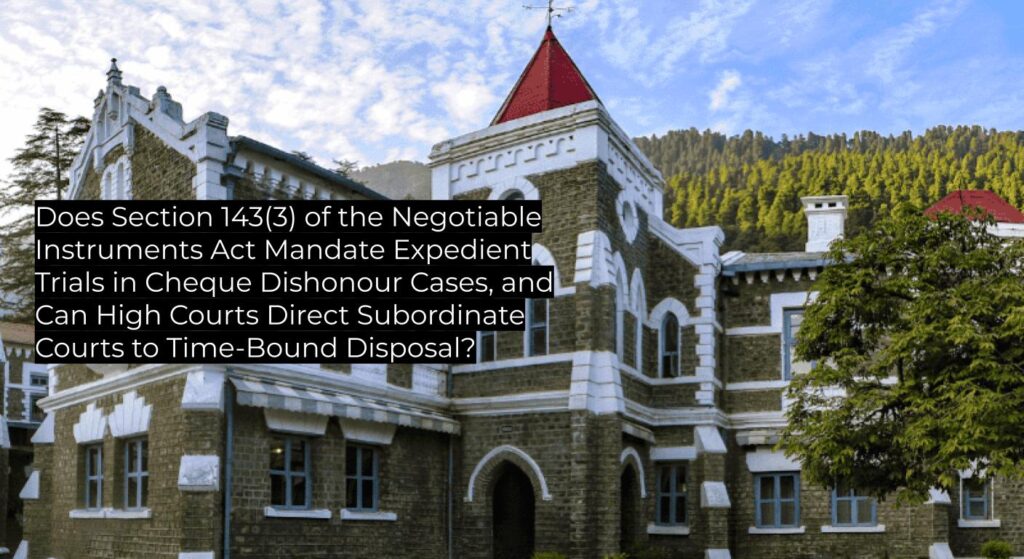
The Uttarakhand High Court reaffirms the statutory mandate of Section 143(3) of the N.I. Act requiring prompt disposal of cheque dishonour cases and exercises its supervisory jurisdiction to order all subordinate courts concerned to conclude long-pending Section 138 cases within one year, reinforcing binding authority on timelines for such matters.
Summary
| Category | Data |
|---|---|
| Case Name | C528/1881/2025 of ANIL PAL Vs RAJAT GUPTA |
| CNR | UKHC010166122025 |
| Date of Registration | 15-10-2025 |
| Decision Date | 17-10-2025 |
| Disposal Nature | DISPOSED |
| Judgment Author | HON’BLE MR. JUSTICE PANKAJ PUROHIT |
| Court | High Court of Uttarakhand |
| Precedent Value | Binding authority for subordinate courts in Uttarakhand on expeditious trial under Section 143(3) of N.I. Act |
| Type of Law | Criminal Procedure; Negotiable Instruments Act |
| Questions of Law |
|
| Ratio Decidendi |
Section 143(3) of the N.I. Act mandates that every trial under Section 138 must be concluded expeditiously, with an endeavour to conclude within six months from complaint filing. The court observed that several such matters had been pending for more than six years. To uphold the statutory mandate, it is necessary for the High Court to direct subordinate courts to expedite proceedings and ensure disposal within a fixed time. The High Court thus ordered all lower courts concerned to conclude listed cheque bounce cases within one year from production of its order. |
| Logic / Jurisprudence / Authorities Relied Upon by the Court | The statutory directive in Section 143(3) N.I. Act for swift disposal of Section 138 cases; necessity for High Court to intervene when legislative intent is not being followed by subordinate courts. |
| Facts as Summarised by the Court | Multiple applications were moved seeking directions for expeditious disposal of long-pending Section 138 N.I. Act complaint cases, some pending for over six years. Respondents in these applications are parties to various cheque bounce litigations, and the applicants had approached the High Court for directions per Section 143(3) N.I. Act. |
Practical Impact
| Category | Impact |
|---|---|
| Binding On | All subordinate courts in Uttarakhand (specifically those listed in the order) |
| Persuasive For | High Courts in other states considering expeditious disposal of N.I. Act cases |
What’s New / What Lawyers Should Note
- The High Court has explicitly directed subordinate courts to conclude long-pending Section 138 N.I. Act cases within one year of presenting the order, reinforcing strict compliance with Section 143(3).
- This judgment may be cited to secure early hearings or orders for time-bound disposal of protracted cheque dishonour trials.
- Lawyers should advise clients that delays beyond the statutory timeline may justify approaching the High Court for similar directions.
Summary of Legal Reasoning
- The court notes that Section 143(3) of the Negotiable Instruments Act requires Section 138 trials to be concluded as expeditiously as possible, aiming for completion within six months.
- The applications demonstrate that several cheque dishonour cases have been pending in subordinate courts for significantly longer periods, some since 2019.
- Observing that legislative intent is not being realised in practice, the court holds it necessary to enforce the statutory timeframe by using its supervisory and constitutional jurisdiction.
- The High Court consequently directs the concerned subordinate courts to make every effort to conclude the specific pending cases within one year from receipt of the order.
Arguments by the Parties
Petitioner
- Prayed for directions to expedite proceedings in multiple long-pending Section 138 N.I. Act complaint cases.
- Relied upon the statutory mandate under Section 143(3) N.I. Act, which stipulates time-bound trial.
Respondent
No separate submissions recited in the order.
Factual Background
Multiple parties filed applications under Section 482 CrPC seeking directions for expeditious disposal of their pending criminal complaints under Section 138 of the Negotiable Instruments Act. The cases in question, being cheque bounce complaints, had been pending in subordinate courts for periods ranging up to six years. The applicants contended that such delay violated the legislative intent embodied in Section 143(3) of the N.I. Act.
Statutory Analysis
- Section 143(3) Negotiable Instruments Act: The statute mandates that trials for offences under Section 138 are to be concluded “as expeditiously as possible” and that an endeavour shall be made to dispose them of within six months of complaint filing.
- The court interprets the provision as requiring subordinate courts to prioritise and accelerate hearing and adjudication in N.I. Act cases, especially where timelines have not been followed.
Procedural Innovations
- The court consolidated multiple similar applications for a common order, streamlining the process for providing directions on expeditious trial.
- Issued a uniform, time-bound direction applicable to all subordinate courts named in the chart appended to the order, creating a procedural precedent for handling numerous, similarly situated pending matters together.
Alert Indicators
- ✔ Precedent Followed – Statutory mandate under Section 143(3) N.I. Act reaffirmed.