


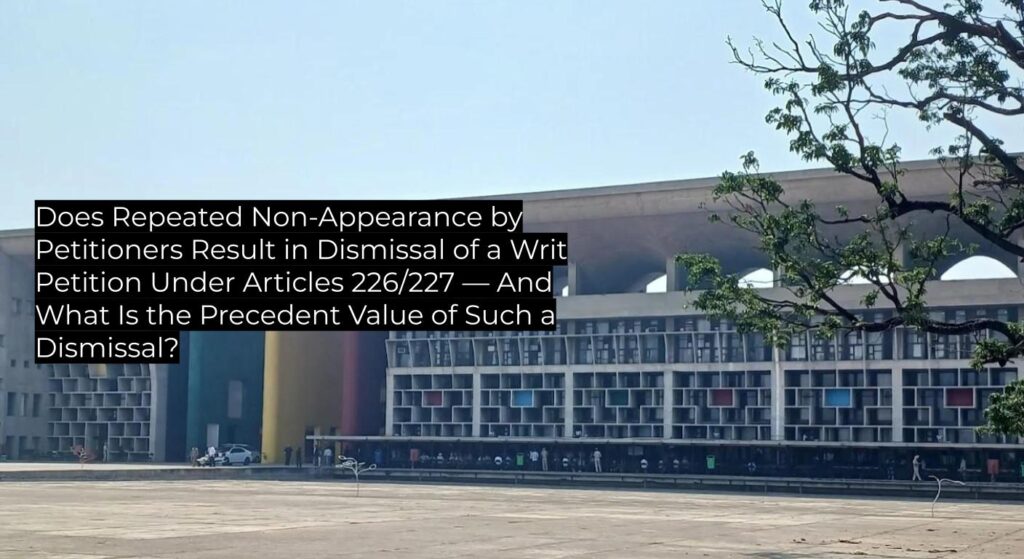
When no appearance is made by petitioners despite opportunities, a writ petition under Articles 226/227 may be dismissed for want of prosecution. This judgment affirms the continuing practice in writ jurisdiction and serves as binding precedent on dismissal procedure within the Punjab and Haryana High Court.
Summary
| Category | Data |
|---|---|
| Case Name | CWP/3844/2001 of MOOL CHAND AND OTHERS Vs THE JALANDHAR CENTRAL COOP. BANK LTD. CNR PHHC010301652001 |
| Date of Registration | 14-03-2001 |
| Decision Date | 29-10-2025 |
| Disposal Nature | DISMISSED |
| Judgment Author | MR. JUSTICE HARPREET SINGH BRAR |
| Court | High Court of Punjab and Haryana |
| Bench | Single Judge (MR. JUSTICE HARPREET SINGH BRAR) |
| Precedent Value | Binding within jurisdiction for similar facts relating to dismissal for non-prosecution |
| Type of Law | Constitutional Writ (Articles 226/227) |
| Questions of Law | Procedure for handling writ petitions when petitioners repeatedly fail to appear |
| Ratio Decidendi |
The court specifically held that when a writ petition under Articles 226 or 227 is repeatedly called and no one appears on behalf of the petitioners — including on the last date of hearing — the writ petition is liable to be dismissed for want of prosecution. Pending miscellaneous applications, if any, also stand disposed of accordingly. The order reflects judicial enforcement of procedural discipline in writ proceedings. |
| Facts as Summarised by the Court |
The petition was filed seeking a writ of mandamus directing the respondent bank to pay amounts allegedly illegally and arbitrarily deducted from the petitioners’ retirement benefits, along with interest at 18% p.a. Despite the petition being called twice, and no appearance on the last date of hearing either, the petitioners failed to appear. Consequently, the writ petition was dismissed for want of prosecution, as were any pending miscellaneous applications. |
Practical Impact
| Category | Impact |
|---|---|
| Binding On | All subordinate courts within the jurisdiction of the Punjab and Haryana High Court; and future benches of the same High Court on matters of writ dismissal for non-prosecution. |
What’s New / What Lawyers Should Note
- Reaffirms the principle that repeated or continuous non-appearance by petitioners will result in dismissal of a writ petition for want of prosecution.
- Applies to writ petitions filed under Articles 226/227, emphasizing the necessity for petitioners to be diligent in prosecuting their cases.
- Any pending miscellaneous applications in dismissed petitions will also be disposed of.
- Lawyers must ensure active and timely appearances to avoid dismissal for non-prosecution.
Summary of Legal Reasoning
- The judgment is brief and procedural: Upon noticing that no one appeared for the petitioners on the day the matter was called twice, and that there was also non-appearance on the last date of hearing, the court determined that the matter could not proceed.
- Accordingly, the court dismissed the writ petition for want of prosecution, including all pending miscellaneous applications, if any.
- The reasoning rests entirely on the absence of appearance by the petitioners, with dismissal following established practice.
Arguments by the Parties
Petitioner
- No arguments available; petitioners did not appear or present submissions on the relevant dates.
Respondent
- No arguments available in the text of the judgment.
Factual Background
The petitioners had filed a writ petition under Articles 226/227 of the Constitution seeking mandamus against the respondent bank. Their prayer was for direction to pay amounts allegedly deducted illegally/arbitrarily from their retirement benefits, with interest at 18% per annum from the date of their retirement. Despite being listed for hearing and called twice on the appointed day (as well as no appearance on previous date), there was no representation for the petitioners, leading to dismissal for want of prosecution.
Statutory Analysis
- Articles 226/227 of the Constitution of India were invoked in the original petition.
- The judgment did not provide further interpretation, reading down/in, or expanded discussion of these Articles — the focus was on procedural handling in case of non-appearance.
Dissenting / Concurring Opinion Summary
The judgment was delivered by a single judge; no dissenting or concurring opinions are noted in the judgment.
Procedural Innovations
- The court affirmed established procedure: Dismissal for want of prosecution when parties fail to appear despite opportunity.
- The judgment specifically notes disposal of pending miscellaneous applications simultaneously with the main petition.
Alert Indicators
- ✔ Precedent Followed – The court follows established precedent and procedure regarding dismissal for want of prosecution in writ jurisdiction.