


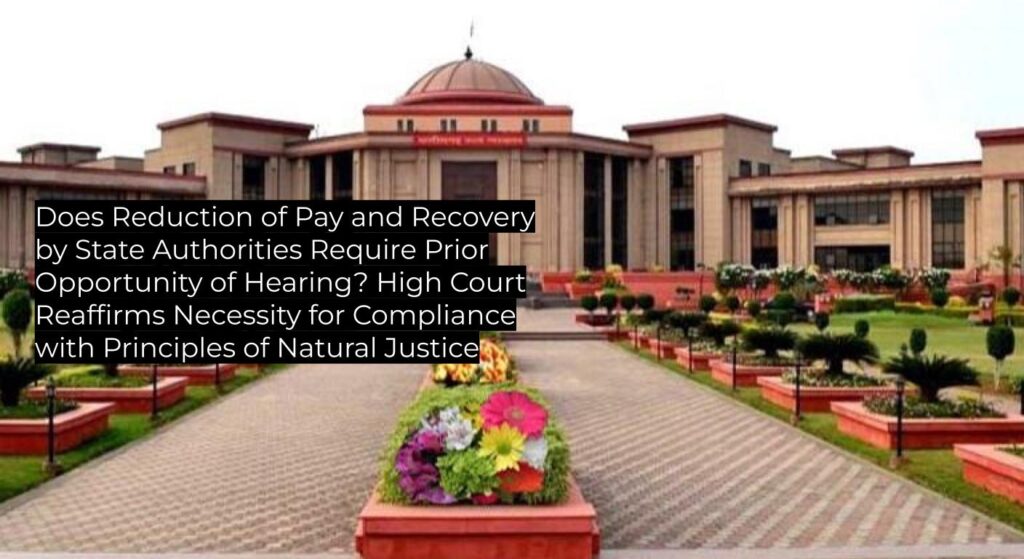
The Chhattisgarh High Court has reaffirmed that any adverse order involving reduction of pay and recovery of excess payment from a government employee must be preceded by an opportunity of hearing, in line with the principles of natural justice. This judgment upholds established precedent and provides binding authority within the State service law context, clarifying procedural requirements for similar future actions.
Summary
| Category | Data |
|---|---|
| Case Name | WPS/1038/2021 of SHANKAR SINGH MARKAM Vs STATE OF CHHATTISGARH |
| CNR | CGHC010040052021 |
| Date of Registration | 09-02-2021 |
| Decision Date | 02-09-2025 |
| Disposal Nature | DISPOSED OFF |
| Judgment Author | HON’BLE SHRI JUSTICE RAKESH MOHAN PANDEY |
| Court | High Court of Chhattisgarh, Bilaspur |
| Precedent Value | Binding within jurisdiction (Chhattisgarh High Court); clarifies and reaffirms procedural requirements for government service law matters |
| Overrules / Affirms |
|
| Type of Law | Service Law / Administrative Law |
| Questions of Law | Whether an order reducing pay and effecting recovery of alleged excess payments, passed without affording an opportunity of hearing to the employee, is sustainable? |
| Ratio Decidendi |
The Court held that an order for reduction of pay and recovery of excess amount paid to an employee, passed without granting the employee an opportunity of hearing, violates the principles of natural justice and cannot be sustained. The authorities are at liberty to initiate proceedings in accordance with law, but only after providing such an opportunity. The necessity for compliance with natural justice is reaffirmed, especially where civil consequences ensue. |
| Judgments Relied Upon |
|
| Logic / Jurisprudence / Authorities Relied Upon by the Court | Principle that employees must not suffer civil consequences without being heard; endorsement in service book or adverse financial orders require opportunity of hearing as per established service law jurisprudence |
| Facts as Summarised by the Court | Petitioner, an Excise Constable, was absorbed in service, had regular pay fixed, and received salary accordingly. Authorities later withdrew the pay scale and ordered recovery of alleged excess amount without a hearing. |
Practical Impact
| Category | Impact |
|---|---|
| Binding On | All subordinate courts and authorities within the jurisdiction of Chhattisgarh High Court |
| Persuasive For | Other High Courts, especially in identical service law and administrative law contexts |
| Follows |
|
What’s New / What Lawyers Should Note
- Reaffirms that reduction of pay and order for recovery affecting civil rights cannot be passed without adhering to principles of natural justice, i.e., without first affording an opportunity of hearing.
- Orders passed without such opportunity are liable to be quashed on that ground alone.
- The judgment upholds the approach in related prior writ petitions and Division Bench appeals.
- Lawyers may cite this authority to challenge similar administrative actions taken without hearing in service matters.
Summary of Legal Reasoning
- The Court noted that the petitioner’s pay was fixed, and salary paid per orders, until the respondents withdrew the pay scale and ordered recovery without granting him a hearing.
- It relied on previous judgments (WPS No. 5549/2021 and Division Bench order dismissing appeals) which specifically held that such withdrawals and adverse entries having civil consequences require prior opportunity to show cause, as mandated by natural justice.
- The State did not contest this legal proposition.
- The order of recovery and reduction of pay was therefore set aside, but liberty was given to authorities to proceed afresh, strictly following principles of natural justice.
- The Court allowed the writ solely on lack of adherence to natural justice, without entering into the merits of the pay fixation itself.
Arguments by the Parties
Petitioner
- The pay reduction and recovery order was passed without granting an opportunity of hearing.
- Such action violates the principle of natural justice.
- Relied on previous orders in similar writ petitions where courts have required opportunity of hearing in such matters.
Respondent/State
- Did not oppose the legal proposition that opportunity of hearing is necessary before passing adverse orders regarding pay and recovery.
Factual Background
The petitioner was initially appointed as a Salesman in a government-run wine shop and later absorbed in the Excise Department, ultimately securing regularization as an Excise Constable with appropriate pay. The authorities, after several years, withdrew the granted pay scale and ordered recovery of alleged excess payment without affording the petitioner prior opportunity to be heard. The petitioner challenged these actions on the ground of violation of natural justice.
Statutory Analysis
- The judgment emphasizes compliance with the principles of natural justice in service jurisprudence.
- The issue centered around administrative actions affecting pay and recovery from a government servant.
- The Court reiterated that statutory and administrative orders with civil consequences must comply with procedural fairness, including a reasonable opportunity of hearing.
- No specific statute is interpreted beyond referencing general principles of natural justice and law governing public service.
Dissenting / Concurring Opinion Summary
No dissenting or concurring opinion is recorded in the judgment.
Procedural Innovations
No new procedural rules or guidelines have been set; however, the Court explicitly reserves liberty for respondent authorities to initiate fresh proceedings if so advised, but only after complying with the requirement of a hearing.
Alert Indicators
- ✔ Precedent Followed – The decision reaffirms and applies settled principles of natural justice in service law as held in prior judgments.
Citations
- Judgment available at 2025:CGHC:45138
- Orders referred: WPS No. 5549/2021 and connected cases; Division Bench in Writ Appeal No. 174/2022 (order dated 20.06.2022)
- Neutral citation and reportable status as per court’s records; NAFR (Not for Reportable)