


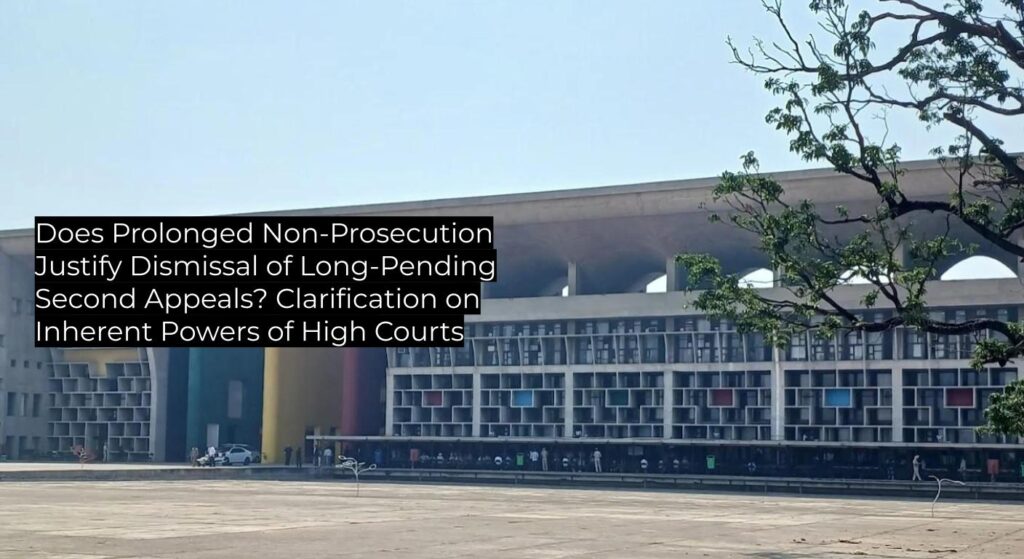
The Punjab & Haryana High Court reaffirms existing precedent by dismissing a decades-old regular second appeal for want of prosecution, clarifying the court’s discretion to remove dormant cases from its docket. This judgment underscores the binding practice that inactive appeals may be dismissed after due opportunity, serving as authoritative precedent for case management by High Courts.
Summary
| Category | Data |
|---|---|
| Case Name | RSA/1971/1998 of VIDHYAWANTI AND OTHERS Vs UIO AND OTHERS |
| CNR | PHHC010444251998 |
| Decision Date | 29-10-2025 |
| Disposal Nature | DISMISSED |
| Judgment Author | MR. JUSTICE VIRINDER AGGARWAL |
| Court | High Court of Punjab and Haryana |
| Precedent Value | Binding authority for similar procedural dismissals by the same High Court |
| Type of Law | Civil Procedural Law |
| Ratio Decidendi |
|
| Facts as Summarised by the Court |
|
Practical Impact
| Category | Impact |
|---|---|
| Binding On | All subordinate courts and benches within the jurisdiction of the Punjab & Haryana High Court |
| Persuasive For | Other High Courts addressing prolonged non-prosecution of appeals |
What’s New / What Lawyers Should Note
- Explicit contemporaneous recognition of the High Court’s discretion to dismiss long-pending appeals for want of prosecution following multiple opportunities for appearance.
- Practitioners must be vigilant in monitoring old, inactive appeals; absences and inaction may result in dismissal unless cause for revival is promptly demonstrated.
- The judgment grants appellants limited liberty to seek revival within a fixed period, setting a clear timeframe for possible recourse after procedural default.
Summary of Legal Reasoning
- The court noted heavy docket pendency and the appeal dating back to 1998.
- Despite the case being called twice, no one appeared for the appellants or primary respondent (UOI).
- The court inferred lack of interest by appellants in pursuing the appeal.
- Emphasising the principle that courts cannot indefinitely retain inactive cases, the appeal was dismissed for want of prosecution.
- Dismissal includes specific liberty for the aggrieved to move for revival within three months.
Arguments by the Parties
None recorded in the judgment as no one was present for the appellants or main respondent.
- Respondent (State of Haryana, represented by AAG): No submissions recorded in the judgment.
Factual Background
- The regular second appeal was instituted in 1998 and had remained pending with no substantive prosecution for over two decades.
- On the date of hearing, no party appeared for either the appellants or the main respondent despite the matter being called twice.
- The record reflects no steps taken by appellants towards prosecution, prompting the court to dismiss for want of prosecution and grant limited liberty for revival.
Statutory Analysis
- No detailed statutory provision is discussed in the judgment.
- The court exercised its inherent procedural power to dismiss cases for want of prosecution when parties remain absent and show no interest over protracted periods.
Procedural Innovations
- The judgment provides explicit liberty for revival within a defined time period (three months), ensuring fairness and preventing indefinite prejudice due to procedural default.
Alert Indicators
- ✔ Precedent Followed – Reaffirms the established practice of dismissing cases for prolonged non-prosecution and allocation of limited opportunity for revival.