


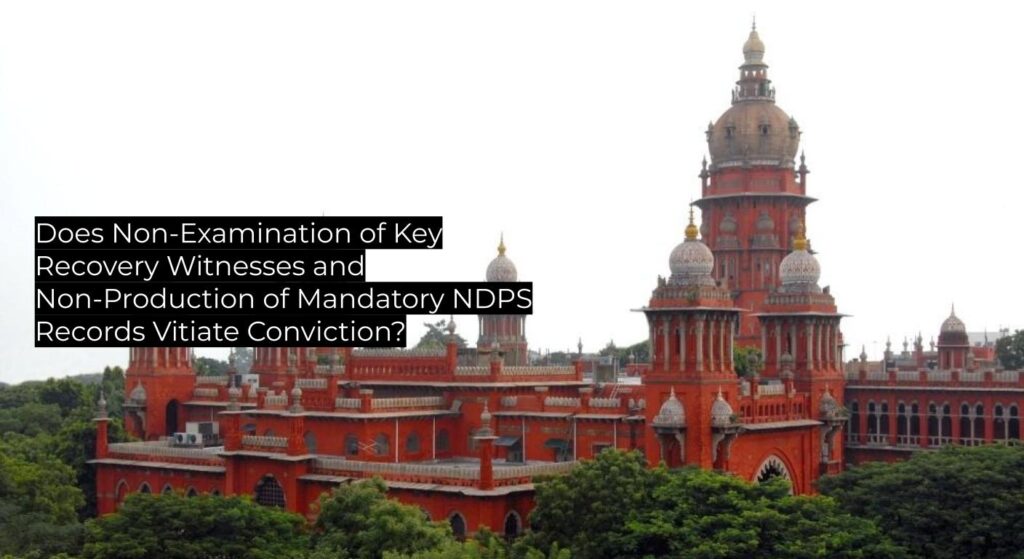
The Madurai Bench of the Madras High Court clarified that failure to examine essential recovery witnesses and non-production of mandatory records such as the General Diary entry under Section 42 of the NDPS Act fatally vitiate prosecution cases; the decision strictly enforces existing Supreme Court precedent, reinforcing the evidentiary burden in NDPS prosecutions, and functions as a binding precedent for all subordinate courts within the jurisdiction.
Summary
| Category | Data |
|---|---|
| Case Name | CRL A(MD)/459/2023 of K.Senthilkumar Vs The Inspector of Police |
| CNR | HCMD010653712023 |
| Date of Registration | 19-06-2023 |
| Decision Date | 15-10-2025 |
| Disposal Nature | ALLOWED |
| Judgment Author | HONOURABLE MR JUSTICE K.K. RAMAKRISHNAN |
| Court | Madras High Court (Madurai Bench) |
| Bench | Single Bench |
| Precedent Value | Binding on subordinate courts |
| Overrules / Affirms |
|
| Type of Law | Criminal—NDPS Act |
| Questions of Law | Whether non-examination of recovery witnesses and non-production of NDPS mandatory records negate prosecution? |
| Ratio Decidendi |
The court held that in prosecutions under the NDPS Act, strict compliance with both substantive and procedural statutory requirements is mandatory. Non-examination of key witnesses to the recovery, inconsistencies regarding the place and time of recovery, non-production of the General Diary entry as required under Section 42, and lapses in the chain of custody fatally undermine the prosecution’s case. Sole uncorroborated testimonies which are not wholly reliable cannot sustain conviction, particularly when accompanied by material inconsistencies and procedural violations. The prosecution bears a higher burden due to the severity of punishment under the NDPS Act. |
| Judgments Relied Upon |
|
| Logic / Jurisprudence / Authorities Relied Upon by the Court |
|
| Facts as Summarised by the Court |
The police claimed to have recovered 25.230 kg of ganja from the accused after receiving secret information, but failed to examine two police recovery witnesses, did not produce the General Diary entry, and offered inadequate explanations for procedural delays and inconsistencies about the place and time of recovery. The trial court had acquitted the accused under some sections but convicted under Section 8(c) r/w 20(b)(ii)(C) of the NDPS Act. |
Practical Impact
| Category | Impact |
|---|---|
| Binding On | All subordinate courts within the Madras High Court’s jurisdiction |
| Persuasive For | Other High Courts |
| Follows |
|
What’s New / What Lawyers Should Note
- Reinforces the necessity of examining all material recovery witnesses, including police witnesses, in NDPS cases.
- Non-production of the General Diary entry under Section 42, when relied upon to justify action in absence of a superior officer, is fatal to prosecution.
- Sole testimony of a police officer cannot sustain conviction if not wholly reliable and suffers from inconsistencies or lacks corroboration.
- Delay in arrest, remand, and production of contraband without reasonable explanation can vitiate prosecution.
- Chain of custody and precise location of recovery must be proved through clear documentary and oral evidence; discrepancies can result in acquittal.
- Factual inconsistencies (e.g., in place of offence, timing during special events like Independence Day, pandemic restrictions) are grounds for doubt.
- Lawyers must challenge procedural lapses and evidentiary inconsistencies rigorously in NDPS trials.
Summary of Legal Reasoning
- The court scrutinized whether mandatory procedures under the NDPS Act—especially Section 42 (information recording, immediate superior intimation)—were complied with.
- Cited Karnail Singh v. State of Haryana (2009), which mandates written documentation of secret information and prompt submission to superiors.
- Noted that the prosecution’s sole reliance on P.W.1’s testimony, without examining the attesting officers to the recovery mahazar or producing the General Diary entry (even though superior officer was reportedly unavailable), was a fatal lapse.
- Distinguished Mukesh Singh v. State (2020) by highlighting that non-examination of independent witnesses may not always be fatal, but failure to examine even available police attesting witnesses or to corroborate recovery seriously undermines prosecution.
- Applied Vadivel Thevar v. State of Tamilnadu principles for sole witness cases—finding P.W.1’s evidence “not wholly reliable” due to inconsistencies and lack of corroboration.
- Found additional doubts due to unaddressed delays in arrest and remand, inconsistencies regarding the timing and place of recovery, and procedural irregularities during the ongoing pandemic.
- Held that the cumulative effect of these material lapses rendered the prosecution’s case not proved beyond reasonable doubt.
Arguments by the Parties
Petitioner (Appellant):
- Mandatory NDPS procedures (especially Section 42) were violated; General Diary entry not produced.
- Key recovery witnesses (including police witnesses) not examined.
- Place of occurrence not clearly established; inconsistencies in records and testimonies.
- Inexplicable delays in arrest and presentation before magistrate.
- Contraband not produced in court within prescribed time; procedural lapses in sample collection.
- Prosecution case is not proved beyond reasonable doubt.
Respondent (State/Prosecution):
- Sole testimony of P.W.1 is cogent and trustworthy.
- Non-examination of attesting police witnesses is not fatal.
- Documentary records demonstrate compliance with Section 42.
- Minor procedural lapses do not impact credibility where seizure and chemical analysis are established.
- Conviction should be sustained on available evidence.
Factual Background
The case arose from an alleged seizure of 25.230 kg of ganja from two persons riding a motorcycle, based on secret information received by a sub-inspector. The prosecution claimed to have followed NDPS protocols, with recovery and arrests occurring on 15.08.2020. However, material recovery witnesses were not examined and the General Diary, which purportedly contained the initial intelligence record, was not produced before the trial court. The trial court convicted the defendants under Section 8(c) r/w 20(b)(ii)(C) of the NDPS Act; the High Court heard appeals on the basis that mandatory procedures and evidentiary requirements were not met.
Statutory Analysis
- Section 42 NDPS Act: The judgment interpreted this provision to require strict compliance; secret information must be written down and communicated to superiors, as reinforced by Karnail Singh (2009). Non-production of such records when the officer claims to have acted independently is fatal.
- Section 50 NDPS Act: The court referenced procedural requirements for search.
- Section 313 CrPC: Accused’s statement; noted that contradictions or the absence of key witnesses during this stage can impact the outcome.
- No explicit “reading down” observed; a strict interpretation was applied.
Dissenting / Concurring Opinion Summary
No dissenting or concurring opinions are present in the judgment; the decision is by a single judge.
Procedural Innovations
- The court drew adverse inference from the non-production of the General Diary where its existence and content were said to be crucial for procedural compliance.
- Emphasized materiality of examining all witnesses attesting the recovery mahazar, even if police personnel.
- Reiterated that documentary and oral proof must converge precisely to establish chain of custody and compliance with statutory safeguards.
Alert Indicators
- ✔ Precedent Followed – Supreme Court principles on NDPS compliance (Karnail Singh, Mukesh Singh) strictly applied.