


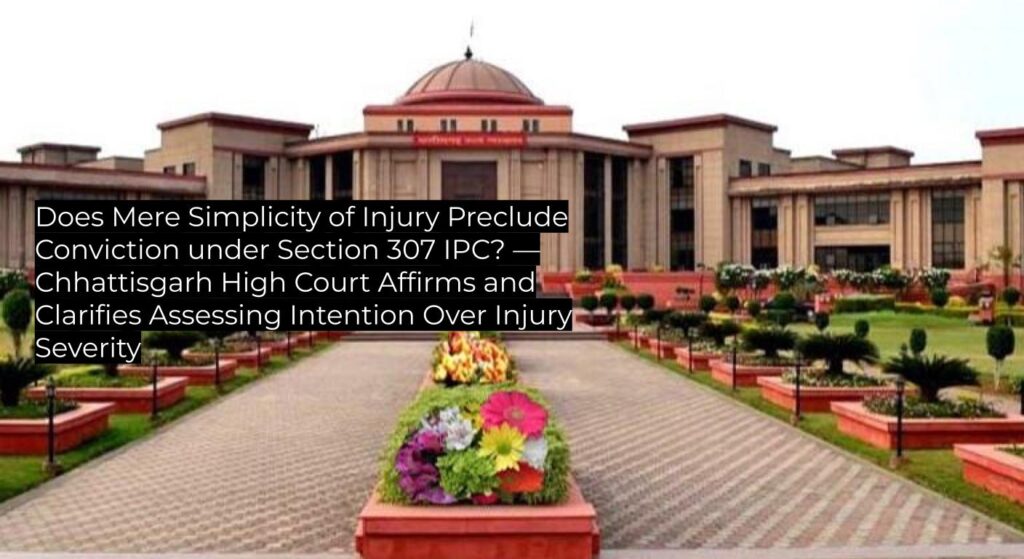
The Chhattisgarh High Court reaffirms that under Section 307 IPC (attempt to murder), it is not necessary for the inflicted injury to be fatal or grievous—conviction can be based on intention and surrounding circumstances rather than the seriousness of injuries alone. This judgment follows established Supreme Court precedents and serves as binding authority within Chhattisgarh, providing clarification for assessing Section 307 cases, especially where the weapon used and intent are evident, but injuries are not life-threatening.
Summary
| Category | Data |
|---|---|
| Case Name | CRA/972/2022 of BHAGWAT DAS VAISHNAV Vs STATE OF CHHATTISGARH |
| CNR | CGHC010188292022 |
| Date of Registration | 16-06-2022 |
| Decision Date | 31-10-2025 |
| Disposal Nature | PARTLY ALLOWED |
| Judgment Author | Hon’ble Shri Justice Naresh Kumar Chandravanshi |
| Court | High Court of Chhattisgarh at Bilaspur |
| Bench | Single judge (Hon’ble Shri Justice Naresh Kumar Chandravanshi) |
| Precedent Value | Binding within Chhattisgarh; persuasive outside |
| Overrules / Affirms | Affirms Supreme Court precedents (esp. Sivamani & Anr. v. State, Saleem, Jage Ram, Kanha) |
| Type of Law | Criminal Law—Section 307 IPC (Attempt to Murder) |
| Questions of Law | Whether simplicity or non-fatal nature of an injury precludes conviction under Section 307 IPC |
| Ratio Decidendi |
The court held that conviction under Section 307 IPC is not dependent on the injury being fatal or grievous. Instead, the intention or knowledge of the accused—assessed by factors including weapon used, location/nature of attack, and surrounding circumstances—are paramount. The facts may show intention or knowledge sufficient for Section 307 even when the actual hurt is not life-threatening. The judgment relied on recent Supreme Court authority, holding that Section 307 focuses on the act and mental element, not just injury result. |
| Judgments Relied Upon |
|
| Logic / Jurisprudence / Authorities Relied Upon by the Court | Supreme Court precedent; distinction between act and result under Section 307; assessment of intent based on weapon, location of injury, and circumstances. |
| Facts as Summarised by the Court |
Appellant and victim (his wife) had financial difficulties causing tension and quarrels. On 03.04.2019, after returning home, following a quarrel over school fees, appellant attacked the victim with a sickle, causing several incised wounds on her neck, fingers, and legs. Medical and forensic evidence corroborated assault. Both parties sustained injuries; appellant claimed false implication. Lower court convicted under Section 307 IPC. |
Practical Impact
| Category | Impact |
|---|---|
| Binding On | All subordinate courts in Chhattisgarh |
| Persuasive For | Other High Courts, Supreme Court |
| Follows |
|
What’s New / What Lawyers Should Note
- Reaffirms that the presence of only simple or non-life-threatening injuries does not bar conviction under Section 307 IPC if intention and circumstances are evident.
- Intent and knowledge, inferred from weapon type, attack area, and incident context, hold primacy in Section 307 prosecutions.
- The fact that both parties sustained injuries does not negate the victim’s consistent account when corroborated by medical and circumstantial evidence.
- Lawyers defending Section 307 charges should focus their challenge on disproving intent or intent-defining circumstances, not merely on the injury’s severity.
- Sentence reduction considerations may factor in the relationship between parties and socio-economic context post-conviction, but not for acquittal on merits.
Summary of Legal Reasoning
- The court recited the established legal position that for a conviction under Section 307 IPC, the injury caused need not be sufficient to cause death—what matters is the intention or knowledge with which the act was committed, as determined by overall circumstances, weapon used, and attack location.
- The court quoted and followed several Supreme Court decisions including Sivamani & Anr. (2023), State of MP v. Saleem (2005), Jage Ram (2015), and Kanha (2019), all of which support the principle that injury severity is not dispositive.
- Applying these principles, the court found that the appellant’s act—attacking his wife’s neck with a sharp sickle—demonstrated sufficient intention to kill, regardless of whether the outcome was fatal or grievous.
- Medical and forensic evidence, as well as consistent witness statements, reinforced the prosecution’s narrative.
- Even though the appellant also had injuries, the lack of a plausible alternative narrative and failure of the defense to rebut intent preserved the conviction.
- The only interference made was to reduce the sentence, considering the familial background, socio-economic hardships, and partial period of incarceration already served.
Arguments by the Parties
Petitioner (Appellant):
- Dispute was a result of domestic tension over finances.
- Both parties, including the appellant, sustained injuries in a mutual scuffle.
- The trial court failed to appreciate evidence in its correct perspective.
- Implores acquittal as the incident arose from a quarrel, not a deliberate attempt to murder.
Respondent (State):
- Victim is an injured witness and her account is corroborated by instant assistance, medical, and forensic evidence.
- The specific targeting of the victim’s vital body part (neck) with a sharp weapon indicates intention for murder.
- Trial court rightly appreciated evidence and reached a justified conviction under Section 307 IPC.
- Appeal should be dismissed.
Factual Background
The dispute arose within a married couple facing financial distress, with frequent quarrels as the husband (appellant) struggled in his fruit-selling business. On 03.04.2019, after returning home following a period of absence, a quarrel broke out over their daughter’s school fees. During the altercation, the appellant attacked his wife with a sickle, inflicting multiple incised wounds on her neck, hands, and legs. Both parties were later admitted to hospital with injuries. The victim’s brother filed the FIR under Section 307 IPC based on her statement. The appellant claimed to have been falsely implicated as he also sustained injuries.
Statutory Analysis
- Section 307 IPC: The court interpreted Section 307 expansively, reiterating that the provision penalizes acts done with intent or knowledge sufficient to cause death, regardless of whether the resulting injury is actually likely to cause death.
- The distinction between act and result was highlighted: it’s the intent (ascertained from weapon, part of body targeted, and context), not just the injury caused, that governs liability under Section 307 IPC.
- No constitutional or other statutes were analyzed beyond the application of CrPC regarding sentencing and sentence reduction.
Dissenting / Concurring Opinion Summary
No dissenting or separate concurring opinions are present in this single-judge judgment.
Procedural Innovations
- The judgment refers to the application of Section 481 of the Bhartiya Nagrik Suraksha Sanhita, 2023, in extending the period of bail bond, reflecting adherence to updated procedural law.
- No new precedent set regarding evidence or procedural maintainability.
Alert Indicators
- ✔ Precedent Followed – The judgment closely follows and affirms established Supreme Court precedent on Section 307 IPC.