


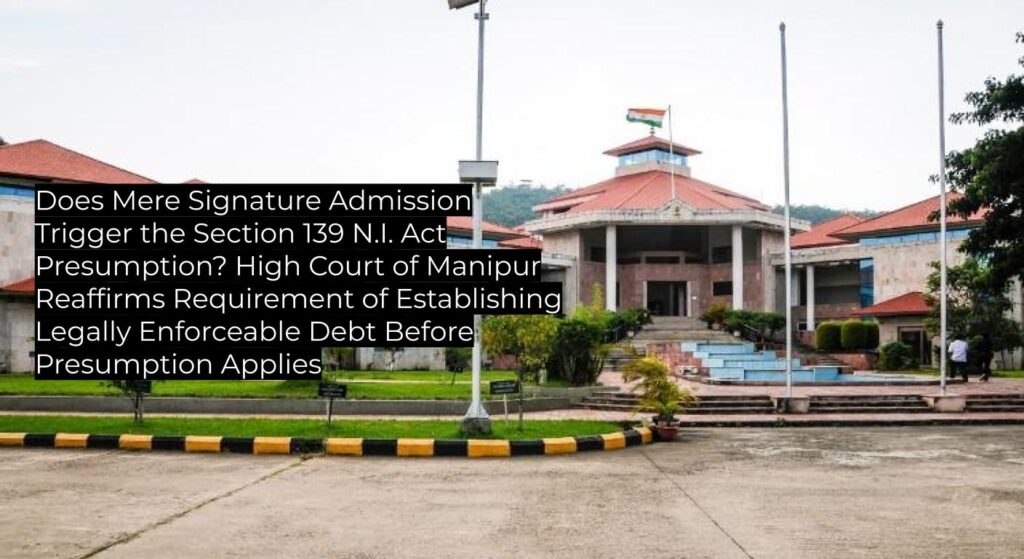
Presumption under Section 139 of the Negotiable Instruments Act is not automatic upon signature admission; the complainant must first establish the existence of a legally recoverable debt or liability. The decision upholds and clarifies Supreme Court precedent, providing binding authority within Manipur and strong persuasive value elsewhere in cheque dishonour cases.
Summary
| Category | Data |
|---|---|
| Case Name | Crl.A./24/2023 of MANOJ KUMAR JAIN Vs MAHENDRA KUMAR JAIN |
| CNR | MNHC010011552023 |
| Date of Registration | 19-10-2023 |
| Decision Date | 16-10-2025 |
| Disposal Nature | Dismissed |
| Judgment Author | HON’BLE MR JUSTICE A.GUNESHWAR SHARMA |
| Court | High Court of Manipur |
| Precedent Value | Binding on subordinate courts in Manipur; persuasive for other courts |
| Overrules / Affirms | Affirms settled Supreme Court law regarding Section 139 and 138 N.I. Act |
| Type of Law | Criminal law — Negotiable Instruments Act, Sections 138 & 139 |
| Questions of Law |
|
| Ratio Decidendi |
The presumption under Section 139 N.I. Act does not arise solely from admission of signature; the complainant must first establish the existence of a legally recoverable debt or liability. If the execution (issuance) of the cheque is specifically denied and there is no proof of payment or debt, presumption cannot be invoked. Complainant’s failure to provide evidence (such as records or witnesses regarding the cash payment) defeats the claim. The statutory presumption under Section 139 is rebuttable and the burden may shift back, but only after a threshold of credible proof of debt/liability is met. |
| Judgments Relied Upon |
|
| Logic / Jurisprudence / Authorities Relied Upon by the Court |
Existence of legally enforceable debt must be proven by complainant before Section 139 presumption operates; mere signature or cheque possession insufficient. Standard of proof for rebuttal by accused is preponderance of probabilities (Basalingappa); Section 139 gives evidential, not persuasive burden; accused may rebut without entering witness box. |
| Facts as Summarised by the Court |
Appellant claimed to have advanced Rs. 24 lakh in cash to respondent, who issued a cheque that bounced due to insufficient funds. Appellant failed to produce documentary evidence or credible witness testimony supporting cash payment. Respondent admitted signature but denied issuing cheque or receiving cash; stated cheque was among 14-15 misplaced cheques. Trial court acquitted respondent, finding absence of evidence of legally enforceable debt or liability and no presumption to be drawn under Section 139 N.I. Act. High Court affirmed this finding. |
Practical Impact
| Category | Impact |
|---|---|
| Binding On | All subordinate courts in Manipur |
| Persuasive For | Other High Courts and Supreme Court in similar N.I. Act cases |
| Follows |
|
What’s New / What Lawyers Should Note
- This judgment reasserts that, in cheque bounce cases, the statutory presumption under Section 139 N.I. Act arises only after the complainant first establishes the existence of a legally recoverable debt or liability.
- Mere admission of signature on the cheque by the accused does not, by itself, activate this presumption if issuance of the cheque is specifically denied and no evidence of debt/liability is adduced.
- The burden of proof initially lies with the complainant to show the existence of such debt. Only once satisfied, does the evidential burden shift to the accused.
- Absence of documentary evidence or supporting witnesses regarding a claimed cash transaction can be fatal to the complainant’s case, even if income tax returns mention such dues.
- The accused may rebut the presumption without stepping into the witness box, by relying on materials already brought on record or cross-examination.
Summary of Legal Reasoning
- The court systematically reviewed both parties’ evidence, focusing on whether the appellant established the existence of a legally enforceable debt or liability.
- The trial court and the High Court noted the absence of any documentary proof or credible witness testimony supporting the appellant’s claim of payment of Rs. 24 lakh in cash.
- The respondent admitted to the signature on the cheque but disputed issuance and receipt of cash; asserted the cheque was among misplaced leaves, and informed the bank accordingly.
- Citing Basalingappa and other Supreme Court decisions, the court reiterated that the presumption under Section 139 arises only upon proof of execution (issuance) of cheque; mere signature admission is insufficient if issuance is denied.
- The High Court clarified that Section 139 only presumes issuance in discharge of a legally enforceable debt — the existence of which must first be established by complainant with credible evidence.
- Precedents were applied which held that in absence of supporting proof (records/witnesses), courts cannot presume the existence of debt merely on possession/presentation of the cheque.
- The appellant’s income tax returns (even supplied on court’s direction) and oral assertions were insufficient absent concrete corroborative evidence.
- The acquittal was upheld, the court finding no perversity or illegality in the trial court’s view.
Arguments by the Parties
Petitioner (Appellant):
- Respondent failed to rebut the claim of missing cheques by not filing FIR/informing bank or closing the account only after the case was filed.
- Respondent’s claim of misplacement of cheques is unsubstantiated and no timely complaint to police or bank was made.
- Crucial evidence such as cheque return memo stating “Insufficient Funds,” legal notice and proof of its receipt were not considered by the trial judge.
- Trial court erred by not presuming legally enforceable debt under Section 139 N.I. Act upon signature admission and did not shift burden to respondent.
- Appellant furnished income tax and GST compliance records showing claimed amount as outstanding.
- Legal reliance on Supreme Court precedents supporting Section 139 presumption and affidavit standard under Section 145 N.I. Act.
Respondent:
- Denied having received Rs. 24 lakh in cash or issuing the cheque; stated cheque was from a missing series and informed the bank.
- Claimed the issuance of new cheque book after reporting the missing leaves to the bank.
- Relied on Basalingappa and other case law to argue that the presumption under Section 139 attaches only after issuance of the cheque is admitted; admitted signature is not enough.
- Highlighted there was no documentary or credible witness evidence to support appellant’s claim.
Factual Background
The dispute arose when the appellant alleged advancing Rs. 24 lakh in cash to the respondent relating to a proposed land sale. While a larger sum given by cheque was returned, the Rs. 24 lakh cheque issued by respondent bounced on presentation for insufficient funds. Appellant sent a statutory notice, but respondent did not pay. Respondent denied receipt of cash or issuance of cheque, maintaining the cheque was lost from his cheque book. The trial court acquitted respondent, finding no proof of legally enforceable debt; the High Court affirmed this view.
Statutory Analysis
- Section 138 N.I. Act: Defines the offence of cheque dishonour; sets three ingredients: (i) legally enforceable debt; (ii) cheque drawn in discharge of such debt; (iii) cheque returned due to insufficient funds.
- Section 139 N.I. Act: Creates a rebuttable presumption that cheque was for discharge of debt/liability, but such presumption operates only after execution/issuance of cheque is established; existence of debt must be evidenced by complainant.
- Interpretation: The court followed a strict construction, holding that presumption does not extend to the very existence of debt but is limited to issuance in discharge of an existing debt; non-production of evidence or failure to establish payment precludes presumption.
- Section 145 N.I. Act: Affidavit evidence is permissible, but does not absolve the complainant of the initial burden.
Alert Indicators
- ✔ Precedent Followed – The judgment closely follows binding Supreme Court precedent on interpretation of Sections 138 and 139 of the Negotiable Instruments Act.