


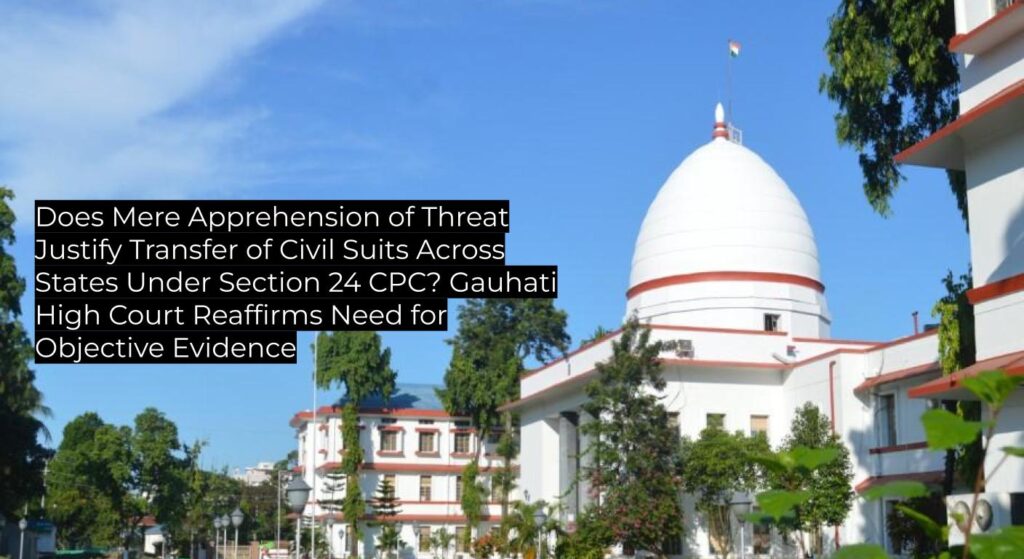
The Gauhati High Court declines transfer of a land-related civil suit from Nagaland to Assam, restating that transfer on grounds of threat requires real, reasonable, and substantiated apprehension. The judgment upholds Supreme Court precedent, affirms the primacy of situs of property, and introduces safeguards to ensure fair trial without disrupting territorial jurisdiction
Summary
| Category | Data |
|---|---|
| Case Name | Tr.P.(C)./32/2023 of SHAH NEWAZ KHAN AND 5 ORS. Vs THE STATE OF NAGALAND AND 5 ORS |
| CNR | GAHC010067342023 |
| Date of Registration | 28-03-2023 |
| Decision Date | 31-10-2025 |
| Disposal Nature | Disposed Of |
| Judgment Author | HONOURABLE MR. JUSTICE BUDI HABUNG |
| Court | Gauhati High Court |
| Bench | Single Bench of HON’BLE MR. JUSTICE BUDI HABUNG |
| Precedent Value | Binding within Gauhati High Court’s jurisdiction |
| Overrules / Affirms | Affirms Supreme Court precedents on transfer of civil suits |
| Type of Law | Civil Procedure |
| Questions of Law | Whether Civil Suit No. 03/2007 should be transferred from District Court, Dimapur, Nagaland, to Assam on the ground of alleged threat and apprehension of prejudice |
| Ratio Decidendi | Transfer of a suit based on apprehension of threat requires that such apprehension be real, reasonable, and supported by objective circumstances, not just subjective or vague allegations. The situs of property is critical in determining jurisdiction, and transfer across state lines is an exceptional measure. Where apprehension is not substantiated by police complaints or contemporaneous filings, and the suit has progressed substantially, transfer is not warranted. However, the Court may direct safeguards to ensure a secured, intimidation-free trial environment. |
| Judgments Relied Upon |
|
| Logic / Jurisprudence / Authorities Relied Upon by the Court | The principle that reasonable apprehension of not getting justice is a ground for transfer, but reasonableness must be assessed on objective material. The situs of property, administrative convenience, and the requirement for exceptional grounds for transfer across states were central. |
| Facts as Summarised by the Court | Plaintiffs and defendants are family members in dispute over landed properties in Dimapur, Nagaland. The suit (Civil Suit No. 03/2007) concerns alleged misappropriation of rents and land sale proceeds, with the petitioners claiming threats that impede their participation in Nagaland courts. Previously, a transfer petition was dismissed by the High Court (2015), but the Supreme Court remanded for fresh consideration. No police complaints or protection applications were filed; the suit had progressed substantially. |
Practical Impact
| Category | Impact |
|---|---|
| Binding On | All subordinate courts under Gauhati High Court |
| Persuasive For | Other High Courts and in applications involving transfer of suits on grounds of threat |
| Follows |
|
What’s New / What Lawyers Should Note
- Reconfirms that mere allegation of threat or apprehension of not obtaining justice, without objective evidence (e.g., police complaint or contemporaneous complaint), does not justify transfer of civil suits across state boundaries under Section 24 CPC.
- Emphasizes the primacy of the situs of the property in determining jurisdiction.
- Introduces practical procedural safeguards (e.g., police protection, in-camera evidence, or video conferencing) to address litigants’ security concerns instead of transferring the case.
- Petitioners may approach the trial court for security and special procedures as directed by the High Court.
- Trial courts are to expedite long-pending matters, with specific directions to conclude within a set time.
Summary of Legal Reasoning
- The Court identified the main point: whether transfer of Civil Suit No. 03/2007 on grounds of apprehension of threat is justified.
- Applied Supreme Court precedents, stating that while the subjective apprehension of a litigant is relevant, the apprehension must also be reasonable and established by objective evidence. Cited Gurucharan Das Chadha, Ranjit Thakur, and Kulwinder Kaur.
- Noted no police complaint or contemporaneous application seeking protection was filed, and that the petitioners participated in proceedings over several years after the alleged threat, suggesting the threat was neither real nor continuing.
- Observed that transferring a suit where all evidence, witnesses, and property are situated locally is exceptional and generally not warranted unless clear bias or risk is proven.
- Noted administrative inconvenience and delays associated with transfer at such a late stage of trial.
- Acknowledged that the petitioners’ apprehensions should not be dismissed, and therefore ordered special protective measures to ensure a fair trial.
- Declined the transfer but laid down directions to facilitate a secure and intimidation-free hearing.
Arguments by the Parties
Petitioner
- Asserted that they face threat and intimidation within Nagaland, as evidenced by news articles naming them.
- Argued that apprehension of prejudice and inability to participate in trial is reasonable.
- Relied on Supreme Court judgments to argue that apprehension alone, if reasonable, justifies transfer.
Respondents (State of Nagaland, NHPC, others)
- Pointed out that no FIR or police complaints about threat were filed.
- Asserted the suit was filed after the alleged threat, and the matter proceeded for years without raising the issue.
- Emphasized the suit is at final stage; transfer at this point causes serious administrative inconvenience.
- Argued that witnesses and records are based in Nagaland; portion of disputed property is Government land.
- Characterized allegations of threat as vague and unsubstantiated.
Factual Background
The petitioners and respondent no. 6 (now represented by legal heirs) are relatives contesting ownership, sale, and misappropriation of rents of family properties in Dimapur, Nagaland. Civil Suit No. 03/2007 was filed in District Court, Dimapur. The petitioners allege threats after a 2006 news publication naming them, claiming they cannot safely prosecute the suit in Dimapur. A previous transfer petition was dismissed by the Gauhati High Court, but the Supreme Court remanded it for fresh consideration. The suit has reached the stage of evidence, with substantial delays already.
Statutory Analysis
- Section 24 of the Code of Civil Procedure, 1908: The court analyzed its power to transfer civil cases. Emphasized that transfer of cases across state lines is exceptional, particularly where the property in dispute is situated locally.
- The court underlined the interpretation that reasonable, objective apprehension is necessary for transfer, not mere subjective feeling.
Dissenting / Concurring Opinion Summary
No dissenting or concurring opinion recorded; single-judge disposition.
Procedural Innovations
- Court directed District Judge to ensure trial is conducted in a secured and intimidation-free environment.
- Petitioners permitted to approach for police protection as needed; protection to be granted expeditiously.
- Trial court authorized to consider recording evidence via in-camera proceedings or video-conferencing on application.
- Ordered the local Superintendent of Police to provide security on hearing dates as necessary.
- Directed the trial court to endeavour to complete proceedings within one year.
Alert Indicators
- ✔ Precedent Followed – When existing law is affirmed.